To Your Adventurous 2010

prayer flags in tibet

“With coarse rice to eat, with water to drink, and my bended arm for a pillow – I have still joy in the midst of these things. Riches and honors acquired by unrighteousness are to me as a floating cloud.” Confucius

Before we began our Asian tandem bicycle adventure, I read Confucian quotes and often couldn’t relate.  This I chalked up to lack of depth on my part, and perhaps the enigmatic (to us) nature of Eastern thought.

Muddling my way through jet lag on our return, and as one friend opined, postpartum depression at the end of another adventure, I pondered the above Confucianism anew, and discovered I suddenly understood. Oh, I had known the surface meaning, from earlier adventures involving discomfort, danger, but not the full depth of his thought. I suddenly noticed that he says, “…have still joy…”  not “…still have joy…” as I had first read it. His meaning was hidden from me until I had eaten enough coarse rice, drank enough wood smoke infused water and slept sufficient times with my bended arm for a pillow.

To have a still joy, a quiet joy, a joy devoid of external condition, of riches or renown, is to have a profound joy, a lasting joy. I will look back on the past four months for as many years as I have left. I will remember the struggles, the discomforts, the challenge of the unknown, even the moments of  near panic, and I will smile. Confucius traveled China, seeking knowledge, seeking deep understanding. And Claire and I did also.

On this blog we have shared the light moments as well as the challenges and discomforts. I hope in coming months, as we integrate the lessons learned and share them, that you will be enriched through our seeking. And then I hope some of you will open a new path for learning, and seek out the adventure that fits your nature and capabilities. We all have the desire to continue to grow, to explore the previously unknown, no matter our age or condition in life. To suppress that desire is to suffer loss.

Here’s to your adventurous 2010, and beyond.

Happy New Year

Christmas Card from Bangkok

Happy Christmas from Bangkok

Happy Christmas from Bangkok

Happy Christmas from Bangkok, from Bob and Claire and Lucky. P-bear, Lai Lai and Foster send their best wishes from Tucson.

We’ll celebrate by crossing the International Date Line on Christmas Day. Does that mean we get Christmas twice?

Happy Christmas

Claire and Bob Rogers

PS. See a video of us having a look-back at our Shangri-la journey from Bangkok, Christmas Eve day.

Bangkok; a Shangri-la among World Cities

Guardian Figure at Wat in Bangkok; Scary eh.

Guardian Figure at Wat in Bangkok; Scary eh.

Claire: With so many temples and shrines around Bangkok, a poor tourist can’t go wrong visiting any one of them–they’re all beautiful. The best part is that the less famous of them still stand apart from the hustle-bustle of the city and provide a welcome relief of quiet and reflection without the crowds to interfere. Morning is a good time to observe Thai acts of generosity and devotion. Put down the camera, pocket the map, forget the time and just take it all in.

Golden Stupa

Golden Stupa

Bob: This is the second long tour we have ended with a stay in Bangkok. After 11 months cycling around Australia, we spent 10 days here, and this time we cycled from China and will spend eight days here before flying out on Christmas Day.

It’s very easy to lose a week in Bangkok. It is more Western than it was when we were here last nearly 10 years ago, but still exotic, still endearing in so many ways. The people are beautiful, the traffic reasonable, compared to China, and the food, the food, heavenly, and inexpensive. Oh, the weather is not bad either, after you become accustomed to sunshine and 90f.

The air quality has improved, or perhaps it is the season, with reliable winds each afternoon; there are fewer motorcycles and more cars, a bad thing, but the motos and tuk tuks are now mostly four-stroke and cleaner.

Bangkok is a great city for your first taste of Asia. Among large cities of the world, it is a Shangri-la.

Longtail Boat on Chao Phraya River

Longtail Boat on Chao Phraya River

Fertility Linga Among the Fish at a Neighborhood Market in Bangkoki

Fertility Linga Among the Fish at a Neighborhood Market in Bangkoki

Orchid, one of many found all over Bangkok

Orchid, one of many found all over Bangkok

Stupas and Offerings in Bangkok

Stupas and Offerings in Bangkok

Most Important Buddah In Thailand

Most Important Buddah In Thailand

Woman Making Offering At Market Shrine in Bangkok

Woman Making Offering At Market Shrine in Bangkok

Beautiful Wat architecture in Bangkok

Beautiful Wat architecture in Bangkok

Peppers In Bangkok Market

Peppers In Bangkok Market

Bangkok, Stupa in Wat

Bangkok, Stupa in Wat

World's Largest Reclining Buddah

World’s Largest Reclining Buddah

Monitor Lizard in Bangkok Cana

Monitor Lizard in Bangkok Canal

Thailand: No Baht, and Asia Roads

Claire:
Our first night in Thailand was spent without any Baht, the Thai currency. Crossing from Cambodia, we breezed through so easily that we bypassed one ATM, then found another, but it was out of order. We weren’t worried, because most places in Cambodia took U.S. dollars anyway. Not here. After having a drink vendor every five kilometers in Cambodia, Thailand seemed almost vacant. When we finally found a place to stay, it was a peculiar resort/bottled water producer/truck stop all in one. After several phone calls, the motel agreed to take our dollars (at an advantageous rate). We also ate dinner and breakfast there. The food was great and we were just glad to have a place to stay and food to eat.

Thai Tour Bus

Thai Tour Bus

Bob:
This tour bus/truck accident had to be fatal. The truck was
destroyed, and from the looks of this bus, the driver and tour leader were killed, and no doubt some passengers.

The wreck was probably less than an hour old, and I almost felt like I knew someone on the bus. We had dinner with a Dutch tour guide, Fritz, who was cycling through Cambodia on holiday, but he wasn’t to be back to work yet.I think the feeling came from the way the Thai busses have such spectacular and individual paint designs. It makes them feel almost personal to me.

We have seen the immediate aftermath of many, I repeat many, accidents on this 2854 mile tour. We saw an accident the first day out of Chengdu, China, and it didn’t let up.

Motobike Wreck Scene Painted On Pavement in Vietnam

Motobike Wreck Scene Painted On Pavement in Vietnam

In SE Asia they mark the pavement with white paint, showing the outlines of where the victims, and their vehicles came to rest. The first few of these fairly fresh markings were a bit shocking, but we became accustomed to them. The bent bicycle, with a person lying motionless in a rice paddy of Yunnan Provence, China, was more personal.

The majority of the accidents were motorbikes, with bicycles coming in a close second. In most of SE Asia, motorbikes outnumber autos and trucks 50 to 1, but bicycles are just on the bottom of the food chain.

Zippy is now safely in Left Luggage at the airport. He is a bit the worse for wear, but the great Thai food to be had in Bangkok will, over the next several days, repair us sufficiently for the flight home.

This is our second extended visit to Bangkok, the first being after our year cycling around Australia. It’s a facinating city, and we will be sharing pictures and hopefully some videos.

We fly home Christmas Day. After the New Year we will take time to reflect on the journey in search of Shangri-la, what we found, what we learned, and what it has meant to us.

Lucky’s Blog: Monkey Business

MonkeyBusiness

Monkey Business

There are some funny things in the jungle. I don’t know what this thing was about. Bob stop him from grab me. I was scared. I don’t care to be used as a model for Bob’s camera thing. But this time I think I was got carried away to some tree and ate. I don’t want to be ate. I not taste good anyway.

I still enjoy visits to the fallen down old rock buildings. There’s lots  in the jungle. Some of them are getting eaten by big trees. It’s spooky sometimes. Bob and Claire like to climb up to the top on little tiny steps. I hide in Bob’s camera bag; pandas don’t climb high.

Lucky from Angkor Wat

Lucky from Angkor Wat

Lucky from Angkor Wat

We took Zippy to  ride yesterday to some place said Angkor Wat. Claire told it was a  important place. It is made of rocks people carved and piled up to make temples to a bunch of gods.

They have scary demons for gods to fight, or something. There is big snakes, elephants, and too, a crocodile carved into walls, and other stuff too.

There are whole armies fighting and different of their big important gods, including Buddha. I’m can’t know how they remember all these gods, but they must have been important for them to do hard work.

Oh, there are 1876 dancing nymphs carved there too, and Bob took a lot of pictures of them.

We went to several other temples that were just as interesting. Claire says we’re going to more today and tomorrow. I’m getting tired, and Bob wants a nap, but Claire says we’ll only be here once, so we gotta keep up to go.

Zippy and me liked the ride back best. It being dark and we no lights. Bob and Claire pedaled fast. We passed bicycles and tuk tuks and even cars. Then me and Bob talked to a little girl selling postcards while Claire got food.

Bob says they’ll put up some more pictures when he finds something called bandwidth. I don’t know what is, but he always grouches about it.

I having fun!

bye,

Lucky

Morning in Kompong Cham

Mekong

Mekong

Nice Frogs For Sale; Want Some Frogs?

Nice Frogs For Sale; Want Some Frogs?

Helper

Helper

Silver Dollars

Silver Dollars

Selection

Selection

fruit

Modern Cambodian Market Woman

Modern Cambodian Market Woman

Sunrise over the Mekong and a morning spent in one of our favorite Asian markets; wonderful coffee and spring rolls at a market stand started our day off right.

We leave the Mekong for good soon, and we will miss it. The river is the lifeblood of SE Asia, and the people use it fully.

We were not far from the river’s source in the Tibetan lands of the Himalaya and enjoyed it in Laos and the delta in Vietnam. It is truly one of the world’s great rivers and we are privileged to have seen so much of it, and it’s people.

The Mekong: Life Along a Slow River

The Mighty Mekong braids its way across Cambodia and Vietnam and supports a huge population. There are many islands with no bridges or ferry services. At the Cambodia border we took a slow boat up the river for a good look at river life from water level, and then a 108k ride the next day beside or near the river in Cambodia. Here are some photos of those two great days:

Panorama of Cambodian Life (click for full size, its big)

Panorama of Cambodian Life (click for full size, its big)


Man throwing a net on a backwater of the Mekong in Cambodia

Man throwing a net on a backwater of the Mekong in Cambodia

Sunset over Phu Chau

Sunset over Phu Chau

Workers

Workers

Patient horse in Cambodia. They reminded me of Turkish horses in their size, ability to haul large loads at a beautiful trot.

Patient horse in Cambodia. They reminded me of Turkish horses in their size, ability to haul large loads at a beautiful trot.

Cambodian bus; the ultimate in appropriate technology.

Cambodian bus; the ultimate in appropriate technology.

Washing His Tractor

Washing His Tractor

Protecting Her Face From the Sun

Protecting Her Face From the Sun

Learning the Trade

Learning the Trade

Not Much Freeboard

Not Much Freeboard

Language Lesson

Language Lesson

Home and Business on the Mekong

Home and Business on the Mekong

On the Mekong life is Smiles

On the Mekong life is Smiles

Slow Boat to Cambodia

[httpv://youtu.be/Qk9mA51jhE8]

After taking the wrong ferry to the border, we finally found our way to a the most laid back border crossing yet. However after we started riding to the Cambodian border station, we discovered the nice small paved road turned to a dirt path, and would be like that for up to 40K, and we didn’t have much water.

After another easy time with our visas into Cambodia, we discovered a small wood boat at the dock and found we could take it four hours to a town with accommodation for $10: both of us, Zippy and Lucky; such a deal.

Lots of photos from our first two days in Cambodia next post.

Haircut and Ear Wax Removal, All One Price

Ear wax removal at the barbers

Ear wax removal at the barbers

One reason you should get away from the tourist avenue and explore the nearby local’s alley. Near China Beach in Vietnam, I got a haircut, and a scary but effective, ear wax removal for a grand total of  about $1. Now the loud truck and bus horns will really hurt!

Buddhist Festival Invitation

[httpv://youtu.be/rTPvCT_ZMb4/]

“Wait! Bob, stop: there’s another temple and it looks like there must be something going on.” I’ll just dash in and take a quick photo. Soon, I was talking to Winnie, an English teacher, while Bob was surrounded by curious men. We’d happened upon a Buddhist celebration revering mothers. How appropriate that I’ve been hearing my mother’s voice telling me about Saigon before I was born. We listened to the chants and gongs and were soon invited to the feast to follow. I watched Winnie tenderly feed her animated 90-year-old grandmother. I told Winnie how lucky she was to still have her mother and grandmother. We tried, unsuccessfully, to fend off the large quantities of food that were being packed for us to ride away with. After meeting with the head monk and making conversation, Bob was able to give our translator the gift of a pair of reading glasses, which he evidently needed.

First Impressions of The Mekong Delta

No Cars or Trucks in this part of the Mekong Delta

No Cars or Trucks in this part of the Mekong Delta

Mid Afternoon Shade Hammock and Soda Break (check out the 7UP bottle)

Mid Afternoon Shade Hammock and Soda Break (check out the 7UP bottle

We are enjoying our first day in the Mekong delta; the ferry crossings, river views, the traditional, and rapidly changing ways of life. We hope to post some videos as we cycle upriver on what we think is a riverside tiny road. We’ll give it a go tomorrow.

Ferry Crossing in the Mekong Delta

Ferry Crossing in the Mekong Delta

Pretty Girls Everywhere!

Pretty Girls Everywhere!

Man Praying in a Temple

Man Praying in a Temple

Zippy: 40,000th mile.

Give or take 100 miles, Zippy has carried us 40,000 miles around the world. He was allowed his wish, and said he wanted to play in Saigon traffic. We gave him his wish. Claire is amazed at how many near misses Zippy had; she could fee the heat from the motorcycle mufflers. Imagine what this would be like if all these motorcycles were cars! I would have liked to have been here when they were all bicycles. Well, on second thought, maybe not.

We could have never dreamed of this day when we rode away from our home in Dungeness, Washington. We are thankful for the adventures, the new friends, and the direction our lives have taken. It is amazingly appropriate that we reached this milepost in the city where Claire was born, 45 years ago.

We have a date with the mighty Mekong tomorrow. We first saw the muddy waters of the Mekong in Yunnan province China, still high in the mountains. It will be a very different river in the delta as it nears the sea.

Read the rest of this article...

What is it with us and drunks?

Tonight we were walking home from a very nice dinner on China Beach, when we heard, then saw a motorcycle crash across the street. We hurried across to try and help. We found a man out cold, a cigarette in his hand, and gasoline leaking from the motorcycle. Claire crushed the cigarette and threw it away, and I got the motorcycle off him, and upright so the gasoline would stop spilling, and turned off the key.

We tried to rouse him, and were greeted with soft moans for a couple of minutes until his eyes opened. We checked him for damage and found mostly abrasions, and apparently a very sore head because he kept rubbing it and groaning. We encouraged him, kept him awake, and checked him out as best we could in the darkness. We haven’t seen a policeman since we arrived in Vietnam, and passers-by showed no inclination to stop, so we knew we needed to help him.

Within a few minutes, he managed to get astride his motorcycle. I was about to remove the key and hide it, he was obviously drunk, when another motorcycle stopped for our waving. We got lucky. The young woman, riding behind her boyfriend, spoke some English.

By now our friend was lucid enough to understand we weren’t going to let him ride. He was able to tell her a phone number, and she made a contact with a family member. She said she would stay with him until they came.

That’s when he began to throw up great volumes of dinner and booze. Everybody jumped away from him; it was impressive. It must have made him feel better, because he smiled at us. We had been patting him on the back and offering encouraging words, so he wanted to shake hands with us both. We agreed to wash our hands as soon as we got back to the hotel.

I’m glad we stopped and roused him when he chundered. Had we not forced him awake, he could have drown in his own puke. It happened to a college acquaintance of mine.

Our hotel is close, so I went back a big bottle of water, and that cheered him. His wife was there by then, and I felt sorry for her. I doubt this is the first time for him, he wasn’t young, probably in his 40’s.

So now we know how some of those 25,000 motorcycle accidents a day happen in Vietnam. We hope most of them happen at night. We have Zippy parked by sunset.

Vietnam: Photos and Comments

A Facebook friend commented that she loved Vietnam. Unfortunately, I can’t ask her what specifically she loved about Vietnam because we are again in a country that doesn’t allow Facebook. This country takes some of its culture from China: we’re back to eating our food with chopsticks and some of the dishes are very similar. I like Vietnam but I guess the noise is dampening my enthusiasm a little. We had grown accustomed to the quieter nature of Laos. Buses and trucks have the same loud horns here as they do in China, though perhaps with a little more variety and expression. The traffic is enough to freeze you in your tracks. Bob nearly got run down twice trying to cross one street.

We’re adapting though and learning to find alternates to Highway 1A that are a little quieter: the route over Hai Van Pass avoided the 10 kilometer tunnel and offered nice views in spite of the weather.

Mom delivering child to school, Hue style

Mom delivering child to school, Hue style

One Last Pass-It Was Easy And Fun

One Last Pass-It Was Easy And Fun

Gathering Greens For Our Lunch

Gathering Greens For Our Lunch

China Beach Vietnam on a Stormy Day

China Beach Vietnam on a Stormy Day

Figure over the door of the Imperial Inclosure in Hue, Vietnam

Figure at the East gate of the Imperial Enclosure in Hue, Vietnam

Lotus flowers in Hue, Vietnam

Lotus flowers in Hue, Vietnam

Bob: I am of the Vietnam generation. A bleeding ulcer (real) and arthritis (really just gout) kept me from coming here under different circumstances. I was young and patriotic, if conflicted about the war, and would have served if drafted, but didn’t have that choice. Over the years my survivors guilt has grown, as I have met so many veterans damaged mentally, if not physically, by their experience in Vietnam. On our first long tour, around the U.S. we met (camped with often) many Vietnam vets who were homeless. There are still many homeless vets from the American War, as they call it here.

It’s odd to be here on China Beach, where so many of vets came for R&R.  If you plan to return, be aware that the Chinese have bought up most of the land facing the beach, and planning huge high-rise developments, quite different from the mid sized hotels here now, which are probably themselves post war. I’m sure it’s very tame compared to those days. I’d love to see comments from you about your experiences on China Beach.

Dogtags For Sale in Hue

Dogtags For Sale in Hue

For cyclists: I think the Vietnam experience, along the coast, has probably been changed negatively forever by too much exposure to foreign cyclists, mostly on supported tours. Almost every international cycle touring company lists the coast of Vietnam tour. The sheer numbers on busy 1A has led to a certain disdain, and worse, sense of entitlement in the people, particularly the children. For the first time in our 40,000 miles of touring, we have heard, “money, money, money,” on our passing, and outstretched hands from children chanting, “dollar, dollar!” Coming from Laos, where the children were so delightful, this has been hard to take. My advice, go somewhere perhaps more challenging, but where your money is more needed, and you will be welcomed for your person, not your money. If you want to come to Vietnam, spend most of your time in the mountains, where the hill people are more like the Lao.

Zippy on China Beach

Zippy on China Beach

Plowing in the rain

Plowing in the rain

Vietnamese Cemetery, they are everywhere

Vietnamese Cemetery, they are everywhere

Vietnam: The Mountains

On a flood damaged road in the Central Highlands of Vietnam

On a flood damaged road in the Central Highlands of Vietnam

Life on the river, Vietnam

Life on the river, Vietnam

Central Highlands of Vietnam

Central Highlands of Vietnam

Boats made from scavanged military parts

Boats made from scavenged military parts

Quang Tri River in Vietnam

Quang Tri River in Vietnam

War Relic in the mountains of Vietnam

War Relic in the mountains of Vietnam

School Girls

School Girls

Catholic Church in Vietnam

Catholic Church in Vietnam

Disarmed bombs used as fence posts near the Lao/Vietnam border.

Disarmed bombs used as fence posts near the Lao/Vietnam border.

Incense burning on military graves in Vietnam

Incense burning on military graves in Vietnam

Ho Chi Minh Trail: Six of Six

[httpv://youtu.be/FS8KuXoCseo]

This is final video about our search for one of the branches of the Ho Chi Minh Trail. There were many branches of the trail, in Laos as well as Vietnam. We wanted to see if we could find one of the branches, or at least have a better understanding of the experience those who traveled on the Laos portions of the trail lived. We got more than we bargained for…

Ho Chi Minh Trail: Five of Six

[httpv://youtu.be/ZEe1msNS_2E]

This is one of a series of six videos about our search for one of the branches of the Ho Chi Minh Trail. There were many branches of the trail, in Laos as well as Vietnam. We wanted to see if we could find one of the branches, or at least have a better understanding of the experience those who traveled on the Laos portions of the trail lived. We got more than we bargained for…

Ho Chi Minh Trail: Four of Six

[httpv://youtu.be/LpG2kWDnhKY]

This is one of a series of six videos about our search for one of the branches of the Ho Chi Minh Trail. There were many branches of the trail, in Laos as well as Vietnam. We wanted to see if we could find one of the branches, or at least have a better understanding of the experience those who traveled on the Laos portions of the trail lived. We got more than we bargained for…

Ho Chi Minh Trail: Three of Six

[httpv://youtu.be/loKiD3nCDU8]

This is one of a series of six videos about our search for one of the branches of the Ho Chi Minh Trail. There were many branches of the trail, in Laos as well as Vietnam. We wanted to see if we could find one of the branches, or at least have a better understanding of the experience those who traveled on the Laos portions of the trail lived. We got more than we bargained for…

Hoh Chi Minh Trail: Two of Six

[httpv://youtu.be/Mt1TvXtL4X4]

This is one of a series of six videos about our search for one of the branches of the Ho Chi Minh Trail. There were many branches of the trail, in Laos as well as Vietnam. We wanted to see if we could find one of the branches, or at least have a better understanding of the experience those who traveled on the Laos portions of the trail lived. We got more than we bargained for…

Ho Chi Minh Trail; One of Six

[httpv://youtu.be/NA0VMYO1Lw0]

This is the first of a series of six videos about our search for one of the branches of the Ho Chi Minh Trail. There were many branches of the trail, in Laos as well as Vietnam. We wanted to see if we could find one of the branches, or at least have a better understanding of the experience those who traveled on the Laos portions of the trail lived. We got more than we bargained for…

Watch for one each day.

New Adventure Plans

Morning in Laos

Morning in Laos

Claire has been getting bored with same old same old exotic Laos, so now we’re headed off on a backroads, dirt roads, “shortcut” to the Vietnam border. We’re looking for a branch of the old Ho Che Minh Trail. That was just the thing to get her excited. It has something to do with her being born in Vietnam, and going back. We’ll be in Laos still, but will be asking directions (sound familiar) and using the compass to make decisions. It could be easy. We’ll see.

We’ve enjoyed the last few days following the Mekong south, and seeing the landscape and people change slowly.

Pineapple Breakfast Prepared By this find Lady

Pineapple Breakfast Prepared By this fine Lady

Couple Running Their Nets

Couple Running Their Nets In A Backwater Of The Mekong

The Broom Lady Begins Her Rounds

The Broom Lady Begins Her Rounds

She pours out the eggs, scrambles them, pours them back in the shell and then steams them. A lot of work for a hard boiled egg.

She pours out the eggs, scrambles them, pours them back in the shell and then steams them. A lot of work for a hard boiled egg.

Vientiane

Lotus Blossoms

Lotus Blossoms

A couple more mere blips of hills, and we are now in the valley of the Mekong, for the next week, before turning toward Vietnam. We arrived in the Capitol, Vientiane yesterday and applied for our Vietnamese visa. Claire got a bit of the last day of the Full Moon festival on video, and we will enjoy this small city for a day, possibly two. She’s over his gastro-intestinal episode, and ready to pedal. She finally found her French Toast! Unfortunately the only syrup they had on offer, was honey. Maple syrup comes from Quebec, for the French, and there are few French to be seen in the former colony, though we do see some of the language, Lao and English appear to be dominant. I can imagine that upsets the French.

Wahoo!

Wahoo!

We saw a single cyclist on the way into the city, met a couple just beginning their tour last night, and another this morning, heading south ahead of us. All are European and speak English. It was enjoyable to converse about our shared passion, places we have been, and share information about the road ahead. The single male, has cycle toured 100,000 kilometers.

Cemetery in Laos

Cemetery in Laos

Steve Wilson just passed 100,000 miles bicycling; congratulations Steve! So there is your new goal Steve. He was probably about your age, but started many years ago. But, it’s only 62,000 miles.

I don’t believe I have the desire for another 40,000 kilometers. Claire said we could do two more loops of Australia. We’ve been talking a lot about Australia on this trip. I think it may be our favorite, though North America still has some unexplored, by us, wonderful places.

We’ll post pictures of the last few days below. We  have scheduled some short videos, one from back in China over the next few days. John Hoyle pointed out that I can schedule posts ahead, so you hear from us, even while we are out there pedaling the Internet-less countryside.

Small Longtail in Laos

Small Longtail in Laos

Frangi Pangi

Frangi Pangi

Rice Fields

Rice Fields

Drum Tower at Wat in Laos

Drum Tower at Wat in Laos

At the Full Moon Festival

At the Full Moon Festival

National and  Party Flags of Laos

National and Party Flags of Laos

Symbol of French Colonialism in Laos, Vientiane

Symbol of French Colonialism in Laos, Vientiane

Sunset on the Mekong

Sunset on the Mekong

He Broke Our Hearts

This is an experience from China. We decided to hold it for awhile.

We often come across people who want to share their troubles, their very personal stories with us. Perhaps it is because we will pedal out of their lives, and carry part of their burden with us. They are right. This is the first time a person has been so bent to telling us his story, that he ignored or forgot that we could not understand a word he said.

One evening, after a hard day in the saddle, we made our way to the fandian at our small Chinese guest house. A man sat at a short table, on a tiny stool. He was bent and nodding. When he saw us he began to insist that we join him in a drink. He had a bottle of clear liquor on the table, and a full meal, untouched. We politely refused and ordered, but he continued his invitation. The waitress tipped an imaginary bottle behind his back to indicate that he was drunk and to ignore him.

He began a speech of sorts. It included numerous Meiguos, accompanied by thumbs up, meaning he liked America. We  politely listened for awhile and said several times, “Wo ting bu dong,” which means “I don’t understand.” This did not deter him and he went on with what increasingly became clear to us,  a tale of personal woe.

He was small, middle aged and Han, dressed in his Saturday night black and red athletic shoes, patterned jeans, and what looked like an army jacket, sans patches; perhaps he had been a soldier. As he got deeper into his cups, his emotions found expression in his face and hands. He touched his eyebrow, rubbed his hand from forehead to chin, shook his head. Once he traced a tear coming from his eye with an index finger, and even used it to show him slitting his own throat.

The three employees tried various ways to get him to leave us alone, and laughed quietly when it became obvious that we were trying very hard to understand him and failing.

There was something about the intensity of his emotion that held us. The expression of his being flowed unabated, as he desperately tried to get two lao wai to understand his pain. He needed us to listen. Even if we all knew we could not understand him, he had to tell his story. We had to listen.

Finally he sank lower on his stool as the alcohol began to take control, and we rose to leave. But we had to do one more thing – touch him. We both patted him on the back and told him it would be alright, things would be better. It may have been the first time he had been touched in a long time. It was all we could do. It was the right thing to do. We will remember it for a long time.

Bikinis, Tibetan Mountains and Stone Jars

Claire: Nothing makes us more stubborn than being told we can’t accomplish our goal.

Stone Jar and Bomb Crater on Plane of Jars, Laos

Stone Jar and Bomb Crater on Plane of Jars, Laos

The nice German tried to break it to us gently that we would probably have to stay with a Lao family because we would not make the big climbs ahead, 1600 meters for the day and it was already noon. He was almost right, we almost didn’t make it. Though we wouldn’t have minded staying with a family, we pushed on a little longer than usual because of his remark. It was a two Nescafe day.

We took a bus excursion to Phonsavan to save ourselves pedaling two days out and back to see the Plain of Jars. The massive, ancient stone jars are intriguing, but what really struck me with awe was envisioning them bouncing and shattering from the impact of the bombs that left huge, diving pool size craters. Some of the answers to the questions surrounding the 2500 year old relics may have been blown to bits.

Soapy Boy Chasing Zippy

Soapy Boy Chasing Zippy

I never did get credit from Bob for pulling off a perfectly timed one day excursion: We rode 50 kilometers by 12:30, found a guesthouse, unloaded and locked Zippy, showered, packed an overnight bag, found the bus ticket seller in the village and were on a bus to Phonsavan by 2:00. Once in Phonsavan, we teamed with Lorenz and Alex in a tuk-tuk to the Kongkeo Guesthouse where we booked the tour for the next day and even arranged for them to drop us back at the bus station at the end of the tour. We made it back to Zippy by 8:30 that night. Okay, it was all just dumb luck.

Bad luck did find me in the form of some foul lettuce. That took a day and some fat out of me, but I’m sure glad Bob didn’t get sick, he doesn’t have any fat to spare.

Though the karst topography is scenic, we’re looking forward to a few less hills. Once in Vientiane, we’ll be riding along the Mekong; the lower elevation will mean warmer temperatures. Let’s hope the roads are good.

Lao Karst Mountains

Lao Karst Mountains

I thought Lonely Planet was joking when they said Vang Vieng was full of backpackers all watching Friends reruns in the bars, but they’re mostly right. It is a strange scene to come upon overfed, tattooed and bikini-clad western girls when the most flesh we’ve seen lately has been on dark, skinny, naked Lao children bathing at the standpipe.

Bob: Claire is not kidding about the fat girls. A bit of weight that comes naturally with age is fine, but to jiggle like Jello at 23, and flaunt it, is bad form. The boys are just pale and flaccid, and drunk by noon. Bah Humbug. I’m getting old.

Mountains

It does appear we are mostly out of the mountains, finally. I think, but I have been wrong before. I looked at our stats, and we will be a little over 1,500 miles for two months. That is very slow for us on tour, as we usually do more like 1,000 to 1,500 per month. Now we are getting older, we would expect our average to come down a bit, but never have we had so many mountains. Of the 1,500 miles, 1,300 were in mountains with climbs of 2,000 to 7,000 feet per day, and many of those climbs were at very high elevation. Neither of those numbers is too bad, except when they come day after day after day, with no let up. For two weeks in Tibetan Sichuan, we were doing those climbs at elevations of 13,500 to nearly 16,000 feet. That was, to put it nicely, hard.

Mountain Panorama of Laos

Mountain Panorama of Laos

When we got to Northern Yunnan, we thought it would ease off, but it was not to be again. The climbs kept coming, just at a bit lower elevation. After the bus ride to Southern Yunnan the mountains continued into Northern Laos, where we were again sure they would at least become hills. It was not to be. Just three riding days ago, we climbed 1,600 meters, or 5,250 feet. This is not a bad day for us in Tucson, on our old but still fairly light road bikes, but on a loaded tandem, in heat and humidity, with 3300 feet waiting the next day, exhausting.

Karst in Central Laos

Karst in Central Laos

I look back at our first tour of the U.S., and the Rockies were with us for a long time, but the top elevation was just over 12,000 feet, and there were rolling plains between the ranges. The Himalayas of Southwest China gave no breaks, and Northern Laos the same, just lower in elevation. British Columbia and Alberta have a lot of big climbs, but the top elevation was 8,000 feet or so, and most of the climbs under 4,000 feet.

So, who is to blame for all these mountains? Me. I could have researched the route and known how hard it would be. But, my natural optimism led me to believe whatever mountains China and Laos threw at us, we would be able to handle. Well, it was close.

But, Stubbornness is our name, tenacity is our game. Now it gets easy, just heat and humidity, and I think there might be some little hills on the border with Vietnam, and some in Cambodia. Not to worry; can’t be much.

A few pictures from the last few days:

Net Fisherman in Laos

Net Fisherman in Laos

Home for Lunch

Home for Lunch

Laos Mountain Scene

Laos Mountain Scene

Working the Rice

Working the Rice

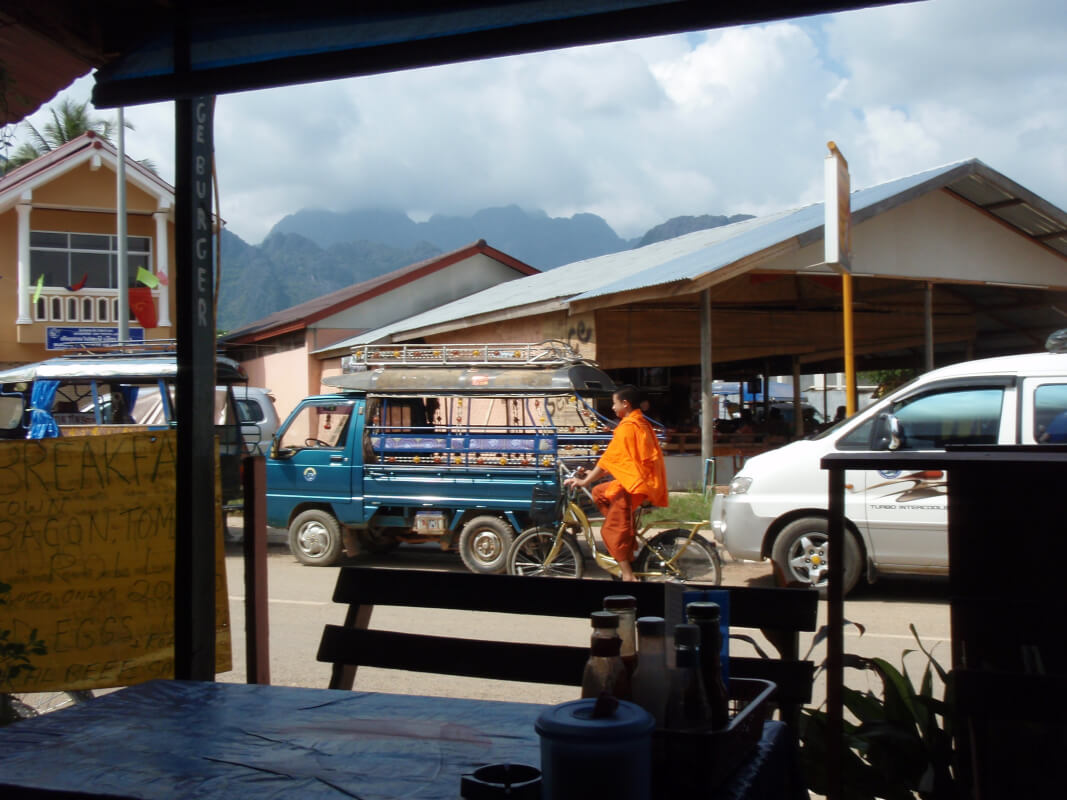
Monk on a Bicycle in Laos

Monk on a Bicycle in Laos

Helping Dad

Helping Dad

Hey! That's My Frog!

Hey! That’s My Frog!

He Found His Shangri-la

His Shangri-la

His Shangri-la

His Shangri-la is Lao

We stopped in the middle of a four hour mountain climb south of Luang Prabang, for a cold drink and some shade. A man came out of the house next door, and I glanced his way. Nah. He looked farang (Western) but it couldn’t be, this far out of the city, in a tiny village. Something about the way he moved about the house, helped a small boy with his shoes, said he belonged here, lived here.

I saw the beard, the nose, yup, farang. He turned to us and said, “Hello.” We spoke, he in a vaguely European accent with excellent English. He said he was German, and had traveled by bicycle, for five years, around the world. We shared touring stories, favorite places, bicycles. He said we could never make the climb by the end of the day, and the worse one waiting after that. We hoped he was wrong.

I wanted to know how he ended up in Laos, and how long he had been there. I waited. It would come.

He began his story: He got food poisoning in Laos. After five years of bicycle touring around the world, he was stuck in Luang Prabang. Then he met her, and his life changed forever. They married, have two children, and he has been in Laos for seven years. He manages a pig farm for his father-in-law, and the family spends half the week in Luang Prabang, where their children can get an adequate education, and half on the farm.

I asked him if he would ever go back to Germany, take his family. He smiled, “Never.” He is Lao now, family man, farmer, happy, healthy. He found what many would call his Shangri-la. His is real. A beautiful wife, comfortable home, two much loved children. So, for some seekers, Shangri-la becomes more than fantasy, an ideal, but a day to day life, real.

He traveled alone those five years on his bicycle; we know just how many pedal strokes that is. He was searching for something, Shangri-la maybe. He entered Laos from Yunnan China, mythical location of mythical Shangri-la, as we did. He hadn’t found it there, lovely as it is. Food poisoning brought it to him, it brought him love and purpose.

Where he lives is beautiful, very, very beautiful. The people are poor, but they laugh at, and with, we crazy farangs pedaling through their lives. They bathe by the roadside at a cold water stand pipe, and instead of complaining, laugh. They expect little, and appreciate much. Perhaps our German friend, now Lao, saw that, and the light of his love’s eyes, and knew he was home, in Shangri-la.

We didn’t get his name, but he has this site and we hope he will e-mail us. We will publish his name and correct any miss-perceptions. We’d also like him to know we made it to Kiukacham, just before dark. It was our hardest day in Laos.

Christmas? Now in a Lao Shangri-la

Christmas? Now in a Lao Shangri-la

Lucky Visits the Plain of Jars

There were all these big things made out of rock in Laos on the Plain of Jars. I got to look at the jars and saw myself in the water. Lorenz and Alex from Germany laughed. The other two nice people from England were Will and Jo. They introduced me to Eeyore. He is in a famous book called Winnie the Pooh, who is a bear. Eeyore is not a bear. He is a donkey. He is the nice people’s traveling companion. Just like me! We had a visit about our travels. He has his own web page. He doesn’t have to share one with his people, like I do.

Read the rest of this article...

Luang Prabang; World Heritage Site

Here are some photos from a morning walk around Luang Prabang. It is a World Heritage Site for the French Colonial architecture. We found much of that architecture degraded, but the town is very lively. Looking at the pictures, we are obviously more into people and food than architecture!

Sun Umbrellas

Sun Umbrellas

Text Messaging

Text Messaging

Fish Market

Fish Market

Interesting Food!

Interesting Food!

First Breakfast

First Breakfast

Morning Ferry Unloading in Luang Pabang

Morning Ferry Unloading in Luang Prabang

The Tunnel

In Southern Yunnan, we had over twenty tunnels on one stretch of fairly new highway. They ranged from 200 meters to nearly four kilometers (around two and a half miles). One small problem: many of them had few or no lights. Try doing that with one of those little LED headlights with weak AAA batteries. Potholes are my greatest fear; you can only see reflective material.

httpv://youtu.be/Lohkyfz1KnU

My Guaranteed Diet

Ride a heavily loaded tandem bicycle across several 15,000 foot passes and innumerable others at slightly lower levels. Then eat mostly rice and noodles, and get sick of both!

I weigh the same as I did in High School, but about fifteen pounds of muscle have just disappeared! The loose skin bothers me, but I am now on a concerted effort to eat as much of anything as possible and in particular protein. Wish me luck!

torso

Laid Back Laos

We’ve been in the mountains of South Yunnan, China and Laos for several days. Our border crossing between China and Laos went smoothly, but we were unable to find accommodation on the Laos side; there were several hotels in Boten and all were filled with workers building two new hotels.

Lao Scene: In the northern mountans of Laos, near here, we saw men walking with  primitive bows and arrows.

Lao Scene: In the northern mountans of Laos, near here, we saw men walking with primitive bows and arrows.

The genius of central planning; in a year, all the workers will have gone elsewhere and the tourists will all be staying on the China side. Brilliant.

So, we were forced to head down the road in the afternoon sun, hoping for a place to lay our heads. As usual all the land is either too steep to camp on, or has crops growing.

Lao House

Lao House

A short 10 kilometers further, we started asking for accommodation, by pantomiming with two hands beside our heads for sleeping. People kept pointing back the way we came, and we feared they meant China, where we could not go, since we’d had single entry visas.

Finally a woman on a veranda nodded in the affirmative, Claire began her magic, and we soon had a nice clean room for $4.80. It was a very nice traditional Lao house. We left our shoes outside, per tradition, and entered a sanctuary of cool tile and warm wood. We were lucky we couldn’t find a Chinese style hotel in Boten; better to stay in a traditional Lao house in a small village on our first night in Laos.

We immediately headed for the wash up room: tile floor, two barrels of cool water, and a scoop to ladle water over our head and body. It sounds unpleasant, but after a day of difficulties, heat and humidity, it felt wonderful. There was a large metal basin on the floor for washing clothes, and a bar of laundry soap. I remember my mother doing a pre-wash in Fells-Naptha before throwing everything in the old ringer washer. The Lao haven’t gotten to those yet. Everything was very clean and our hostess went to the local store for a mosquito net once we found how to ask for it in the phrase book. We had noticed that the other three rooms were equipped with them.

Next on the agenda, was to find my first BeerLao, supposedly the best lager in SE Asia. It was certainly good, and cold from the closest store, 650ml, $.48. I’ll let you know if it’s the best after a few months.

We sat on the veranda of a woman who was old enough to have learned French under French rule in Laos, and Claire obliged, to the limits of her memory.

I enjoyed my BeerLao, and a fast developing sub-tropical rain storm beating the tin roof, releasing new exotic plant scents, and setting off the family rooster.

Welcome to Laos

Welcome to Laos

We slept well and awoke to the largest grasshopper I’ve ever seen gracing Zippy’s stem. We had a long day today, with more mountains, beautiful mountains, fecund and fragrant, so different from the Tibetan Plateau. The road turned awful; fist sized embedded rocks for kilometers at a time, or worse, a maddening 100 meter patch of bitumen every 500 meters. This was a county connector road, and we expect better very soon.

Claire has mixed emotions about leaving China. She was getting pretty good at carrying on basic conversations (I smile a lot) and now we have a new language to learn. We only have 30 days in Laos, so we won’t learn much before facing yet another language, Vietnamese.

The Internet is rumored to be slow in Laos, appropriate for a third world country, but we hope not so slow as to preclude the videos and photos we enjoy sharing with you. (So far it has taken one-half-hour to upload the grasshopper – we will hope for better in tourist towns a few days from here).

Claire:
I was kind of blue at the thought of leaving China. Twice, we’ve been here now and I wonder if we’ll ever be back again. The people have been very kind to us and I hope we’ve brought them some joy, at least a giggle or a good belly laugh as they take a break from the never-ending work. I wish the best for them.

I was glad to be finished with the countless tunnels along the new highway, some of them as long as nearly four kilometers and some with no lights. Poor Bob had to just aim his light at the yellow line and try to keep his balance. The worst tunnels were the ones with bollards to keep cars from overtaking, which meant we had to stop and pull over to the right as far as we could to let trucks pass. It wasn’t a shoulder, but rather a covered drainage ditch, with some of the concrete covers broken through, so Bob had to pick the right spot to stop. The noise was deafening sometimes and the fumes were thick.

The Xishuangbanna region is definitely more Southeast Asian than it is Chinese, environmentally and culturally. It’s a good transition for us. Though we’re sweltering hot by 10:00 a.m., we expect it to start getting a little cooler over the next month.

So far, I love Laos. We’ve seen all sizes of electric blue and neon yellow butterflies; we can hear insects buzzing, frogs chorusing and birds singing; bright flowers bloom and scent the air. The children are delightful; the little ones run naked after us, scattering chickens, waving and squealing “Sabadee, sabadee!”

Change in Latitude; Arriving in Southern Yunnan

Claire:
With a 13-hour bus ride, we’ve changed the backdrop of our tour from a temperate to a tropical climate. The sleeper bus was an experience we’d wanted to try after seeing them on our 2005 tour. In my research, I learned to expect a noisy, smoky and cramped ride of up to 24 hours. We found the bus fine (no smoking), though we would have both been a little more comfortable if we could have removed our feet along with our shoes, as everyone is required to do. (Stepping on the bus, the first thing I noticed is the smell of sour feet, but I can stand anything for a day.) The bunks shoehorn together with the feet of the  person behind tucking into an angled cubbyhole that props up the head of the person in front.

After a while, we learned to adjust our positions and use extra blankets to prop up our knees. We tossed and rolled through the curves and bumps of the night, glad to not be riding Zippy on these steep, switch-backed and largely unpaved roads. Being at the very back of the bus (not by choice), meant that some bumps launched me clear of my bunk, landing me in a completely different position than the one I’d carefully arranged. I finally started using my safety belt when, unable to sleep around midnight, I watched the bus driver pass fuel trucks on blind curves of a particularly mountainous road.

Lessons learned: Take advantage of every bush break or you’ll regret it later; Women: bring your funnel so you can stand on the roadside along with the men (ignore the curious stares), and never, EVER step anywhere you can’t see (I almost went over a ten-foot wall at the 2:00 a.m. stop and ended up covered in mud from catching myself).  Thirteen hours into the trip, we were just getting the hang of it, so you can imagine our surprise, when at 8:00 a.m., we learned we were already in Jinghong and and had to hastily offload and ready Zippy.  We didn’t expect to arrive until 7:00 p.m. and had planned to shoot a video, read, nap and enjoy the scenery. We’ll be glad to get back on Zippy tomorrow.

Another Transition

Another Transition

Hibiscus in Southern Yunnan

Hibiscus in Southern Yunnan

Woman cops a Nap while selling Chickens

Woman cops a Nap while selling Chickens

Bob:
All we had read about these long haul sleeping buses was that the experience was torture. We are both fairly small people, and that must have helped us find reasonable positions on the tiny beds. We have a motorhome with two bunk beds at the back, and they are two feet longer and a foot wider than these bus beds. The scent was not as bad as it could have been; only one man insisted on smoking, out the window he thought, while we were stopped. I would have died in the old days when smoking was allowed anytime during the trip.

The road was very rough and I am glad we didn’t have to put Zippy through that section; he’s had enough of the fist sized rocks, deep potholes and mud, thought I expect SE Asia will provide more of that.

Besides the great change in plants and weather from 2000 meters down to 550 meters, we have noticed that many of the people do not speak Chinese, and many of the signs are in another language, perhaps Bai (Thai/Lao?). We will soon find out; off tomorrow for a few days cycling in the humid hills for the border with Laos.

I like the food here. The hot is a SE Asia hot, hot but it goes away after awhile, unlike Sichuan hot which lingers. We ate at a street fandian twice today: a bowl of rice topped with any mix of at least a dozen different selections. I picked a smokey fatty hot pork and a couple of vegetables. Yum. I think the best food in Asia is found on the street, but then we never eat at high end places for foreigners; we eat what the people eat.

We sat on a stone planter with construction workers on stools or squatting, shoveling in the good stuff. We went back this evening, tried some different toppings to the rice, and a Snow Mountain beer, as we watched the rush hour of mothers hauling young school children on bicycles, recyclers on their truck/tricycles, buses and motorcycles.

Small groups played cards on short tables under the palms, settling in for a long evening of street socializing. There is no place like Asia. I think we’re going to like this part. I’ll let you know if the hills are smaller after a few days.

Zippy Draws A Crowd

httpv://youtu.be/sTK_-HDTPpk

This interesting thing about this is there were twice as many people before I took out the camera to video. Chinese do not like to be photographed as a part of a crowd, and yet they always like to be a part of a crowd. I wonder if it has to do with how much they are under surveillance, or think they are?

Dali and Plans for Beyond

Snow Mountain

Snow Mountain

October 14, 2009
Leaving Lijiang

Claire:
We may be out of the mountains, but we’re not out of the really big hills yet. Language got in our way again as we attempted to leave Lijiang. I didn’t expect to have trouble, but somehow we missed a turn to the new expressway? and ended up on a road that quickly deteriorated to a dirt track. With no one to ask and no traffic, our confidence that we were on the right track flagged. Everyone we had asked earlier and even the road signs indicated this was the way to the next town, Heqing. But this can’t be right! Finally, after 10 kilometers, we saw the expressway and realized our track was a shortcut to it. Soon enough we were back to wishing for less traffic than was on the expressway. Everyone in China, it seemed, was either on the way to or from Dali. And the mid-autumn holiday is supposed to be over.

Along The Way

Working The Rice Fields

Working The Rice Fields

Making Charcoal By Hand

Making Charcoal By Hand

Harvest Time

Harvest Time


Dali Old Town

One Dali Old Town Gate

One Dali Old Town Gate

"Ethnic" guides in Dali

“Ethnic” guides in Dali

Bob:
Two days from Lijiang, and one big hill later, we are in Dali tourist Mecca for the Chinese if there ever was one. We are not having any luck finding a helmet for Claire, the Chinese only wear helmets, on motorcycles not bicycles, and not many even then. We have glue and will apply it liberally to the crack.

The landscape is changing with big hills farther apart, and the summits at lower elevations. Most of yesterday was in flat rice fields, many being harvested and others being prepared for winter crops, with lots of rice chaff and manure, animal and human, being dug in by hand. The amount of hand labor involved in raising rice here is amazing, but there are a lot of people to do the labor. Large paddies are filled with people doing various jobs, and the roadsides are piled high with manure, or harvested rice, forcing us to compete with buses and trucks for the roadway. When the shoulder (yes they often have them in the flats) is clear we cruise in the mid twenties kph, with little effort.

Yesterday we had bunch of school kids trying to keep up with us on their way home to lunch (they all go home for lunch here, biking). They were all yelling and laughing as we passed; we must be quite a sight to them with all our bags. It’s fun to show them something different. I can imagine them being difficult in afternoon classes, trying to figure out what we were.

We Could Rent This In Dali

We Could Rent This In Dali

We are, however, weeks behind schedule due to the unexpected number of 15,000 ft passes on the Tea Horse Route, our hospital visit, and poor planning on the part of the route planner, me. The mountains took nearly two weeks longer than planned for.

Since we are leaving the mountains now, and the ethnic areas we came to see, now we are going to live dangerously: we will take a bus to southern Yunnan to the sub-tropic mountains, and catch up a bit. Laos calls. Lonely Planet says a long distance bus trip in China is a Rite of Passage. We’ll see.

So did we find Shangri-la?

Of course we did. You knew it all along, didn’t you? Shangri-la is a dream, an imagination, and for us it is The Journey, the travel, the things we learn, the things we see and marvel at, and the others we will never understand.

Come with us to Southeast Asia.

The Journey continues through the mountains of Southern Yunnan and Laos, down the valley of the Mekong, over more mountains into Vietnam, Cambodia and ending in Thailand.

There will be new adventures, new sights and smells, new foods, languages, and surely more of those smiling faces we see so often. The adventure continues. Stay with us.

Smiles

Smiles

Backroads Accommodation in Shangri-la

Thanks to everyone for the comments, especially after our unplanned detour to the hospital. It’s really nice to feel more connected to a community and we love hearing from you.

Zippy Joined Us

Zippy Joined Us

‘I complained because I had no shoes until I met a man who had no feet,’ comes to mind after one of our stays along the backroads of Shangrila. Remember the fun we had with the video detailing the trip across the road, down the stairs and over the bridge to the outhouse? This time we stayed at a “hotel” with no toilet–at all.

The Tibetan women we stayed with earlier were not in business, but this hotel was running an accommodation where the toilet was a five minute walk along the road to where the fence ended and the hillside dropped down through some trees for privacy. One really had to watch one’s step and keep eyes from wandering should another villager be occupying a nearby tree. Even open space here has a purpose. On the bright side, Zippy was able to stay with us for a change, rather than with a baby pig or in the meat locker.

The lone light bulb flickered and faltered in sync with whatever was going on in the family living area next door. We didn’t charge our computer or cameras that night!

China Hotel

Shangri-la Backroads

Misty Morning in Shangri-la (Claire)

Misty Morning in Shangri-la (Claire)

We took the recommendation of Bill Weir and Alice and Andoni, cyclists we’d met way back in Almaty in 2005, and took a back road rather than Highway 214 to Tiger Leaping Gorge. We had at least one climb each day, one day we had three climbs totaling about 18 kilometers. The road is now paved except for washouts and we had very light traffic and beautiful views. Villages along the way were full of hard-working but friendly people eager to say “Hello!”. Coming the backway into Tiger Leaping Gorge was more fun because we didn’t feel so much a part of the tourist hordes. The big rock slide blocked vehicle traffic so we had the gorge to ourselves for most of the morning.

Shangri-la Vista

Shangri-la Vista

Clothsline in Shangri-la

Clothsline in Shangri-la

Plowing with Oxen

Plowing with Oxen

Fall Colors in the Mountains of Shangri-la

Fall Colors in the Mountains of Shangri-la

Nearing Another Pass With Moss Covered Trees

Nearing Another Pass With Moss Covered Trees

Shangri-la Flower

Chinese carrying burden of plants for animalsshangri-la flower

Travertine Pools of Bai Shui Tai

Travertine Pools of Bai Shui Tai

The main reason we went the longer, back way to Lijiang was that I (Claire) wanted to see the travertine terraces at Bai Shui Tai. Unlike at Havasupai, these terraces are perched on a hillside, rather than in a canyon.

Flower in Shangri-la

Flower in Shangri-la

Dahlias grow everywhere.

Carved Headstones

Carved Headstones

Village in Shangri-la

Village in Shangri-la

The expansive valleys on this route were stunning; deep enough that we couldn’t see all the way to the bottom.

Mountains of Shangri-la

Mountains of Shangri-la

Chili Harvest

Chili Harvest

View from our $4.20 room

View from our $4.20 room

Lunch Time in a Shangri-la Field

Lunch Time in a Shangri-la Field

All Dressed Up

All Dressed Up

Hava Snow Mountain

Haba Snow Mountain

Tiger Leaping Gorge

Tiger Leaping Gorge

After the rain in Tiger Leaping Gorge

After the rain in Tiger Leaping Gorge

Detour to the Hospital

Our trip through the back country of Shangri-la turned out to be four days instead of two, due to a landslide and constant big (still) mountains.

First Class Care

First Class Care

Bob:
Yesterday we took a little detour on our way into Lijaing – to the hospital. We crashed. A combination of a long day, with 1200 more meters of climbing, a patch of water laid down by the cooling water of a truck’s brakes, a little bit of clay, and down we went at about 30kph.

Claire was not responding at first and I got her out of traffic carefully, in case any bones were broken (none). I can’t explain how I felt seeing her, barely moving, having trouble hearing me, or answering to her name.  She finally came around, and I got her sitting upright and talking coherently. I checked her eyes for dilation or wandering, and she could focus and had no double vision (we’ve been through this before).

A motorcyclist helped direct traffic as I dragged Zippy to the edge. I started to search for the first aid kit, and by then Claire was thinking clearly enough to tell me where to find it. Before I could start cleaning her abrasions, a van full of police arrived. My first thought was that we were in even more trouble than the crash aftermath, but they were great. “We take you to hospital,” said with authority, had an amazingly calming effect. They commandeered a small pickup, and loaded Zippy in. We wondered if we’d ever see him again, until we saw one of the policemen get into the truck.

Claire:
It’s really frustrating having to admit you need help, but when the police came and said “hospital” I knew we probably should go, even though it meant transporting Zippy some other way, struggling to communicate with doctors or nurses, arriving in an unfamiliar town not under your own power, and worst of all, losing your bearings.

Since I’d lost a minute or two, I had a lot of questions for Bob and it took me a while to come out of the fog that makes you think you’re having a bad dream. I remember knowing we were going down, but that’s all.

At the hospital, we had our scrapes swabbed. They thought my nose might be broken, but I think my glasses just gouged it. I took the hit evenly between shoulder and hip. Bob got it pretty bad on the knee, but it hasn’t swollen. Bob noticed the doctor watching me for signs of brain trauma, and from previous experience, he knew to wake me in the middle of the night to make sure I knew who and where I was. We’re both a little stiff and sore today, so we’ll take an extra day in our three star hotel. (Total hospital bill: $6)

We’ll post our days in the back country soon. Beautiful…

With this sign would have been before that curve!

Wisn this sign had been before that curve!

Shangri-la: More to come

Stupas in China

Stupas in China

Another day, another two mountains. When we reached the Yangtze we thought we would be cruising down the river for a few days, but China 214 took a hard left into a narrow gorge where we found yesterday’s accommodations.

China's mountains cloaked in mist and clouds

China’s mountains cloaked in mist and clouds

We began this morning in the rain. The mountain ahead – a 1,000 meter climb – looked grim, with tatters of gray rain hanging from charcoal clouds. Rain dripped from our parka hoods, spray from trucks and small streams crossing the road had wet us thoroughly. We settled in to listening to Zippy creak and grind in the wet and grit.

We stopped often for moon cakes and Tang, our primary power sources these days, and plodded on at the reasonable pace of 6 to 8kph (about 4 to 5mph) for a couple of hours. The road made a switchback that took us away from the rain and we slowly began to dry. An hour or so later, we topped out for a few kilometers of descent and began another 500m climb, with rain threatening the summit.

Claire:
Our day was made sunnier by the friendly Chinese tourists foisting food on us. At one point, we had to reject a girl who was on her third trip to give us fruit and moon cakes. We were already loaded down with walnuts from this morning.

Chinese Village

Chinese Village

We also had a great exchange with some other bike tourists. David and Maria from Bilbao, Spain are going north. I felt bad that they seemed anxious about how high the climbs were and we couldn’t tell them anything encouraging; yes, there would be some very hard all-day climbs ahead. I know exactly how that feels, but during the climb it doesn’t seem so bad after all.

David gave us a map he would no longer need and I gave him my notes transcribed from Mark and Julie McLean’s great website: Mark-Ju.net. Julie’s detailed description through this last segment was spot on.

David and Marie from Spain

We are seeing some of the plants we all take for granted as garden plants here in the West, but originated here. It was Joseph Rock’s explorations in these mountains that began the garden boom in England, and subsequently the Western World. An English author read a story in National Geographic, and based his mythical Shangri-la on Joseph Rock’s cultural observations as an aside to his botanical work. So it is in quite a round-about way that the Shangri-la no-tell-motel on the seedy side of town is named “Shangri-la.”

Flower of Shangri-la, one-inch tall

Flower of Shangri-la, one-inch tall

Still Shangri-la?

Is this part of China still Shangri-la? For many of the people content to live the simple life of farm work and devotion to Buddhism, it still must be a peaceful existence. They watch the world pass and wonder at it, but have little desire to follow it to the cities. Of course, some of the young do follow China 214 to the city, and village life no doubt suffers for their loss. The outside world nibbles at the edges of their world, but so far makes seemingly minor inroads. We see a village high on the mountain as we pedal the China 214, and wonder at how they possibly can get up there, how they found a place to put a house – let alone a barn, and those terraced fields. A few hundred meters is a long way when the slope is 45 degrees.

Are they the healthy happy people who live long lives, as described in the novel? Their smiles indicate they are happy. As for their health, they must have strong hearts to navigate the near vertical hillsides all day – every day. Their sanitary systems are nonexistent, but they’ve probably adapted to some degree, and all consumed water is boiled.

Many of them live as my grandfather lived in West Virginia more than 100 years ago. He was still mowing hay by hand when he was 90 years old. He worked  with horses, had no electricity, went to the outhouse, ate pork every day, and died peacefully at home at 93.

Shangri-la? Not for us, but considering the challenges of modern life, and that American’s life spans are decreasing for the first time ever, perhaps there are lessons to be learned.

Claire took a nice video of a man dragging logs with a team of oxen that reminded us that we were in a world not wholly made up of diesel belching trucks, wildly driven SUVs, and kilometer long lines of tourist cars.

The National Holiday

We are in the middle of one of two national holidays in China. All Chinese who can afford it, and there are many more than four years ago, want to drive their personal autos to some tourist hot spot. We are entering the area defined by the tourist industry as “Shangri-la,” and it is apparently a prime destination.

We’ve had our picture taken so many times by so many Han Chinese, with their huge Canons and Nikons, that I am considering declaring us an official minority and charging for our images. One time it was a huge tour bus filled with photographers, wearing camera vests and sporting lenses larger than both of our cameras put together.

It gives me a new perspective on photographing people. When I was a photojournalist I often just charged into a group and began knocking off frames at a furious pace, with no consideration of the feelings of the people. I don’t have to do that any more. Now I ask, or am so unobtrusive that I don’t disturb the flow of their lives.

Claire shoots from the back of the tandem, and that seems to disarm people. We also get a kick out of the Chinese amateur photographers, scrambling for the best angle, jabbering away, finally waving and giving a thumbs up; it’s all road entertainment for us.

Shangri-la, The City

After a short descent to a large lake which seems to be a major tourist attraction, judging from the traffic jams, we again rode in the rain into the city of Shangri-la. Claire was surprised at the size of the city, and despaired of finding the guest house we sought. We finally found it, paying eight times what we paid the previous night for the privilege of hearing our neighbors, and choking on their smoke that seeps through the walls. The extra price is for arriving during the national holiday; the Chinese also pay the higher fee.

So far it seems like any other medium sized city, except there are many more hotels (all full). There is a tourist “Old Town” that we must see while we are here.

Iris in Shangri-la, China

Iris in Shangri-la, China

We’re off on a back road trip to Tiger Leaping Gorge. Claire says more mountains are ahead of us –  and no doubt some spectacular scenery.

save

Meeting the Yangtze

httpv://youtu.be/c0vp0AkYaiU

You might wonder why we don’t find better accommodations? The next Bingwan was 84 kilometers, and 1500 meters up the road, a hard all day ride. Sometimes the basics seem awfully nice after a long hard day, with another one waiting.


October 3
Shangri-la is changing as we drop in elevation. The yaks are gone, replaced by mixed breed cows, sheep, goats and donkeys. The high meadows, empty of human habitation, other than seasonal tents, with sparkling air and clear water, have been replaced with terraced fields of crops, villages with substantial houses, roofs filled with drying corn and racks with hay. The people remain friendly and vocal as we pass, our unusual mode of transportation a novelty still.

But there is a change. The prayer flags, stupas and monasteries are fewer, the flags more likely to be tattered and faded, and the architecture increasingly Han and not Tibetan. There have been a few instances of architecture new to us, indicating we are entering an area of more diverse ethnicity. Groups of women walk in brightly decorated dresses and several varieties of head dress.

Today was a nearly perfect cycling day: the road was smooth, and mostly downhill, with just enough cooling upstream breeze. We had a few hills, but none were long. There were friendly people, cute donkeys and goats, spectacular gorge scenery, and all our official interactions at check stations were pleasant. I’m beginning to think we just got a couple of bad eggs, on edge because of the 60th anniversary of Communist China’s founding. The army was even guarding a bridge, complete with sand bagged bunkers, though they seemed relaxed, perhaps because the day, October 1, has come and gone without incident, as far as we know. Unescorted foreigners are still blocked from the Tibetan Autonomous Region, though that was supposed to be lifted this week.

Read the rest of this article…

A Thorn Tree Grows in Shangri-la

[httpv://youtu.be/CUH08hlrnbM]
This is the second time small Tibetan boys have stood at attention as we passed and held a salute until we released them with a return salute. We wonder what it means? Is it serious, or is is sarcasm reserved for foreigners and police and army?


October 2, Derong, Sichuan, China: A Thorn Tree Grows in Shangri-laBob:
We left Xiang Cheng, for another long day of climbing, our last over 4,000 meters. The road had a reasonable grade (we could maintain 7kph (about 4.5mph) and the surface was good bitumen. The views back down the valley to the monastery were spectacular and the few small farms blended organically into the vertical mountains.

Tibetan valley with houses

Tibetan valley with houses

At one curve in the road, a woman looked up from weeding her small orchard, and let out with an extended soliloquy on our presence, accompanied by a large smile. Her husband, walking in the road, waved us down, and eagerly suggested, in pantomime, the we join him for a rest under a shade tree. He too beamed with joy at the possibility of enjoying our company. We had a difficult (more than we knew) day ahead of us, and I pointed at my wrist and shook my head in denial. He persisted, and we went back and forth, all with smiles.

Finally we waved and pushed off, our 26 inch prayer wheels spinning out thousands of goodwill messages up his mountain; but I think we might have missed the point. The farmer and his wife live Shangri-la, not just in it, but they are Shangri-la. They are poor, but well fed, and the circle of their days allows for a break when tired, a visit with passing strangers, the rhythm of weeding, or wall building when they feel like it, and the song of bird and stream as accompaniment to it all.

We, on the other hand, have brought our schedule laden philosophy with us. We are here to SEE Shangri-la, not be it or live it. We have conquered her mountains, seen those living Shangri-la, but have not made the truth-based myth our own. Oh, we have absorbed much more than those black SUVs that pass us by the scores each day, carrying Chinese to possess for a holiday, their most exotic locations. At least we have the memory in our legs and lungs of the place; we have the images of the genuine smiles from the minorities directed to us as somehow kindred spirits. But will we bring it home with us?

Farm in China along river

Farm in China along river

Now for that thorn tree: As you will read in Claire’s note, there are many police in Shangri-la. As we have descended the Himalayas, the number of police posts on the roads has grown with one about every 50 kilometers. As we came up the eastern side of the range’s fingers, there were few posts, and they always waved us past, usually with a smile. Here it is different. We are still in Tibetan minority area, and very close to the border with the Tibetan Autonomous Region, where we assume they are expecting trouble. We were not able to go into the TAR as independent travelers, only as part of an organized group with a minder/guide. About a week ago, even that privilege was revoked for foreigners.

Police post in China

Police post in China

To me it seems at least a few of the police on this side have taken a negative tone with laowai (foreigners). Not all by any means, most perform your passport check professionally and even smile. But, after a beautiful descent of our last 4,000 meter peak, we came to a village where we understood there was accommodation. At the police stop, in the center of the village, one young man strutted back and forth of Zippy, regaling the growing crowd of mostly Tibetans with his apparently negative opinion of us. He particularly seemed to dislike the Tibetan prayer flag we had attached to the handlebar bag, and indicated his disgust with a sneer and a dismissive flip of the flag. He also told us the accommodation was no longer available, and through a translator, that we get a family to put us up, an unlikely possibility after word spread about his dislike of us. The locals fear the police. They don’t seem to be there to solve crimes, but to watch over the non-Han population, and make sure they have little contact with foreigners.

Claire Rogers and Lucky in tent

Claire Rogers and Lucky in tent

Tent camouflaged with branches

Tent camouflaged with branches

Valley and river in China

Valley and river in China

Claire getting water from a seep in China

Claire getting water from a seep in China

Tibetan couple

Tibetan couple

Monks on a motorcycle

Monks on a motorcycle

At this point we knew we would have to guerilla camp, and bought two chicken legs at a store, and got some stir-fried egg and tomato, a huge bowl of rice, and all our water bottles filled with boiling water. While we were eating, an old Tibetan man fingering his beads, came over, touched our prayer flag, nodded his head and smiled. There is a split here and it revolved along religious/ethnic lines. Only one side wears uniforms. This could get us thrown out. Yesterday, I had to help a policeman go through all the pictures on the camera Claire uses to shoot from the back of Zippy. He was a pleasant young man, just doing his job, but to an American, it was difficult to endure. Few countries have a First Amendment. Treasure yours.

We left the village for a 12 kilometer climb to an uncertain camping spot. The mountain sides are so steep, below the Plateau, that we had to camp on a power line road, in full sight of the main road. We used a few limbs to break up the contour of the tent, made sure headlights wouldn’t hit us directly, and we don’t think we were seen. Claire had a couple of disturbing dreams, but we both slept well.

There were two more encounters with the police, including a mostly pleasant one here in Derong. We hope this eases us; even though we are getting accustomed to the delays, they are not the delays we would choose.

Stupa in far SW China

Stupa in far SW China

Tibetan women carrying stacks of hay

Tibetan women carrying stacks of hay

Fall colors in China

Fall colors in China

Looking back down a Chinese Valley

Looking back down a Chinese Valley

Woman filling sacks in SW China

Woman filling sacks in SW China

The (renamed) town of Shangri-la (here it is pronounced Shan Ge Li La) is two days away. Stay tuned.

Claire:
We watched the National Day festivities on television last night. The hyperactive, color coordinated crowds rallied for the cameras and the massive, meticulously staged production was visible only to Party members with box seats and everyone in television-land. Our celebration of the day consisted of us wishing the police well on China Day, three different times. The roadside checkpoints only grew tiresome because our day wore on longer as we waited for our passports to be returned. One lone police man called us in to somewhere, browsed through the photos on one camera (he didn’t know about the other one), then after some tense effort to communicate, made it clear we were to check in at Derong, 40 kilometers down the road. At one checkpoint, the police seemed to laugh at us for interrupting their card game.

The festivities here in town consisted of ten minutes of fireworks a few meters in front of our hotel, but I think we were the only ones watching.

We’re enjoying the light traffic and rural roads of this steep mountain country, knowing that we’ll soon come back down to more densely populated areas. Here, the land is simply too vertical to support a large population and any relatively flat space is occupied or in use for growing food.  The thin, clear air has been good for our lungs and the stiff climbs certainly good for our legs.

Entering the Back Gate to the Garden of Shangri-la

[httpv://youtu.be/8WF3b_LdvJA]

We’ve called this often grueling trip from Chengdu, the Back Road to Shangri-la. A few days ago, we entered the high gate to the garden of Shangri-la. We topped out above 15,000 feet each day, and often stayed there for hours. We meandered the Tibetan Plateau, in company with yaks and Tibetans, surrounded by a landscape stippled with stupas, prayer flags, tiny wildflowers and singing mountain streams. Meadows of jade steepened up to fresh snow covered peaks, at least some days backed by a cobalt sky and cotton clouds.

At least one day was miserable with rain and we cut our day short, rain soaked and freezing, at an unheated roadhouse infested with Mahjongg playing and yelling, day off revelers. But those are not the things we will remember. We will remember the smiling Tibetan greetings of “tashi dele” from every roadside yak camp or a passing motorcycle, laden with bags of grain, and sometimes the whole family.

We will remember the hours long climb each day, each switchback revealing new wonders of high meadows and lines of blinding peaks. Then we begin the long descent through rock walled paddocks, friendly villages, and herds of yaks and deep gorges of evergreens, autumn coloring trees and roaring streams.

Do the people here live to very old ages? Are they always healthy and happy as the Shangri-la myth tells? No, they are mortals, increasingly invaded by the outside world, nudged into ways foreign to their culture and religion. But from the smiles on their faces as we pass, an exceedingly strange apparition from afar, the hearty waves and open-faced surprise, I know they are a happy people. We were told by one man that they don’t even think about the weather, no matter how bad, and it can be very bad! That tells me the Buddhist philosophy is real and alive in their lives. We’re not there yet, especially when it comes to weather!

So Shangri-la is in some measure real, at least here in the high meadows. There is much more to discover, much more to come.

Tibetan plateau

Tibetan plateau

Claire getting a hug

Claire getting a hug

Read the rest of this article…

Lucky’s High Pass

[httpv://youtu.be/Hz7nMKelW1U]

Lucky made it! I guess we can take credit for 16,000 ft. since we’re all on the same team.

We’ve been in the high meadows of the Tibetan Plateau, most days over 15,000 feet for hours; we have found the back garden gate of Shangri-la. Look for a longer post soon with lots of pictures.

Claire:
Poor Bob had to pedal by himself halfway to Sangdui because I was too busy kicking myself up the mountain. Can anyone tell me why one remembers something left behind only after you’re well beyond going back to retrieve it? My security blanket is gone, and it’s all my fault.

At the breakfast table, in the roadhouse where we spent the night, I left my packet of maps, phrases and our chopsticks. It was an envelope I clutched tightly anytime we were off the bike. Now, it was 30 kilometers back and 1000 feet down. We weren’t going back for it. So we’re without a good map until at least Shangri-la (Note: Bob was smart enough to photograph the road atlas pages, so we do have a backup). The phrases? I’ve mostly got down the basics enough to get us a room or a meal without my cheat sheets. And the chopsticks? Well, this is China.

Bob:
There will be more mountains to come, and some will probably seem harder than this one. Zippy is making strange noises from the drive-train, and we fear we have put him under too much strain this time.

We are sometimes tired, but feeling stronger every day. We’ve reached that magical three-week point in a long challenging bicycle tour, when we are in the zone, when we feel pretty much ready for anything.

The next post is one you won’t want to miss: we now know we have entered the high back garden gate of Shangri-la. The success was hard won, but all the more rewarding for the suffering.

It will be posted soon with lots of photos.

Loving Litang; a look back, a look forward

Tibetan woman spinning her prayer wheel in Litang

Tibetan woman spinning her prayer wheel in Litang

Bob:
We’ve been traveling two weeks now, but somehow it seems much longer. The Chengdu valley and the Tibetan Plateau are very different places, in landscape and people. Chengdu is a very large city of Han Chinese, and the Himalayan west of Sichuan is sparsely populated with Tibetans. Many people think of the Tibetan people and the Tibetan Plateau as being only within the lines drawn by the Chinese government, the Tibetan Autonomous Region. Both the Plateau and the Tibetan people are spread over several other provinces. The government  encourages Hans to move into Tibetan lands with various incentives, and by building new cities deep in formerly exclusive Tibetan lands. But the fingers of Himalayas we crossed to climb the Plateau, and the difficulty in building and maintaining roads, have kept this part of Tibetan land Tibetan.

We will now turn south, remaining on ridges of the Plateau for a few hundred kilometers, with at least one pass higher than any we have yet crossed, nearing 16,000 feet. Not far from here, the great rivers of SE Asia are given birth; the Yangtze and the Mekong are the two we will meet. We will cross the Yangtze as it turns north, and follow the Mekong south into Laos, Vietnam, Cambodia and Thailand. Here, these already powerful streams, are separated by just a few high ridges before becoming the two greatest rivers in this part of the world. Along their courses live one of the largest concentrations and most diverse collections of peoples on Earth. We will encounter many cultures and the landscapes that helped form them, and we will share what we learn with you.

These postings are a small part of the material we are gathering, and they will be expanded into a larger picture of the region, after we return home.

And now a brief look at Litang:

Monk at the Litang Meat Market

Monk at the Litang Meat Market

Litang is one of the few cities in China with a majority Tibetan population. We were told in Chengdu, by a resident experienced China traveler, that we would see a more genuine view of the Tibetan people on the route we were taking than the throngs of tourists going to Lhasa. It does seem that we see few laowai (foreigners) here and we haven’t seen any touts (“Hello friend! Let me take you to a wonderful hotel!”)

A Monk Detailing His Motorcycle

A Monk Detailing His Motorcycle

They are a rambunctious people, and demonstrative toward strangers. Their culture and religion seem more important to them than to most, and they seem eager to share it. We visited a chorten (stupa square) Baita Gongyuan, where a smiling man invited us to take a lap and spin the prayer wheels. There seems almost an element of play to the practice; Claire noticed the Tibetans were so fast that they lapped us.

Turning Prayer Wheels

Turning Prayer Wheels

The public market is lively and filled with interesting fungus, vegetables, fruits and sides of yak, with men arguing over the value of various cuts. There are various fried breads and all manner of hand-made and manufactured things unknown in the West.

We have enjoyed walking the streets and interacting with the people, more than most Chinese cities, and I will miss it when we turn south toward Shangri-la, still many kilometers and mountains away.

Claire:
While we wait out the rain that has not yet materialized, we’ve spent some time getting to know Litang. I feel more comfortable now than when we first arrived; it’s like arriving in a new country. The people look different, act different and it takes some time to acclimate to the change in culture as well as in elevation.

I’ve been learning to speak a little more Mandarin and was even able to say: “We have friends who (do) Mahjongg, but we can’t.” But now, my limited Mandarin is useless here and I had a very funny exchange today with a friendly Tibetan woman who guessed, through graphic gestures, that I was looking for a toilet. She led me, arm in arm; she was going to the same place.

Monastery

Monastery

Today, we walked up the hill to the monastery through traditional Tibetan neighborhoods. The monastery reminded me of San Xavier del Bac because of all the intricate detail being put into the renovations. Huge murals filled the walls, yet looking at them up close, we could see how fine the painting was. That level of detail went all the way up, so high that no one could possibly appreciate it up close, yet there it was. I’m sure the artists who painted it appreciated it. The entry to the main hall was in the process of being carved and was not yet painted, yet it was just as beautiful as all the painted woodwork. While we were looking at the large Buddha, some Tibetans came in with young children and began the prostration ritual.

Buddhist statue

Showing off for the Laowai

Showing off for the Laowai

They love their trucks, and decorate them.

They love their trucks, and decorate them.

Decorating his stoves: winter is coming.

Decorating his stoves: winter is coming.

At the market

At the market

Monster scaring laowai

Monster scaring laowai

Two young women enjoying the streets of Litang

Two young women enjoying the streets of Litang

Elation, Pain, Surprise; Part 3, Weary Pass

[httpv://youtu.be/Y2paEIc3ptU]

Not that day anyway…

September 24, Litang, Sichuan, China

Claire:
Neither of us slept very well through night with our Tibetan hostesses. We were grateful for a warm, dry place but I fretted about the rain, relieved to hear it stop, only to find it had turned to snow.  The snow stopped long enough for us to get started and we knew we had another 15,000 foot pass to get over, but it was hard to tell our elevation (we don’t have an altimeter on either bike computer).

With the sky socked in and lots more climbing, we were convinced we’d reached the pass even though neither the Tibetans acknowledged it with prayer flags nor the Chinese marked it with a sign. To us it was a pass, so we took photos, made a video and descended. The snow turned wet and the road muddy and we discovered we had more climbing. This time the pass was marked, with flags in one spot and with an official sign a half kilometer away.

For cyclists who know the great 30 to 50 mph descents we have in the western U.S., these are nothing like those. The asphalt is not up to the weight of the heavy trucks and the road is full of ruts and moguls so we have to keep our speed down to 20 kilometers per hour. At one point we were bouncing so much our sleeping bag and Thermarests bounced off into the muck (they were in plastic bags). We reached the end of one long downhill and could see a long climb ahead. My knees were stiff and Bob’s neck and shoulders were worn out from controlling Zippy. Neither one of us wanted to face that climb.

Yesterday, we’d passed what looked like a roadhouse with a big Chinese flag and here at the base of the climb was another one. I walked into what I thought was a restaurant and asked about a room. Yes, they had one, it was a storeroom with two cots: $6. There was no heat, water or electricity, and the short-drop was outside. Zippy’s secure parking spot was the meat locker that was the entryway to our room. Through gestures, the proprietor made it very clear we were to keep the meat locker door closed at all times, I guess to keep the cats and any loose dogs out.

We tried to regain some heat by curling up in bed for a while, then ventured out for dinner. That’s when we finally figured out all the people coming in were road workers; we were staying at a road maintenance camp. We ate what everyone else ate, a big comforting bowl of noodles and sat around the kitchen stove to warm up. I don’t know that it was really so cold, but we were still so chilled that we went to bed huddled together with Lucky in one twin cot with four fluffy comforters on top of us. We slept well in the very cold room; there’s a reason they store the meat there.

Zippy in the meat locker

Zippy in the meat locker

Read the rest of this article…

Elation, Pain, Surprise: Part 2

September 23: Litang, Sichuan, China

Shelter

Shelter

Bob:

In our last video post (scroll down and watch it first) we’d made quick work of a 7,000 ft climb to a 15,252 ft. plus pass, and were feeling pretty chipper considering the troubles other cyclists had encountered with the steep grades and high elevations. Our regular climbs of Mt. Lemmon (close to 9,000 feet elevation) in Tucson, had prepared our legs well, and we took enough off days for good acclimatization. After a nearly two weeks of our legs getting accustomed to the 80 pounds our so we carry, the climb was not as difficult as expected.

However, rather than the long descent to lower elevation for rest and a decent camp spot, we found the road stayed high, rolling up and down 1,000 feet or so as the weather deteriorated to rain, wind and sleet, and then climbing again. We knew that a night of rest at lower elevation would be essential for the next pass of 15,475 feet, but this was not to be.

Staying High

Staying High

We stayed high as the clouds lowered and the sky darkened. We were shivering from the wet and cold and the effort of the pass. We knew we had to find shelter, high altitude or not, and hope our light sleeping bag would be enough. We failed to find a flat spot; this is called the Tibetan plateau, but it is riddled with 1,000 to 2,000 foot mountains with steep gorges and very few spots flat enough for a tent. Just as we were about to give up and camp beside the road (not something we do unless in dire circumstances) we saw a Tibetan settlement, and decided to see if we could at least get water. We were low and there was only some snow to eat, and maybe find a place behind a house out of sight. We would have to sleep at well over 14,000 feet, but we needed shelter.

Warmth and Food

Warmth and Food

As we rolled up to a small stone house/barn, an older looking woman smiled at us and made the international sleeping sign: prayer hands laid next to her head bent sideways. Nothing ever looked so good to us. A young woman, whom we took to be her daughter, and her child were in their small barnyard with their small herd of yaks preparing for milking.

She motioned for us to bring Zippy into the house, which was on the bottom level, the barn. We leaned him up against the stone wall, unloaded our bags and followed grandma (we’ll never know her name) upstairs. Their living quarters was one large room with a small hearth and a cozy fire. There was not a chimney, but a stovepipe reached just as far as a roof hatch, and the space was filled with a blue haze of smoke that softened all shapes and colors.

Home for the Night

Home for the Night

The floor was rough cut slabs and the roof was supported by large log beams, but in the stone walls were set modern aluminum windows with latches. Various food items were drying on feed sack material and the beds were rolled up in one corner along with corn husk pillows. The hearth held all the pans they owned, and all the cooking was done on top of the fire. The daughter hurried up from her milking to prepare our meal and grandma sat and smiled at us and attempted to communicate.  She knew no Chinese, only Tibetan, and our communication was by pantomime.

Eating Yak Butter, Grain and Sugar

Eating Yak Butter, Grain and Sugar

First, we were served a liquid from a pot that seemed to have a permanent spot on the hearth. It was yak butter tea. It’s pretty much as its name describes: water, yak butter (lots), and a few tiny leaves of tea. Now this sounds awful, but we found it quite good, and warming after a trying day.

Snowy Morning

Snowy Morning

Our first course was a white crumbly substance that Claire likened to the curds we had in Wisconsin, only they didn’t squeak in your teeth as much and had a very fermented flavor. I looked over and I could see a large pile of what we were eating drying/fermenting on the floor near where we would probably sleep. We ate from a communal bowl, grandma first, showing us how with the fingers of her right hand (this is important to remember). We are not prone to insulting the hostess, so we imitated her. We both liked the unusual texture and fermented flavor. I could see uses for it in other genres of cooking.

Grandma prepared the next course while the daughter finished milking. She sliced potatoes French Fry style and fried them in a huge amount of an unidentified oil poured from a large plastic container stuffed with a rag. Then she added some water for a steamed finish. This was served with rice, and more yak butter tea. It was quite satisfying, and enjoyed with the company of a Buddhist monk who’d dropped in for a meal. Apparently you feed a monk when he shows up at your door, anytime.

After dinner, and another couple of rounds of yak tea, we both needed to relieve ourselves of some liquid, and asked (don’t ask how we asked) for the toilet, which we expected to be a short-drop, i.e. a shallow pit with weather shelter over it. Not here. We were pointed to the guardrail and over the hill to the village toilet. It wasn’t as bad as you might think. Such places in America are littered with toilet paper, the white of which announces each deposit. Here they do not use toilet paper. Remember how all the eating and touching of food is done with the right hand? Yep.

The next morning, just at first light Claire and I both felt a need and headed past the sleepy yaks, over the guardrail where we each found – recently at least – an unused bush. It had snowed overnight and we had two inches of something much better than toilet paper to use. Chilly, but refreshing.

During the night we slept like the family, fully clothed on the floor on light pads with husk filled pillows. We went to sleep to the sound of grandma reciting her prayers on her prayer beads. Breakfast was – guess what – yak butter tea, leftover potatoes and rice, and an addition – yak butter rolled in a mixture of rough meal and some sugar. Again, strange sounding, but good and filling. The little girl of three or so got her breakfast from mom, two teats worth.

Friends

Friends

Claire:

It sounds romantic: going to sleep to the sounds of chanting and waking to the sounds of milking. But these women’s lives are a gritty existence that our culture hasn’t known for generations. Hauling wood, water, and food up the ladder to the living space, making butter and curds, grinding grain, hand washing clothes, keeping the fire going, cooking… Mundane, routine, weather-dependent, smoke-filled and layered with years of grime. At first, we were both a little uncomfortable with their aboriginal way of life (we even took some Pepto-Bismol as a prophylaxis against any reaction to the yak butter). It’s kind of like going feral in Australia, at first, you try to avoid the bull dust, then you live with it, until finally it becomes your outer layer.

Wonder What She Thought of Us

Wonder What She Thought of Us

The five tiny calves at the bottom of the ladder were the future for these women. Their house was smaller than most in the village. I wondered where the men were? What would the little girl’s life be like? Would she get an education? Would she look at that post card of the horse those people on the bicycle gave her and realize someday what a big world this is? We used Bob’s jacket printed with a map of the world on it to try to convey where we were from, where we’d been and where we planned to go. I have no idea if they’d ever seen a map before. It doesn’t really matter to them, their world is an isolated village along a road between two passes and 50 kilometers from the nearest town. An occasional bicyclist may pass by their house or ask for shelter. To us, these women will always be a part of our world, and I don’t ever want to forget them.

What lies ahead as the yaks are put out to pasture.

What lies ahead as the yaks are put out to pasture.

Bob:

And it’s not over yet. We left the family as the snow began to melt, expecting the second 15,000 foot pass to be a few kilometers further since we had slept so high, and also expecting the weather to turn.

The Road To Shangri-la is not always what is expected.

High Places and Thinking of Food

[httpv://youtu.be/nvOFs5RroQE]

We get a lot of these surprise reactions from Chinese. These were at yet another pass, this one about 14,339, and a several hundred foot higher summit a few kilometers on. The road was nice all the way to the top, and looked like a beautiful 40 kilometer downhill from the top. It was not however to be; the road was severely frost heaved. It was fun at first to ride the moguls, but got old after a few kilometers. Here are some pictures from the day:

The Up

The Up

The Top

The Top

Lucky proving that dandelions grow everywhere, even at 14,339 feet in China

Lucky proving that dandelions grow everywhere, even at 14,339 feet in China

Lunch in Ya Jaing

Lunch in Ya Jaing

Claire: We’re getting to the stage where we think about food a lot, and we tried to make a decent dent in the big bucket of rice, but we failed to come close to finishing it. Yes, we’re eating pork now, or any kind of protein for that matter, and we eat whatever vegetables they bring us. At the grocery stores, we study and poke the packages and hope they’ll sustain us through a night of camping. Yogurt and cookies (a whole roll) is a before bed tradition of carbohydrate loading and we even bought Tang for our water bottles tomorrow. Wish I had some Cheerios, they always charge me up. If you’re out pedaling today or tomorrow, push a pedal stroke for us, we’ll need it; tomorrow; (tonight for you) we climb 7,000 feet to well over 15,000 feet and hope to get down in elevation to find a camping spot low enough to allow for sleep, before dark.

Highest Point: Continued

This is what the up was like on the last post. Visit the last post too.

[httpv://youtu.be/Xj1iS0PJH8c]

Though the mountain was crowded with lots of construction workers, it was somehow comforting to have some of the road crew trying to beckon us over to their fire to warm up. They didn’t seem to understand that our lightweight clothing was plenty for as hard as we were working but that we would cool down if we stopped. Much as we would have liked to have tea and a visit, we had to keep moving. We got many cheers, thumbs up, much misinformation and even a push from two road monitors.

A New High: A Layered Meaning

[httpv://youtu.be/q9s7Pusfssw]

September 17, Xinduqiao, China

Bob:
Yesterday we rode Zippy to the highest elevation ever for us. We started at 8,500 feet in Kangding and topped Zheduo Pass at 13,900 feet in 35 kilometers, or 21.7 miles, all under construction/repair. For our Olympic Peninsula friends, that’s like taking the Hurricane Ridge Road, raising the sea level start to 3,000 feet above the Ridge, loading 70 pounds on your tandem before beginning. Oh, I forgot, put 1,000 people and hundreds of trucks and equipment on the now gravel/dirt/broken concrete road.

We had some concerns about the rapid elevation gain from low Chengdu. Other cycle tourists had told stories of riding for a few meters, resting, pushing for a few meters before riding again because of the lack of oxygen. Others reported terrible headaches and lack of muscle strength.

Near the pass we were stopping for short rests every half kilometer or so, during extra steep sections. We had a little dizziness and mild headaches, in the steeper sections. We topped out in a good mood; although there were moments along the way of despair.

We dropped off into a beautiful Tibetan valley, unfortunately with only a few kilometers of newly paved road, and arrived in town much later than usual. We are taking another acclimatization day, at about 11,000 feet. There are some higher passes to come. Today we took a walk through the village and enjoyed the Tibetans in their beautiful land.

Claire:
I’m not sure which part was the most trying of the day; the construction was a nasty surprise, sometimes the route looked more like a mud track than a major highway. I asked directions more often than our Azeri taxi driver did on the run for the Georgian border. Going up into the fog was pretty demoralizing, partly because it was eerie and also because I didn’t want it to get as thick as it did on that Iceland Hellisheidi Pass. It didn’t, and ultimately may have been better for us because we couldn’t see how much farther up we had to go. Overall, the worst part may have just been the unknown, but really, that’s why we’re here, isn’t it? Dealing with whatever happens. We put ourselves here for just this type of experience, and though it can feel harrowing at the time, the intensity of the day becomes a part of us. In retrospect, yes it was hard, but for me, my resolve came from a continual mantra of: “We’re doing it, we’re still moving forward, we may be slow, but we’re doing it.” And both Bob and I kept good spirits and good strength the whole day through. We’ll need that for the 7000 foot climb to 15,000 feet soon.

Bob:
I’m not surprised that Claire touched on what I intended to end with. I am sure some of you new to our travels are saying to yourselves, “What would possess them to do put themselves through the things they do?” I’m pretty sure a lot of Chinese are saying that to us, we just can’t understand them!

Here’s a major part of the answer. Creating challenges for ourselves, and facing them together strengthens the bond of our marriage. Couples often allow the romance fade as the years progress. It’s easy to become immersed in career, children, differing interests and circles of friends, and put the partner in a secondary position. We said some vows nearly twenty years ago, and our habit of creating challenges for ourselves, and meeting them as a team, has helped us keep those vows, and kept the romance alive. We may seem crazy, but the rewards of our mutual struggles are great.

Stupa at first pass into Tibetan lands

Stupa at first pass into Tibetan lands

Into Tibetan Lands

The Himalayan foothills are turning vertical and Zippy’s long wheelbase and weight is making it difficult to hold a straight line, especially when a bus screams at us with its ear splitting high pitched horn, and the captain reacts toward the 100 ft. drop off into the river! So far so good, and the old reflexes will soon come back. The first weeks are the hardest, and these mountains are really really hard. We might have kept these mountains for the end of the trip when we are fit, but then the passes are snowed in; there is a typhoon approaching the coast, and we might get it even now. Hope not.

We have taken a day off at 8.000 ft. to acclimatize, catch up on getting some protein in; you have no idea how hard it is to get good quality protein in the small villages, and our bodies are craving it. Last night we bought a can of some kind of strange fish with a very strong flavor, and some black beans mixed in; wonderful. We have boiled eggs for morning and a bunch of greasy (tasty) pastries for the climb.

We are getting into Tibetan prefectures and seeing the dress and features of the minority population. After a 13,000 plus pass tomorrow, they will no longer be the minority. We are already seeing prayer flags flying, and old women turning prayer wheels as they walk, men dressed in huge leather cloaks with cowboy style hats and daggers. Everyone is friendly, and the air is finally clear!

Here are a few photos from the last couple of days:

Lucky Studies His First Prayer Flags

Lucky Studies His First Prayer Flags

Corn Husking Party

Corn Husking Party

Market Day

Market Day

Our Constant Companions

Our Constant Companions

A Few Minutes We Were Pedaling Up That Switchback

A Few Minutes We Were Pedaling Up That Switchback

View From Our Binguan

View From Our Binguan

Buddhist Rock Paintings

Buddhist Rock Paintings

Food

Food

First Pass, Chinese Cycling Friends, and a Long Tunnel

[httpv://youtu.be/57qJbzFAunE]

Last night at a basic binguan, we met three Chinese cyclists and they showed great interest in Zippy, our tandem. In the morning a larger group of their club friends arrived and there was round of picture taking and general language confusion, but lots of smiles. We saw the large group off up the mountain, had our breakfast and followed about a half-hour later.

We caught them 1,000 vertical meters later at the entrance to the summit tunnel to great exclamations of pleasure and another round of picture taking, with Zippy at the center. Lucky was busy flirting with one of the girls and got left out of the picture, again!

There were police and army personnel all over the place, protecting the tunnel no doubt, and we had to show our passports to be allowed through. We had heard horror stories about the tunnel, but found it reasonably well lit and smooth. As usual, when you worry, it is always unnecessary.

It was fun riding through with the large group and part way down the hill;  Zippy, is fast downhill and we soon left them. They are staying in the same town and we will probably see them tomorrow on a 5,000 ft climb to the next binguan and food.

They are a really sweet group of young people, all in their 20’s, and we look forward to seeing them again. Two different people in the group stopped at vendors and bought us apples. They all have nice looking mountain bikes with slicks and the most up to date clothing, so they are not poor.

It’s really fun to see the Chinese getting into bike touring and seeing their own country.

The Tea and Horse Route

Picking Tea in Sichuan

Picking Tea in Sichuan

We have been interested in the Horse Tea Route, Tea and Horse Route, and other translations, of an ancient trade route that rivals the Silk Road in importance for China and Asia. We first heard about it from a friend, Cindy, and wondered if our route would take us near the ancient route.  It must have been a slow brutal traverse of the Himalayas, from what we endured, in the foothills today on the “modern” route.

Horse, Symbol of Ancient Tea Horse Route, and Tanker Truck, Symbol of the Modern Route

Horse, Symbol of Ancient Tea Horse Route, and Tanker Truck, Symbol of the Modern Route

As we were leaving Ya An today, we saw some beautiful, larger than life, bronze statues of horses and men carrying heavy burdens. A sign nearby indicated that it was a memorial to the ancient route that took tea to SE Asia, India and Lhasa, in exchange for trade goods, and horses from Tibet. We are roughly following the southern route that was supposed to go to Yunnan (Shangri-la) and into present day Laos. We hope to find out more as we get deeper into the mountains. If we are lucky, maybe we will see a bit of the original.

For now, the modern route is challenge enough, with landslides, constant mud and water on the road, trucks, buses and all manner of smaller vehicles competing for a narrow deteriorating road surface, often with precipitous drops into a burnt sienna river raging with rapids. The captain’s shoulders are tired and the stoker’s nerves are frazzled.

Videos of our first days on the Tea and Horse Route

So many things go on during our days of pedaling that we thought it would be good to post a video of what we see in an average day so far. This is combined from three days, with lots left out!

httpv://youtu.be/b1s03widPPo

Goat to market

Goat on the way to market.

Lucky says he is not ready to comment on this bicycle touring thing, or China. His white is turning gray like us, and everything else here, and the rough roads are taking a toll. He’ll reserve comment until the mountains, soon. I hope the beauty of the high country wins him over, and ends his silence. Claire and I have done this a few times, but it’s all new to Lucky.

The locals in Ya’an make steep uphill signs, raise their eyebrows and exclaim when we tell them where we are going. One man, in elaborate pantomime, told me we should take a bus.

It’s all a bit unnerving, especially the idea of the four kilometer tunnel somewhere ahead, and the rain last night didn’t help. Ah the pleasures of the unknown. It always works out, somehow.

First Days

Bob:

September 8, 2009

Day One: Left Chengdu to parts unknown. Encountered difficulty: finding the right post office, getting our bank card to work, finding our way out of town. Visited a nice big plaza and took pix of Chairman Mao statue. Traffic eased as we got out of town, but were almost hit by a car coming onto the street from a side street. We both stopped in time. Then it got really, really hot and the humidity was killing me. We stopped twice and I chugged sodas; the sugar and caffeine kept me going for another half hour each time. Finally found a binguan after asking at least five times. Air conditioning! But nothing else works very well. Finally got hot water after dinner which was an epic. All we could find were streets filled with hot pot restaurants and they couldn’t really accommodate us for under 100yuan, and a lot of confusion. We weren’t that hungry.

Near a street market, we stopped for a meal of baozi, and met a nice family group and a regular customer. Lots of language issues, but lots of fun communication and laughter. The regular customer bought our dinner! We presented the family with business cards. Stopped for pastries to eat on the way back to the binguan. One was filled with sweetened squash! Wonderful.

September 9

Day Two: Went back to the same place for breakfast: two tea eggs, three jiaozi, two bowls of rice soup, and pickled vegetables: 5y or 70 cents for a great breakfast for two. Claire was made happy the one person who didn’t get a business card last night, and they all got to wonder at Zippy!

On the way out of town, one missed turn cost us about 3k, not too bad for getting out of a medium sized city.

We stopped at 39K. The heat/humidity index has to be over 100 because we are exhausted early; we have four months (or more) ahead of us, and some 12-15,000-foot mountain passes not many days away, so we need to ease into this thing! We should be getting into some cooler temperatures soon; today our closed plastic bags collapsed some, so we gained some elevation, but it’s still hot and humid, though the pollution is easing.

We would have done another 20 k, but are pretty sure the next binguan is 78k more. We’ll save that for tomorrow. We averaged less than 20k/hr even though there was much less stopping for traffic obstructions than yesterday. Today was riding near the edge of a 2m concrete drop/off into trees or an irrigation (empty) ditch. My shoulders and back are tired wrestling a fully loaded long wheelbase tandem. I’ll work into it.

I packed extra hex wrenches because I wasn’t sure I had all the sizes necessary to fit every hex bolt on the bike. Turns out I had, and I had probably 200g of excess baggage. We looked for a bike mechanic all morning and found one fixing an old bike for a waiting woman. I offered them to him, “I don’t want, do you want?” in Chinese (Wo bu yao, ni yao, ma). Claire knew how to say that! She keeps amazing me, and I keep using pantomime. At first he asked me how much I wanted, “Duo shao qian” (more money, less money literally). I told him I didn’t want any money, “Wo bu yao.” He looked a little confused at first, then happy. Those tools would have cost him quite a few bicycle repairs.

That little interchange, like many others we have on these trips, helps remind us how fortunate we were to have been born in a wealthy country. A small gift, like the reading glasses I gave the Uyghur man in far western China, or those hex wrenches, makes us realize how much we take for granted the little things that most people lack.

Claire:

Today, it only took asking once for a binguan – it was right across the intersection. Bob impressed the whole front office of the hotel when a woman dropped her scooter coming down off some steps and he was able to fix something that broke. I could tell they were also in awe as he muscled the fully loaded Zippy up the same steps.

I’m learning that, in this language, context is everything. So many syllables sound so similar, (and with four tones, my chances of getting the pronunciation wrong is 4:1) that mumbling single words doesn‘t seem to work. If instead, I can prattle off a full line of words, people seem to get the gist. I’m also trying to memorize just the sounds of the last few syllables of the questions people might be asking us. Otherwise, I just get a deer-in-the-headlights look on my face.

Saw three dead pigs today – two in the river and one in the irrigation ditch. I didn’t think pigs had the chance to die a natural death here.

On The Road to Shangri-la At Last

Bob: After five days of building up Zippy, visiting pandas, exploring Chengdu, we are leaving. Claire has been organizing route maps from the China road atlas Peter Snow – Cao  bikechina.com gave us. Peter has China bicycle touring company, but he bought us tea at a lovely tea house along the river, and shared information about our route. If you want to travel China with a guide, Peter is the man to contact.

We have enjoyed everything about Chengdu, except the poor air quality. Buildings across a single street have a blue/gray tint from the air. We will be glad to begin climbing the mountains, even if the stories we have been told about altitude sickness, harrowing long days for cyclists. There won’t be much air, but it will be clean at least! It will take us a couple of days to get across the valley and above the pollution basin. Then we will be in the mountains 10-15,000 feet for two or three weeks. We have already decided that we will need to extend our visas for China to leave time for altitude acclimatization and the usual, everything-takes-twice-as-long-in-China.

Lunch: Jiaozi, chilli sauce and spiced vinegar, with cold pejo (my spelling of how to pronounce beer).

Claire: I’m trying to eat more adventurously on this trip and so far, the spicy Sichuan food is very tolerable. Good thing Bob has had me in training for the last few weeks. (I’m beginning to absorb just how Sichuan food burns twice.) Tonight, we had mapo doufu, a regional tofu dish that is very spicy. We also actually did get green beans this time: wonderful crispy fried and salty. I’m sure our restaurant hosts thought we were out of our gourd for not wanting rice, but it was already more than we could eat and we hate wasting food, after all, there are starving children in America.

Those of you who know us and how we try to eat so healthy at home should know that our anti-inflammatory diet stayed stateside. We’re back on the see-food diet: we see food, we eat it.

I should mention here that Sim’s Cozy Guesthouse is very warm and hospitable. We got to meet Sim finally tonight and he was able to give us some good information, being a cycle tourist himself. He even gave Bob some Chinese herbal medicine for a rumbling gut. The amenities are great here and we fully appreciate that this may be the only place we’ll stay in that has in-room Wi-Fi.

Lucky: Leaving finally! I’m ready to rock and roll!

Pandas In China

My worst fears have been realized about not being able to connect to FB, or Twitter  I was told this morning that China is blocking social networking sites here in Chengdu, perhaps all of the country. Apparently this started about three months ago. Our FB friends can communicate with us directly by posting a comment at the bottom of the blog, just as if it were FB.

So far we are able to post on our own site, but we will be careful with words. Panda eating

We will still post still photos, and narratives of our travels. And Lucky will still be able to do his blog!

Lucky and a cousin panda

Today we went to the Panda Breeding Center to show Lucky his cousins; here’s his post:

What a day. My cousin pandas are big, even the babies are big, and they are always eating  something called bamboo. I hear my friends P-bear, Foster and Lai Lai talk about it, but they don’t eat either. The Chinese people are proud of their pandas. There were lots of Chinese there making flashes with little cameras and getting into the pictures. I got into  Bob and Claire’s pictures too. I think I’m prettier than those pandas. The old ones just laid on their backs and ate bamboo, but the young ones wrestled and pretended to bite and rolled around. One even slept in a tree. I guess they really are bears. Claire liked the babies best. I’m jealous. She coooed over me, but nothing like she did with the baby pandas! We even got to watch the bottom end of the baby feeding process. Evidently, baby pandas need lots of help with keeping their stuffing moving through and nurses are on constant display stroking tiny panda butts (theirs didn’t have tags that said Made in China). Bob and Claire cheered for that panda when he finally finished.

Claire: It was really fun to see so many pandas and yes, the tiny ones were really adorable, but the cubs, up to a year and a half were more fun to watch. In slow motion, they loll and wobble and tumble and wrestle. They gum, and paw and flop and blink and yawn. Every move they make is absolute innocence and honesty. With the adults needing most of their day just to feed, I don’t understand why the little ones, who are growing so fast, aren’t constantly hungry and lean. Their diet must be very rich.

The rest of our day was fun too. We rode into the center of Chengdu to meet with Peter Snow-Cao of Bike China Adventures http://www.bikechina.com/index.php. He was able to offer lots of very helpful advice about our route: he confirmed that it will be grueling. On the way home, we got lost three times, it was great.

Bob: Now I know why we get lost so much; Claire likes it. Hmmmm. Claire shot another video as we wove through traffic on our way home. Per the above problems, it will be awhile before you see it, but worth the wait. Most of the people we ride with in Tucson will know that I prefer hills to flat traffic rides, but that I have a fair amount of testosterone for an old guy. Well, there is something about Chinese traffic, chaotic, crazy, dangerous, that brings out the old mountain bike racing instincts and skills from twenty years ago. I get into a zone and we merge with the throngs. I absorb the pattern of traffic flow, read “body language” and know when to challenge the cabbie, and when to track stand and let him pass. It is thrilling and calming at the same time, and I can’t get enough of it. I could do without the deepening cough I get from the horribly polluted air, but it will only be a few more days before serious elevations will have me wishing for air of any kind, polluted or not. Peter says our, now generally set, route through Tibetan cultural area (better than Lhasa he opines) will reach elevations of 15,333 feet at least. Yikes.

Sichuan foodTonight we tried another of the family fandians in our local hutong, and had even more fun than before. This time Claire took photocopies of food pages from a travel guide so we would have some idea of what we were ordering. We ordered fish and green beans and eping pejo (they are big and we share) When the fish dish came it was huge and loaded with all the things I love, garlic, chillies and ginger, also tiny bones and the head and tail. The strange head meat (brains?) was tasty. When the green beans came they were peas. Oh well, 50% isn’t bad. Everything was delicious. There was a general loud banter between the staff, regulars and the lao wai (foreigners). Everything we did was watched with general approval of our eating style. One other diner loudly proclaimed that Claire was very good with chopsticks, and better than me. True.

Life is not easy for most Chinese, the average wage here is about 10 kwai ($1.46) PER DAY. Our expensive, for them, dinner this night, because of the protein, was about $6. We made their day. Our average daily expenses so far in China, $29 including the panda tour and special van from the airport. Travel doesn’t have to be expensive to be fun.

Chengdu, China

Bob: We’ve arrived in Chengdu, China.

claire working on zippy lucky and zippy

Despite jet lag we got Zippy put together with a couple of problems that were solved with a little patience and some muscle. Lucky was particularly helpful, supervising and giving encouragement. We went riding around town today, and it is crazier than Beijing, more like Baku, Azerbaijan. We attract quite a bit of attention on the tandem, something they appear to have never seen.

first dinner in chengdu

We were starving on arrival and went wandering for food around our backpacker hotel, which serves mainly Western food to the less adventurous youth. We saw a hutong (alley) and it reminded us that the best food we found in Beijing was in hutongs. We saw an inviting pile of vegetables and were drawn by a cute girl working the street in front of her family’s three table fandian. We pointed at some noodles and green beans.  They brought us paper cups of  boiling water, for sterilization, and I ordered a beer for us. Both no name dishes were wonderfully spiced (dried juniper berries in the green bean dish)  and the heavily hopped Chinese beer was  just as good, and cold, as I remembered it. Total cost for dinner and beer, $2.19

From Claire: I’m hoping our taxi ride from the airport was the most adventure we’ll have on this trip. Sure, Bob was having fun in the front seat–he had a seat belt. Zippy and I clung together for dear life in the back seat of the van. For the driver to have hit a bicyclist on our way from the airport would have been very bad karma all around.

It is odd how the very distinct smells (all except one) are somehow comforting because now they’re familiar from our first trip. Mostly food, but also some incense and lots of other unknowns. And my ears perk up to the language, trying to pick out recognizable words. Already, I’ve found there is an accent to deal with, so that’s why, once again I’m not picking up much of what people are saying. I feel a lot more relaxed this time, we got a good night’s sleep last night and Zippy is back in one piece.

Bob: While Claire was in a grocery today, reacquainting herself with the joys of shopping when none of the packaging is readable, I stayed with Zippy and had a conversation with a Chinese man. He was middle aged, a bit soft looking, in white t-shirt, black shorts, black socks and black shoes. He asked for a light for his cigarette. I think he was testing me, because he immediately produced a lighter when I indicated I didn’t smoke.  Odd to shrug my shoulders in apology for not smoking! Then he asked my age. I knew because it happened so often on our Silk Road Crossing in China. We each drew out our ages on a bench, and used finger counting.  He was 53, and showed shock that I am 65. Then he wanted to see how hard my legs are, a reaction to Zippy as usual, and even went so far as to make me flex my arms for him, and he slowly traced my large veins down my biceps and forearm. I suspect he doesn’t have such good circulation. He complained about the pollution (bad) in Chengdu, between deep draws on his cigarette. He was just curious about me, and not shy about it; Chinese seem to be so shy that they pretend not to see you, or get very personal. All this was sign language, helped along by Claire when she arrived.

Then we had an exciting ride back to the bingwan. Now it’s time for dinner. What unknown dish will we have tonight? I’m ready for that cold pejo!

Shangri-la: Journey into Myth, search for Reality

Stupa at first pass into Tibetan landsOur original blog articles are now arranged chronological sequence. The first article appears on this page. Simply follow the sequence by clicking another article from the page boxes at the top and bottom of each page. You can leave your comments to each article by clicking the “Replies” link located at the bottom of each chapter.


The British author James Hilton published a small novel in 1933. He was no doubt shocked at the widespread repute the location of his fictional sacred Utopian kingdom would achieve, and the misuse that would subsequently occur. spaceman slot

Las Vegas to Shanghai, luxury hotels, and the no-tell motel in the seedy underbelly of thousands of towns, have expropriated his fiction. Shangri-la is the idea of a magical place where people live long happy lives in perfect bliss. All of these places, even the most plush, fall short of the dream.

Whole countries have laid claim to the title, and all but one are fabrications. James Hilton’s Shangri-La is not in Bhutan, Nepal, or Myanmar, but in China; in Yunnan province of the Tibetan cultural region of the eastern most ranges of the Himalayas. Here the great rivers of Southeast Asia begin with trickles, explode into violent torrent, gather into the mighty forces of nature to embrace one of the most dense populations on Earth, and to eventually braid out across huge fertile deltas from Shanghai to Myanmar. judi bola

Misty Morning in Shangri-la (Claire)

Misty Morning in Shangri-la (Claire)

Amazingly, Hilton was not a traveler. He got his inspiration from the National Geographic which published the explorations of the botanist, philologist, Joseph F. Rock, who spent years in northern Yunnan. The collection of plants was Rock’s primary mission, but he also documented the local Tibetan cultures. Rock’s plant collections are said to have sparked the, now ubiquitous, exotic garden craze in the United Kingdom and beyond. Hilton grazed from this material the fictional beautiful and perfect place. slot deposit qris

Shangri-la, and surrounding mountains, hold most of the minorities of China, and are one of the last holdouts from complete domination by the Han majority.

The unique southerly curve of the Himalayan range at the east end, allows the valleys to funnel warm wet monsoon clouds to extremely high elevations. This makes for a fecundity of plant and animal life found nowhere else in the great stretch of the Himalayan range all the way to Central Asia.

Claire and I crossed the Tien Shan mountains of far western China on our Silk Road Crossing. They are the western ending of the Himalayan range in Central Asia. This trip we hope to cross the far eastern part of the Himalayan range, in our search for the real Shagri-la.

What will we find? Well, as with the Silk Road, fantasy and reality are not the same, but in Asia, reality is always fascinating and alive, always challenging and rewarding. bonus new member

From Yunnan we plan to ride into Laos, then Vietnam, where Claire was born, Cambodia and end our journey in Thailand, after about four months.

We hope you will come along with us, here on our New Bohemians site as we begin in Chengdu, Sichuan, where the great earthquake devastated the region and killed thousands. From what we know of will and energy of the Chinese, the people are recovering. We hope so. We’ll visit some pandas of course, along with our Lucky, and then attempt the mountains, monsoon snows, and vagaries of Chinese Communist bureaucracy allowing us to make the trip. Wish us well and then bookmark and follow us on our unusual, and no doubt enlightening, quest documented on this site.