We recently had the pleasure of sitting down to an interview with Jerry Kopeck of Bike Life Podcast, the program for the Warm Showers community of bike travelers and the hosts who keep them going.
Here’s the transcript from the show:
What started as a spontaneous one-year bike tour across the U.S. turned into a thirty-year odyssey for Bob and Claire Rogers. In this episode, they take us along for the ride through the Australian outback, the winds of Iceland, and everywhere in between. You’ll hear how they navigated remote deserts with broken gear and relied on intuition to find their way through foreign lands, proving that a little humor and a lot of adaptability go a long way when you’re living life on two wheels.
Beyond the logistics of long-distance cycling, Bob and Claire share heartfelt stories about the global community of travelers and the unique bonds formed through hosting others. It’s a beautiful look at how bike travel acts as a bridge between cultures, fostering resilience and curiosity at every turn, and how a bit of courage can take you where you least expect.
Here is a link to the episode:
https://www.podpage.com/bike-life/lost-found-and-still-biking/
Join our community at Warmshowers.org, follow us on Instagram @Warmshowers_org, and visit us on Facebook.
Watch this and all episodes of the Bike Life Podcast on YouTube.https://youtu.be/wmacADoMAfw

The wall against which eight men were executed by russia a short distance from Kyiv
Two men one forty one mid 20s, one heading to the front one leaving the country. You might pick the 20 year-old going to the front and the 40 leaving the country but you’d be wrong. It’s the opposite. The 40 year-old is going back for his third year at the front, the young man on the train with his mother has all the proper papers but the border officer I can tell has suspicions. I observed, and she noticed, that the mother’s face flushed as her son handed over his papers. I doubt he will be coming back. What a choice, the mother, her son, and the soldier have made. I won’t judge. It is their choice, and Ukraine, perhaps more of Europe, hangs in the balance.
America has a choice; will we give Ukraine the resources to protect her civilians and drive the russians back, or will our leaders be the Neville Chamberlain of this century?
If you don’t know who he is, your lack of interest in history is the problem.
12

Back to the cobbles. Someone will buy, and read.
He stands in the middle of the cobblestone street in a light misty rain people move past him and perceptively lean away as he reaches one of his books toward them. A very few give him money sometimes he doesn’t take it but let him take a book. At first I think he might be passing out religious tracts, but I would rather not think that, it just doesn’t seem the way he’s moving, dressed, he has a poet’s demeanour. I’d like to think that they’re his own poems his own work of a lifetime. The books are dog eared; he’s been trying to sell them for a very long time, years, a lifetime. His spirit is as gray as his coat; it is dark wool and he wears a Tam O’shanter cap he lifts and re-sets as another potential pretends he is not there. He moves slowly but purposefully as he goes back into a doorway. He sits there and sorts through his books maybe deciding on a different one to take out that might attract attention, one he has tried before. Young girls stride past, show bellybuttons, creamy skin, carrot hair and tattoos, eyes ahead or down at the great unreal world in their hand. It’s a bellybutton year here in Ukraine; perhaps a positive sign for hope against the aggressor. Delivery boys on bicycles slalom around him, purposeful walkers glance, curious; more look away. His beard is white; he moves carefully but quickly: there must be something in those books, in that life. I should go and find out. But I don’t want to know. I don’t want to know what he was like as a baby as a young man, as he grew into manhood and why it’s important to him to let people see what he has labored onto the page. I do wonder where he will sleep tonight. He waves a book weakly at each passer, loose in his hand from dropped wrist to attract a glance at a title, or at his dark rough hands, another story. A couple stop and look, they pick something and hand it to their small son. He looks at it for a long time and hands it to his mother. Maybe someday he will read it, and remember. They took a selfie with the old man in the background as he goes back to his doorway and sorts through his books, again. He turns to look at street to see if he’s missed anybody. The mist has stopped. He pulls a scrap of bread from a bag and he throws it out for the pigeons. He looks up and down the street to see if anybody’s coming close. I wonder and I wonder and I want to keep wondering. I don’t want to know. Maybe I don’t want to know because I too am an old man and I have written things that no one has read. Maybe I should be standing on the cobblestones offering my scribbles to strangers.
I just wanted to get these notes down so I never forget them.
Our Kyiv apartment, rented through AirBnB, has been great.

Our apartment

The fountain where we get our drinking water reminds me to be thankful for clean drinking water.

The workshop with all the needed tools has been a great place to work.

I’ve been saving the inspirational quotes on our store receipts. Maybe someday I’ll write a post just about them.

We climb 90 worn steps up the old stairway in the 1910 building, taking plenty of time to appreciate some of the carefully preserved original fresco wall and the art deco elements.

A preserved fresco in our building.

Decorative designs in the floor, among the 90 steps up.

A local piece of art I appreciate in the hallway of our apartment.

Sleeping in the very well-lit hallway.
It’s a very simple life, though we do have WiFi and steady internet access, so the world is brought to us through our phones, whether we want it or not. Chop wood, carry water. The people are genuine here, there’s no act, no performance, no judgement, old souls. Get real.

Jesper telling stories after a wonderful dinner.
The peace was briefly broken when an F-16 flew overhead. We’re used to that sound in Tucson, but it feels completely different when you know that this is for real. A brief silence fell over the group.
As the evening cooled, we moved inside for dinner and had a perfectly Danish, hygge time. So much so that, by the third bottle of wine, the trains had all stopped for the night, and Uber drivers were not willing to make the 45 minute drive out to get us, and curfew was only an hour and a half away.
“Claire, are you sober enough to drive us, in Jesper’s car, back to our hotel?” By the time they asked me a second time, I thought I’d better be. So, I was. Just as we started the car up, the air raid sirens went off. Hmm, in a strange car, on unfamiliar streets, after dark, with no reliable GPS signal because of an air raid, in a war zone. And we all have to be off the streets by midnight. So, yes, I got a speeding ticket, automatically generated and sent to Jesper.

Claire speeding in Kyiv. I think I was doing 86 kph in a 50 zone.

The presentation

The bane of Russian drones

The custom patch of the Witches of Bucha.

I’m not in danger. I AM THE DANGER.

The Danish ambassador with Witches flags

Kalypso (Lead Witch), the Danish Ambassador, and another Witch

She might join

Every woman is responsible for their own uniform. Kalypso still wears a men’s flak jacket.
Next, we did some sight seeing around Bucha. As we drove around Bucha and imagined the the occupation, we saw walls strafed with bullet holes all along the road. We visited a sad memorial where nine men were lined up and shot, executed. One survived and played dead until he could crawl to the next house. Russians found him as he was recovering in the vacant house and they brought him to their recovery unit. He survived to tell the story. During the occupation, Russians killed 500 residents. That’s why the Witches of Bucha have to do what they’re doing.

End of the line for the Russian tank parade, not far from Kyiv.

Destroyed tanks.

Maybe someday, this will all be art.
The wall against which eight men were executed.
We love how one thing leads to another in our life.
Similar to a simple email that arrived in our inbox twenty four years ago, inviting us to crew on a catamaran for four months in the South Pacific, this was a direct message from a new friend telling us the Danish group Biler til Ukraine (Cars for Ukraine) needed drivers for vehicles being donated to Ukraine. Could we make it to Denmark next week? And as with our answer 24 years ago, it only took five minutes to decide. Yes, we were going to leave Ukraine by train and taxi, fly to Denmark, and drive in a caravan of ten vehicles back to Kyiv. Why not?
Here’s how it all went down.
Making new friends through volunteering is relatively easy in Ukraine. Kelly had just driven down to Kyiv with Biler til Ukraine, and we met her while she was visiting Mikael, of DIY-Ukraine, while we were all working on the planters and benches for Kontraktova Square. 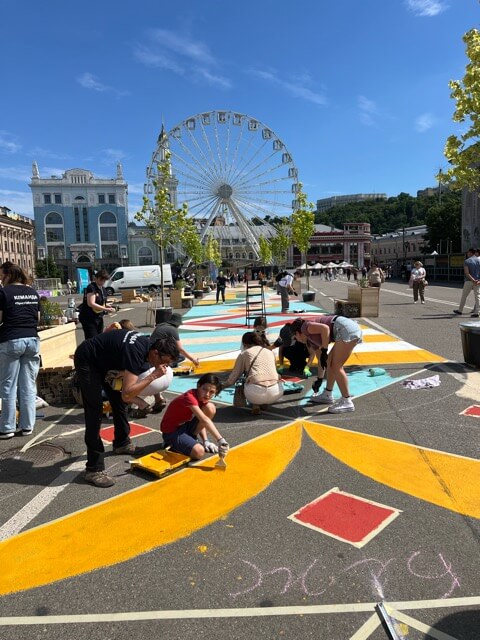 We kept in touch through Facebook and the invitation came a week later. With lots of help from a volunteer who specializes in travel arrangements for drivers, we made the multi-modal trip up to Denmark. Beautiful Denmark.
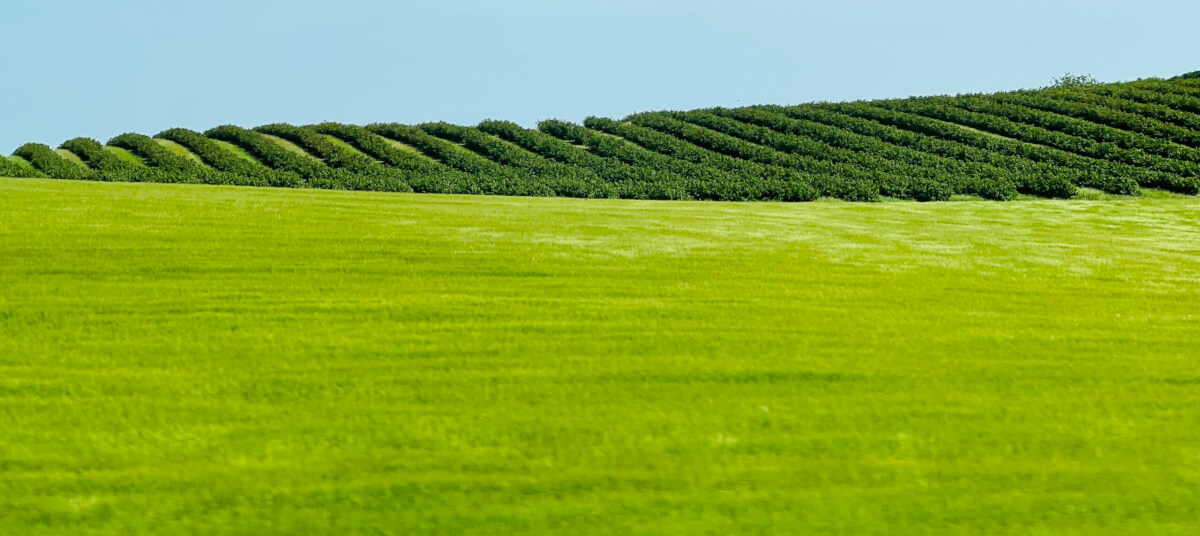
Danish countryside
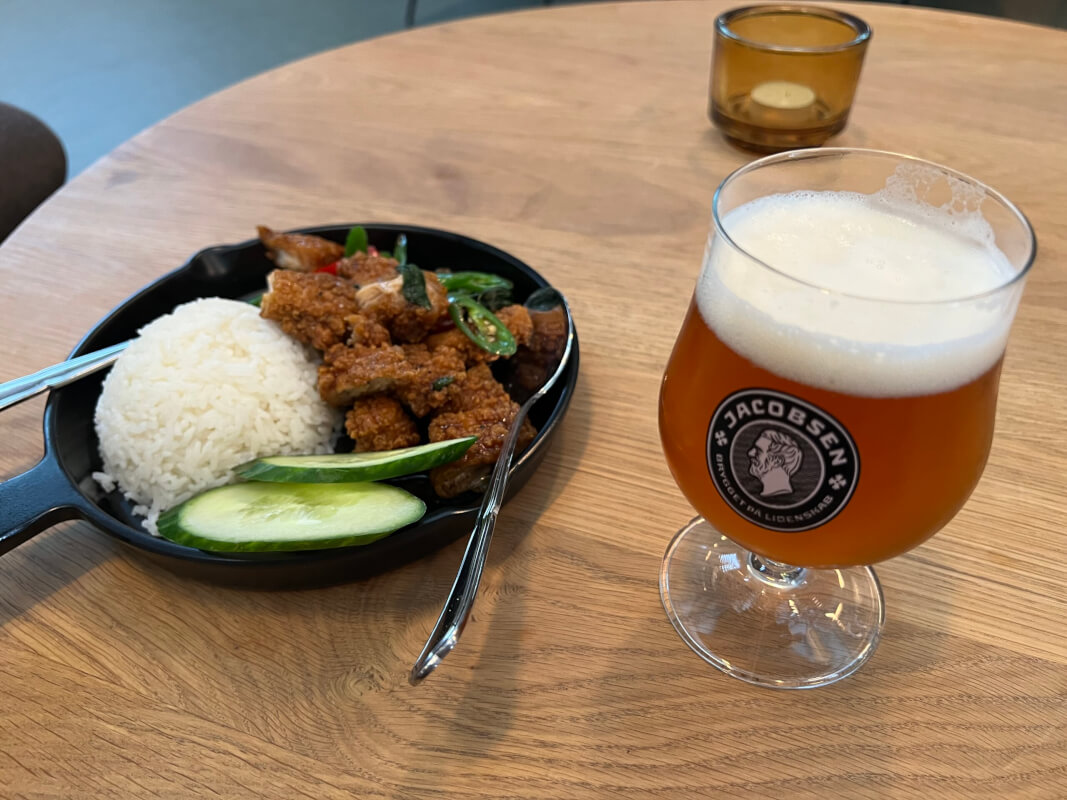
Food!
We took a bus and a ferry to Århus, and the next day, a tram to pick up our vehicle. A Hyundai H1 6 speed diesel with just over 300,000 kilometers on the odometer, whose previous life was in service to a mason. It was still on the lift for an overdue brake job, so we waited an extra two hours for the mechanic, Hassan, to finish.
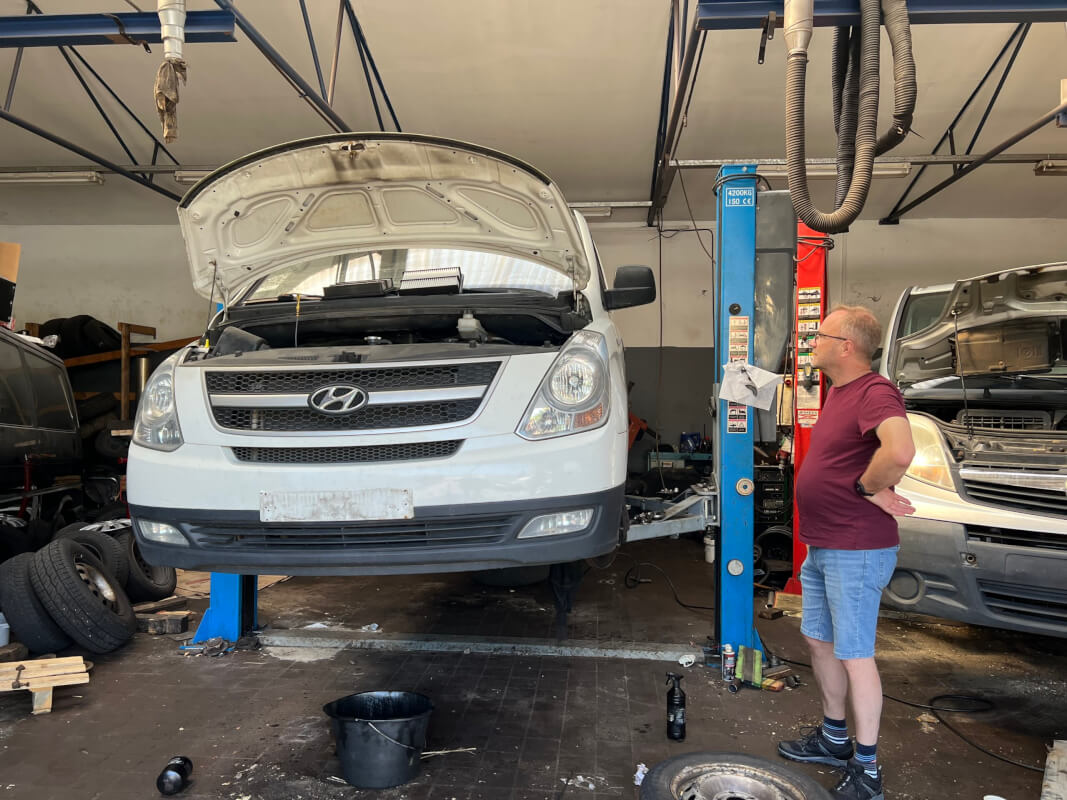
Still on the lift!
The brakes still chuddered, the rear left blinker didn’t work; I smoked the clutch, stalled in a roundabout, and then we were off!
To the Rema warehouse for donated medical supplies. Except by now, it was break time, so we waited. Then, a manager let us in and gave Jesper a quick lesson in driving a forklift.
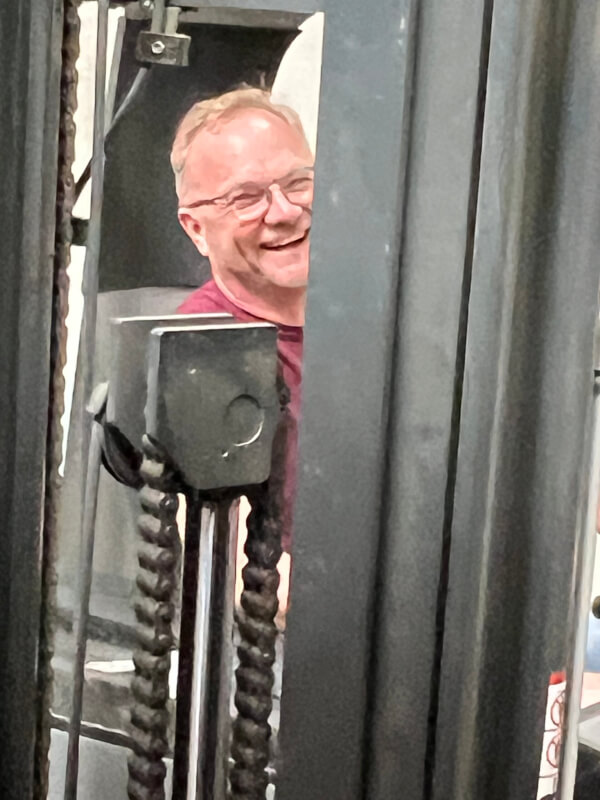
Happy Jesper!
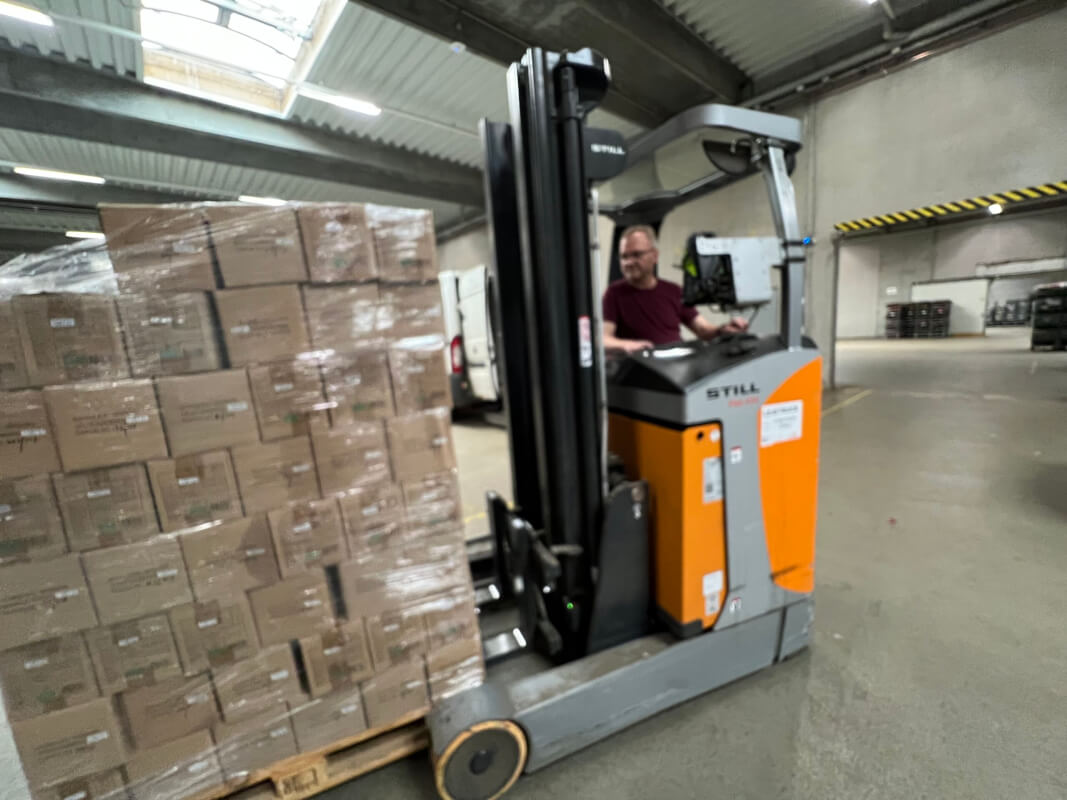
Loading
We’re not even to the start of the trip yet, but Bob and I made our way to the hotel for the night, ate a late dinner and were in bed around 11:00.
After a light breakfast and no flat tire, we were ready to roll at 7:30 the next morning. Our smaller caravan of five cars met up with the Copenhagen contingent north of Berlin. I had been anxious about driving Germany’s autobahns, but it really wasn’t hard. Having a caravan and two way radios helped. I was also concerned about the frequency of WC breaks, but that turned out not to be a problem.
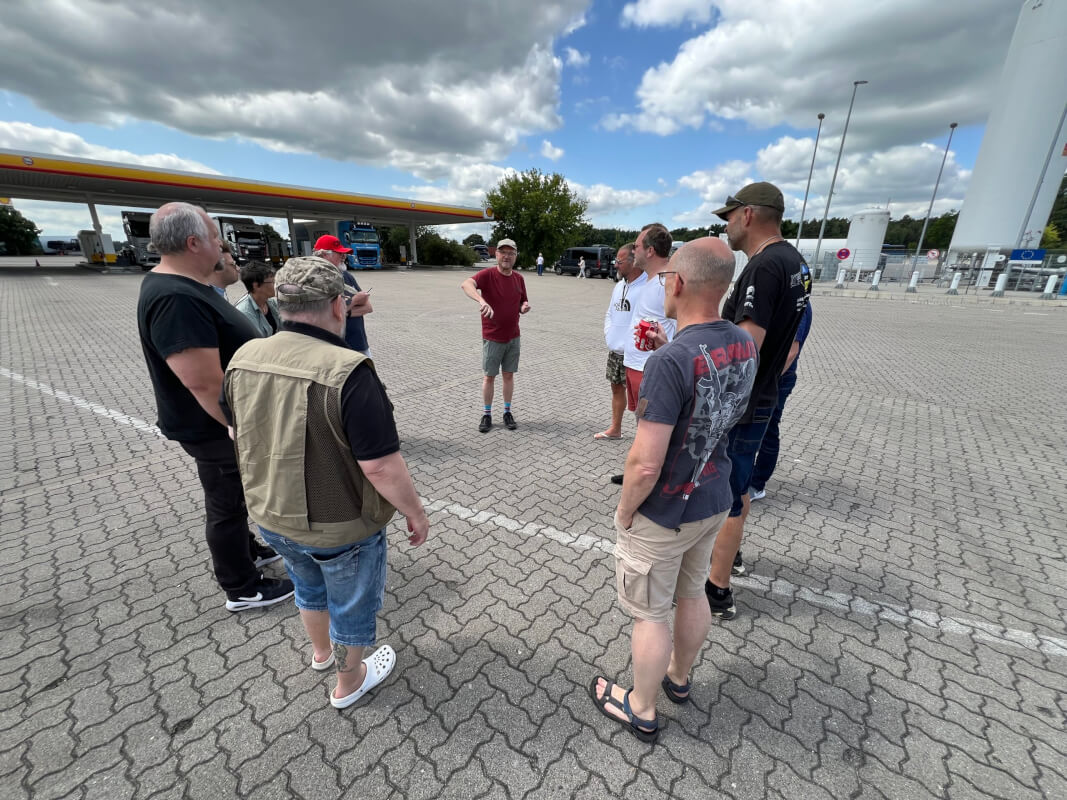
Instructions for the next leg
Our first day of driving was 1341 kilometers, and we arrived at the hotel around 23:00.
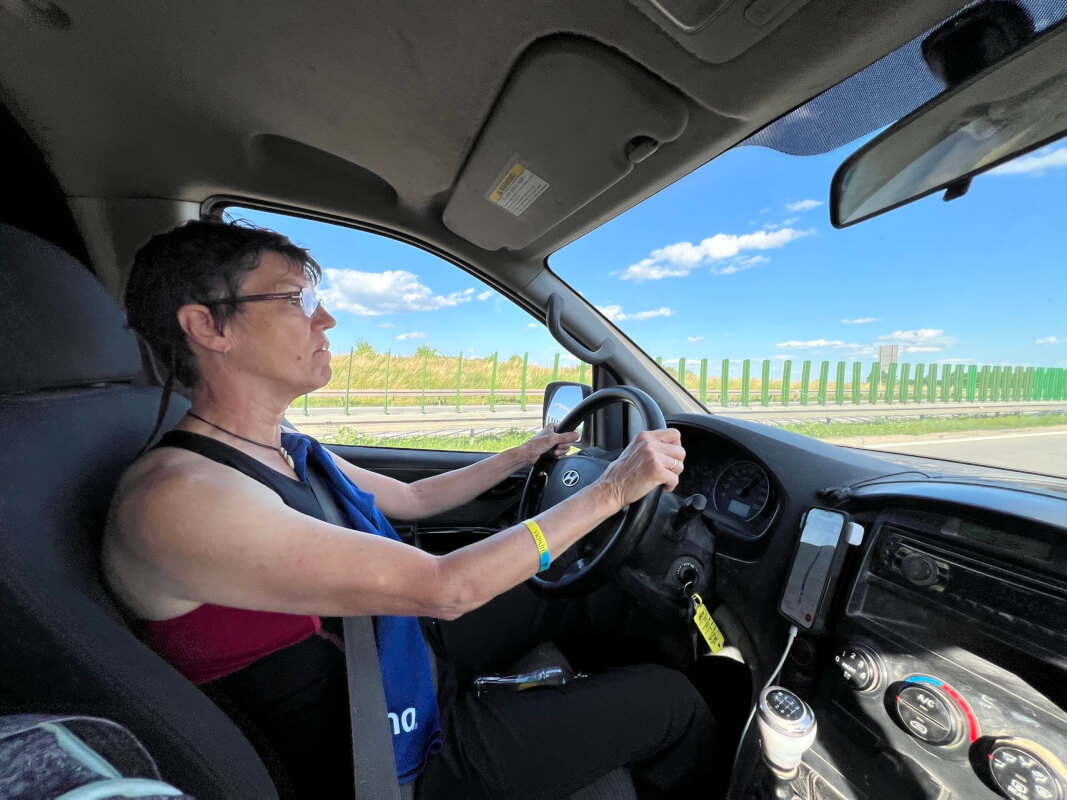
Five hours between breaks!
We’d had no border crossings yet, and importing vehicles to Ukraine involves a lot of paperwork. Jesper handled all of it beautifully and we sailed through to the gathering point, only to wait for one vehicle snagged in bureaucracy. At the fuel station/gathering point, another group from Ireland was also driving donated vehicles. It was really fun to watch the Danes and the Irish comparing notes, exchanging barbs, and finally, trading sports jerseys!
Sadly, the condition of the roads in Ukraine is comparable to some of our roads in Tucson. Yes, really. So I was fairly comfortable with the fast paced slalom through potholes of a backroad. One car took a direct hit, however so our lineup waited on the roadside as Jesper figured out what was wrong. The translation that came down to us was “the motor dropped out” so that’s what we translated to the cute old men and granny’s walking by. Three of our drivers lucked into a horse cart ride while we chatted (through Google translate) with a babushka about her beautiful milk cow. It turned out the truck’s fuel line had come off, so it was another relatively quick fix and we turned back onto the highway.
Driving in Ukraine felt more dangerous with some speeders taking crazy chances and lots of break downs sometimes blocking traffic. Maybe a war zone does that. Driving into Kyiv after dark was the most challenging part of the drive for me, but we made it to a hotel and we were in bed by 11:30. Our drive today was only 650 kilometers and technically eight hours. Glad to have made the trip in two days with no major breakdowns.
Our final day, delivery day, was really special. It started with us meeting the members of E+, whose would be taking the majority of the vehicles to the front lines in the east.
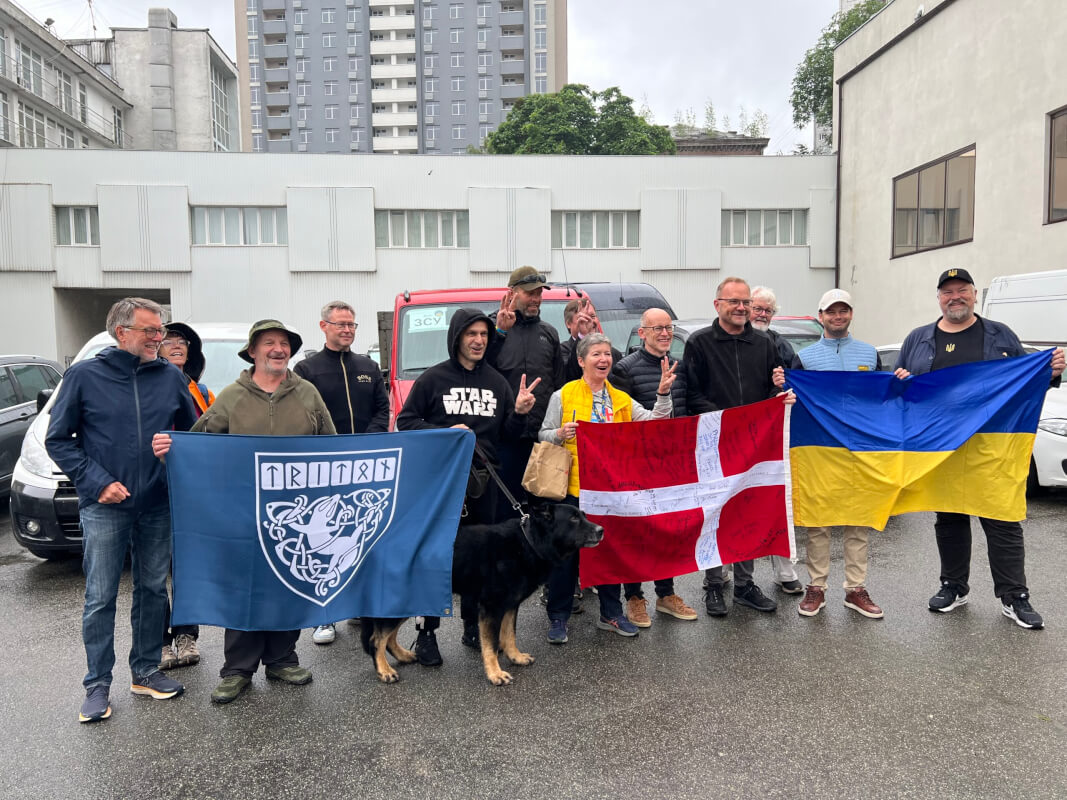
Turning over our vehicles for the next leg to the front
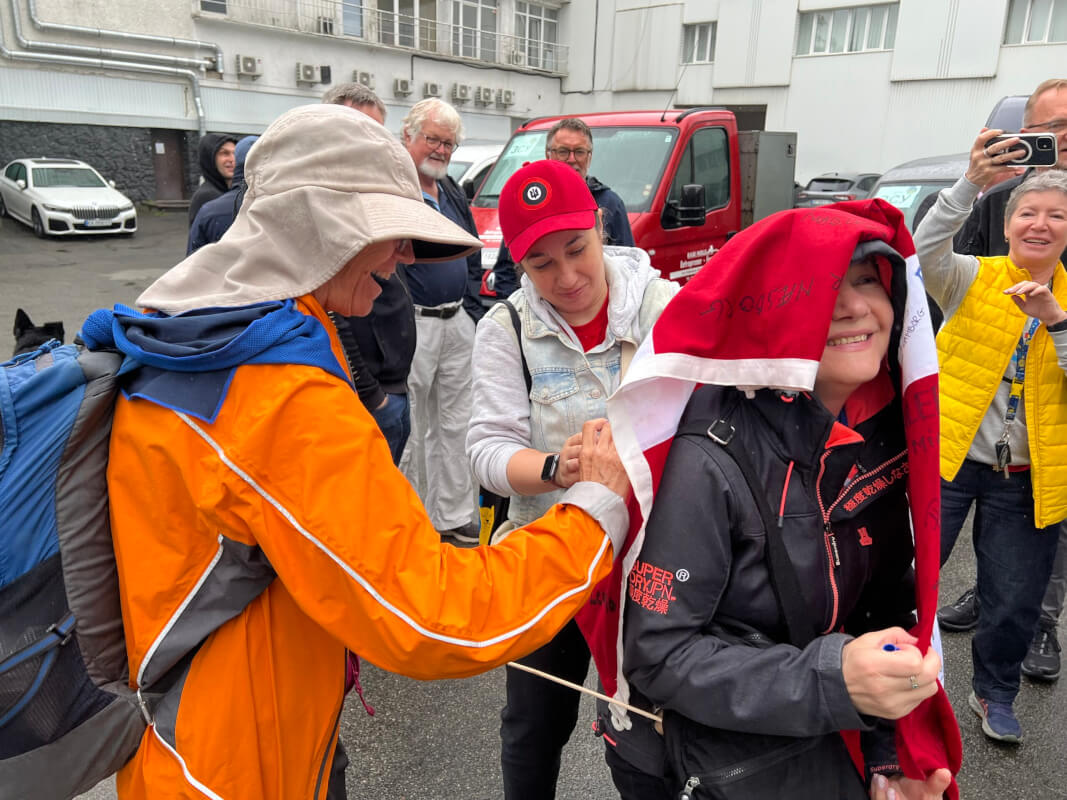
Claire signing the Danish flag
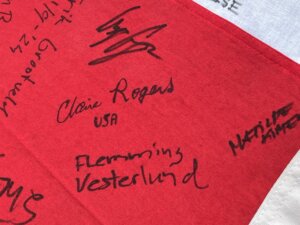
She added USA
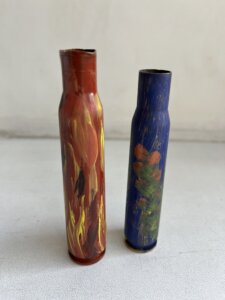
Hand painted artillery shells we won’t be able to keep.
One of the reminders I learned from this is: you have to ask. If you don’t ask, you’ll never get there.
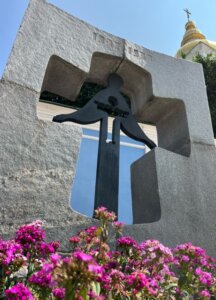
Holodomor
We’ve been doing as much talking as working in the garden here in Kyiv, because Ukrainians, as with many Europeans are bilingual, at minimum. And they love to chat. So we visit with all sorts of people, some eager to keep their history alive by telling their stories.
I’m embarrassed to admit that I didn’t know about the famine of 1932-1933, known here as the Holodomor. Holodomor was a preplanned siege by the Soviet Union to repress efforts by Ukrainian farmers to remain independent from the USSR.
A woman told me this story in the garden. I had to go look it up. What I found on the website of the Holodomor Museum filled in more details.
The history of the oppression of the Ukrainian people goes back to the late 1700’s, when the entire left bank of the Dniper River was colonized by the Muscovites as Little Russia. Ukrainian language and culture was suppressed or banned and Ukraine was Russified.
The Ukrainian People’s Republic was established in 1918. By 1922, Ukraine was incorporated into the USSR, with the agreement that all republics were equal.
The spirit of independence however, remained strong in Ukraine and became problematic for the communists. Anyone resisting the collectivization of small farms in 1928 was targeted. Protests became frequent and the communist rulers used terror and propaganda to try to control the farmers who spoke out against the poor conditions and long hours forced on them in the collectives. According to the Holodomor Museum website, over 4000 mass demonstrations occurred protesting collectivization, taxes, robbery, terror and violence in the early 1930’s.
To subdue Ukraine, Stalin forced a famine by implementing a grain procurement plan with impossible production requirements. When farmers failed to meet production, all the grain and other food stocks were seized, creating a famine. Further crackdowns occurred through blockades of any incoming foods, including aid from the International Red Cross.
In January 1933, Stalin signed an order restricting travel of anyone from the famine ravaged area. The famine was at its peak by June 1933, when 28,000 people were dying every day.
One result of the genocide was that large farms in the east part of Ukraine became available to resettlement by Russians. So when confused people incorrectly say that Ukraine is half Russian, they may not be aware of the full history.
Russian propaganda has continued to assert that the famine was non-existent, and the use of “hunger” as the cause of death of death records was banned. How many died in the famine of 1932-1933 will never be known, but it is estimated in the millions; all while the Soviet regime sat on stockpiles of grain.
So, the reason I never heard of this before is that the Russian propaganda machine was as strong as the Nazi propaganda machine. But the Ukrainians still have their history, their family members who died, and they will continue to tell their story.
The Holodomor Museum offers a media literacy class to high school age students in order to learn how to identify propaganda.
In this war, the Ukrainians will never break. They will not acquiesce. Putin wants territory. Ukrainians are fighting for their lives. You may recall that just before the full scale invasion, Russian soldiers were told they were going into Ukraine to rescue them from a Nazi takeover. They found out that wasn’t true and they’d been lied to. Many lost their lives over a lie.
When you hear people try to justify this invasion of a sovereign nation by suggesting the left bank and eastward is culturally Russian, you can correctly remind them that the Ukrainians living of that land were exterminated and replaced by Russians.
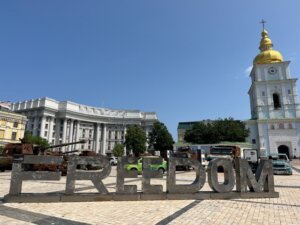
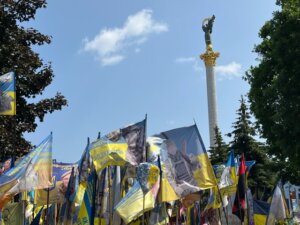
Additional details for this history are from Ukraïner.net.
Bob delivering wood, tools and screws. Another work day. He was rewarded with a big hug by a passing Ukrainian woman. They love that we care to come. We reap the rewards.
IMG_2774

Painting on the square.
A few folks have asked how they can help. You’ll know, trust your instincts AND do some research.
Over last winter, we watched online, as the group we’re currently volunteering with steadily transformed an abandoned and abused space into a beautiful garden. It truly takes years for a garden to come into its own and we’re only here to help affirm to the locals that, yes, there is a future here.

Garden
As I wander around Podil, I’m making a mental tourist map of all the possibilities: a bike route of the murals, drop in art parties at the garden, a bird/wildlife walk through the forest of Artist Alley, a bike ride to car free Trukhanov Island, hang out at the new parklets on Kontraktova Square. These are all beautiful things already, in a future of peace, they will come alive.

Building steps

Planting into planter boxes/picnic tables.
For now, we have found, as in a democratic society, that lots of people are taking their own initiative to make a difference. There are plenty of non-government organizations, all with a different cause. Some flame and finish in a quick effort; others endure. Many work in hopes of ending the reason for their existence.

Contemplating her box
Yesterday on a bike ride, we met Lars, from Switzerland, working here with Dobrobat, a home rebuilding program, for those whose homes have been destroyed in bombings. The day before, we met Kelly, who helped drive a convoy of donated vehicles from Denmark. Basel is here from California, as a student of transformative urban landscape design, volunteering with us at DIY Ukraine.
DIY Ukraine is completing a series of projects to help engage and build community. One thing I’ve heard about Ukrainians is they don’t really recreate, they work. The DIY garden offers the type of physical work that shows immediate results in a therapeutic green space. One never regrets time lost in a garden.

Bob and his compost
The Torv Kyiv project gives some human scale to a large public square, offering color, life, shade and seating so people can slow down, relax, and connect in a space they previously had to just get across.
Bob and I have really enjoyed our commitment here and will be sad to go. The people of Kyiv are truly delightful and seem so happy to have these projects. They deserve a normal life, and someday soon, they’ll have it.
We’ve heard that courage is contagious, and it certainly is. So please, listen to that little voice, use your gift of good judgment, and go out and do that one small thing today.

Grandma sharing her love of gardening

Captain Sunflower recently walked 2000 kilometers from Brussels to Kyiv and planted sunflowers in the community garden. 19,345 Ukrainian children abducted by Russia. #BringKidsBackUA
Here in Kyiv, I picked up a tick while working in the garden. It was well embedded by the time I spotted it and we didn’t succeed in getting all of it out. Some of the mouth parts were still in my skin, so according to protocol I had to get it medically removed. Everyone here was so helpful, from actually taking me to a clinic and translating for me, to offering to drive me for a Lyme test, should I need it. Once again, I came to help, and I’m the one being helped. They were doing One Small Thing. I want to live in a place like this.
Two women sidled through the gate, taking in the garden; Claire, me and Rich deep in gabfest. We welcomed them to their community garden, and introduced ourselves. Rich from New Zealand and we two Americanski. After some small talk, in English, one of them, looking at me asked,
“Why are you in Ukraine?”
I gestured to the garden-in-progress and answered with our message statement for this journey, and held my finger and thumb indicating small, “One small thing, do just one small thing.”
They understood.
One looked at me, “Not so small. That you come is good for our,” she searched for the right word, “psychology.” A nod and smile.
We chatted about how the garden works before they left. They will come back.

Weeding and transplanting
The garden space is an old vacant lot that was used for a dump by the neighbors and worse by the homeless. And little by little, (pomalenko), a place full of broken glass that seemed hopeless is becoming an enchanting, inspiring refuge for people to come in off the street and rest. Here, a community barn-raising effort is called Toloka.

Claire and Rich


Clever picnic table planter

Our first night in Kyiv, sleeping, or trying to, in the hallway of our apartment building because of multiple air raid alerts through the night.

Our view for the night

Our home for three weeks. An historic 1910 with thick walls.
He opened his wallet and showed a picture of his wife, and “his boys.” Pointing to three, killed defending their homeland. “All gone.” He shook his head, eyes glistened. “Tears cannot be shown.” Google doesn’t translate pain well. He can’t let go of the what he has seen. He is unable to cry it out. “I can’t sleep at night.”
Within minutes of when we had met him, he was hugging us. Google translated our love of Ukraine, and appreciation of his sacrifice.

An hour or more, more hugs, an invitation to go mushroom hunting with him, some drinks, a look at our bikes.
I gathered he must have been a lower level leader at the front. What he had seen was written on his ruddy face. He was now reassigned to the border patrol. I think we were looking at the broken soul of PTSD. His eyes were filled with pain and his voice desperate for relief. With Google between us we could offer little more than hugs. Some days that may be enough. He smiled some, even laughed.


Purple Heart of Lviv
We have several reasons why we wanted to visit Ukraine: we have the time and the privilege, we want to show our support, we want to be of service (more on that later). One reason is that we prefer to drop our tourist dollars here rather than anyplace else. Lviv is a nice place to visit. There are a lot of other tourists here: an Australian who came to Lviv for a couple of nights to say he’s been here, an Austrian who hopes to go to Kharkiv to see what is happening. We are going day by day. Bob is fulfilling his goal of bringing a smile to the face of one stranger each day.


Lviv streets
 Claire here: The relief of making it through a border crossing into a new country always makes me a bit high spirited, so the clouds didn’t bother me at all, at first. Then the questions at passport control settled a bit deeper: have you ever been in a war zone before? The armor of all the special preparations I’d made—extra insurance, heavy duty medical supplies, a detailed itinerary—might still not be enough for the weight on the psyche of a population under threat for the last three years. First it was a grandfather holding tightly to a toddler, waiting by the roadside. Where was the loved one that connected these two? Were they coming back? Our years and years of touring and observing gave me a pang of intuition. Later, as I wandered around town, my naive behavior caught the attention of a policeman. I was trying to translate a bulletin board featuring the local PD’s most wanted. It’s his job to spot peculiar behavior.
On my way home, I visited what will likely be the first of many memorials we’ll see, remembering the locals killed in this war. Some were in the military, many were civilians, pictured in candid photographs with nothing darker than what’s next on their schedule reflected in their eyes.
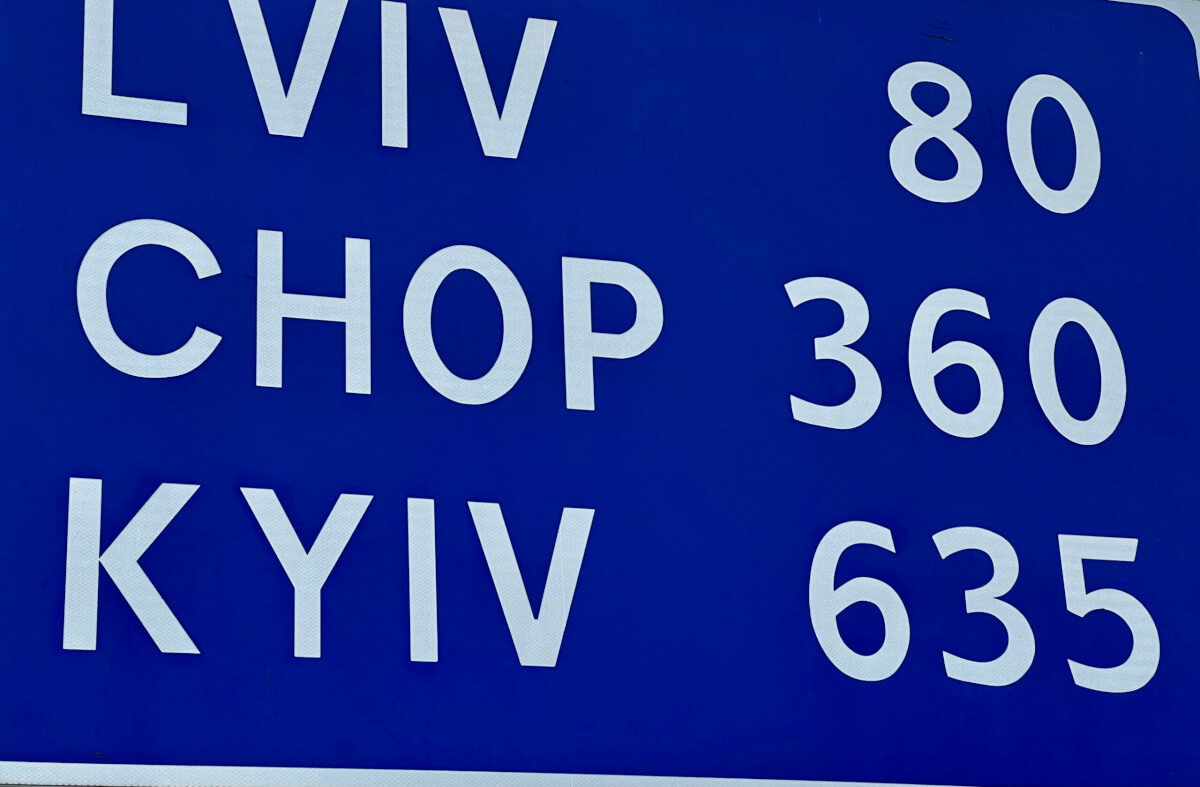
First sign in Ukraine
“You know you are entering a war zone?”
Pause
“On bicycles.”
“Yes.”
“Aren’t you afraid?”
“No.”
Eyebrows up.
“Have you cycled in a war zone before?”
“No. But we cycled two days in the jungles of Laos where the anti-personnel bombies hadn’t been cleared. The odds are
better in Kiev. We’re not going to the front lines. We won’t be a burden.”
We’re here. Why we are here will come later.
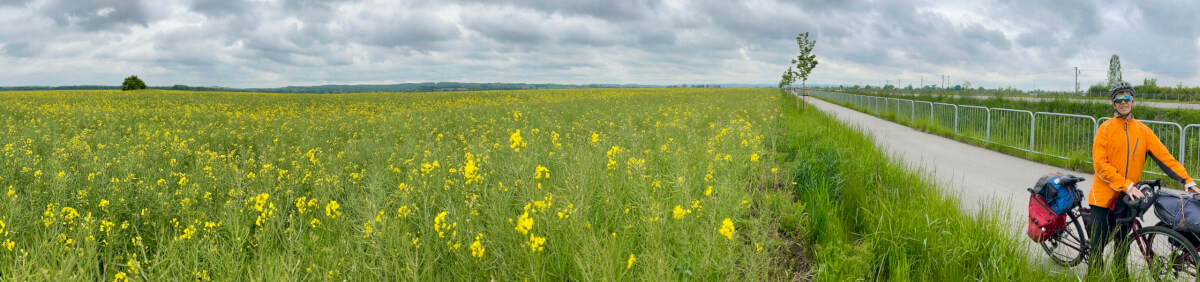
Before the Border in Poland.
He was lying on his back under an overpass, boots set beside him, feet bare. I bicycled past. It was none of my business. He might be offended. Angry. As I rode on I tried to dismiss an unease. A thought. I can’t let this pass. I did a quick U-turn back to him, laid my bike down in the rocks. He stirred and gave me a concerned look which faded to curiosity; I am after all an 80 year-old in funny bicycling clothes, not very threatening.
“Hey, how’s it going?” I said. Dumb.
”Ok. I guess.” He nodded to the direction he’d come, “Long walk today.”
”How are your feet?”
”Hurt. But I can go some more.
”You got water?” “Yeah.” “Food?” “ Uh huh.” I didn’t believe him.
”Money?” He avoided my eyes. “Some.”
I took out my emergency stash, “It’s only twenty.”
He looked at the folded bill in his hand. “I never imagined I would come to this.” He paused. “Two years ago I had lots of money. Lots.” He looked away. “Lost it all.” He tried to shake away the memory.
“Thank you for this,” he said.
“You didn’t ask.” I smiled.
I listened to his story. Not all of it I’m sure. The pain was in his eyes.
“Do you have a place to go tonight?”
“Kolb and Golf Links. I hope I can make it before dark.”
”I’m eighty.” I had his full attention. “I’ve met a lot of people in my travels, business. I can read people.”“You will make it past all this.”
I picked up my bike to leave, “I believe in you.”
His eyes glistened, “I needed that.”
That twenty won’t make much difference, but maybe when the struggle is almost too much, he will remember that one person looked at him, listened to him, and offered encouragement. Hope.
I love where my bicycle takes me!

Thomas and two prized volunteers!
We’ve been enchanted by Thomas Dambo’s trolls since we first set eyes on some of his work in Denmark. How cool it would be to get to help build one of his trolls? When we learned his team would be coming to Victor, Colorado to build a troll, we decided that was close enough.
As an artist, Dambo is living close to his ethos by building art from reusable wood and creating expressive spirits that arise from local space and culture. Every troll has a name, a unique story, a new design challenge, but all are part of a global troll family, all watching out for the little people. Us.
Working with Thomas’ team was an enriching cultural exchange showing once again, that we are more alike than we are different. To find Thomas’ trolls, visit: https://trollmap.com/

Artist at work

Early stage

Hands on!
We enjoyed soaking up the history of Estonia. A strong culture who, with other Baltic people, overcame the oppression of the Soviet Union and now offer an uplifting narrative of how to step into a bright future while honoring an entire generation lost to Siberia. The music is a patriotic favorite, sung at the conclusion of the Estonian Song Festival in honor of The Singing Revolution.


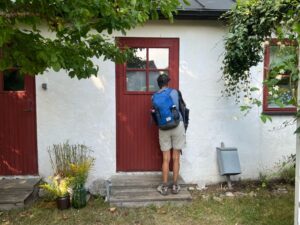

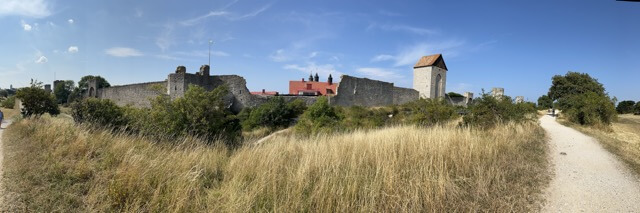

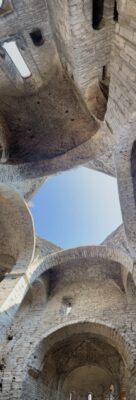


Saguaros we’ve found everywhere. Five continents.

Desert, Saffron cream and wild berries.


Baltic blasted tree


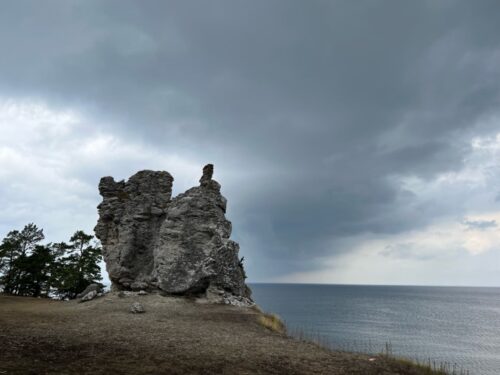



Fixing Soviet Ugly.


Eighteen hours to Sweden. The blankets were found for us by a Polish couple. Sweet.
KClaire on the Eighteen hour ferry to Sweden.Were unable to rent bikes for a week tour so spent it in Gdansk. Maybe more later. Mixed feelings and one very great experience with Poles on the ferry to Sweden.

Old Town. Would like to know more about the Architecture.

Old Town Panorama
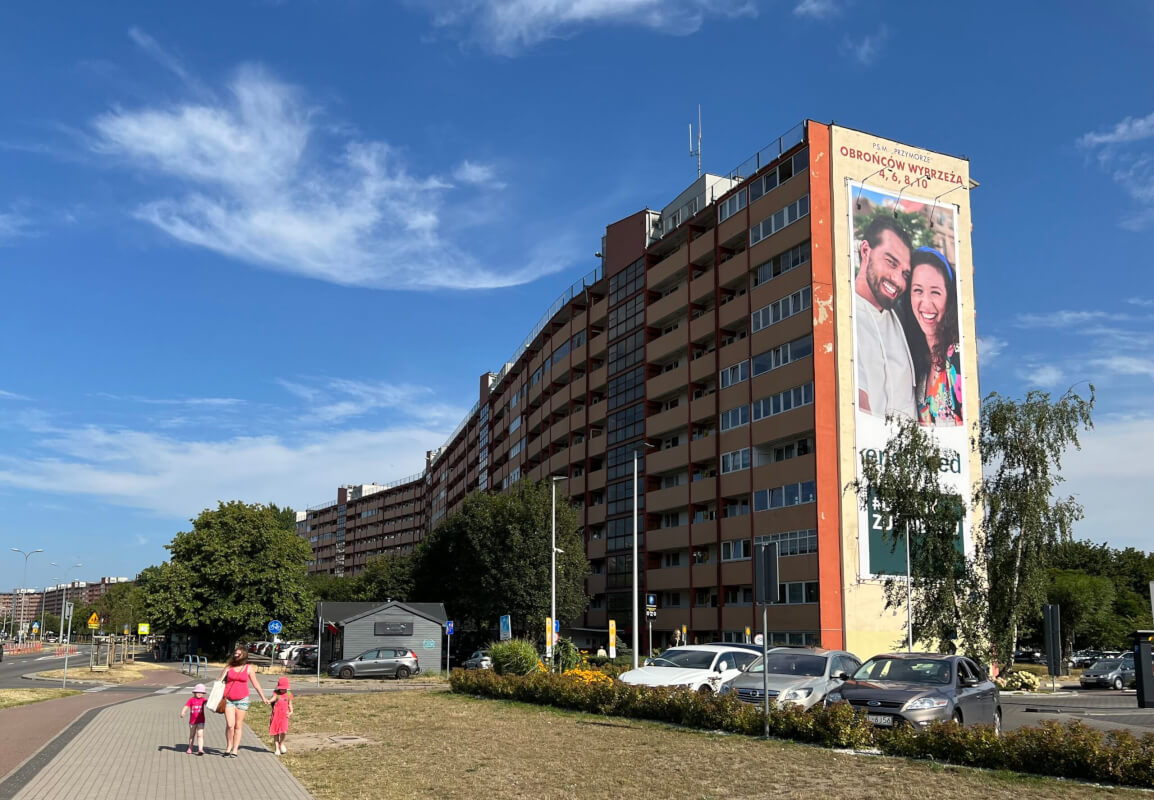
A lot of Soviet apartment blocks, refurbished. Still look Soviet to me, but practical to modernize them. The Soviets used lots of concrete well protected here. In Georgia we found them crumbling.

Better than a selfie!

Half the city was at the beach! The other half were on the metro with us. May have where we got sick; not Covid.


The three previously free states along the Balkin sea freed themselves from the Soviet rule imposed after World War II. They have since enjoyed freedom and increasing prosperity with their own versions of a mix of Capitalism and Socialism. We wanted to see this for ourselves, and what better way than by bicycle, feet and some public transportation, which is generally excellent. The photos were supposed to start in Tallinn, Estonia, the most successful, go south to Riga, Latvia and Vilnius, Lithuania, and countryside between. But WordPress often had its own ideas. This is just an introduction and may be added to later.


Art poster in Lithuania


Srt poster


Wedding in the Square.


Inside of a Soviet submarine.

Yellow Submarine!


Bicycling friends playing

Root Cellar

Fearless Leader

Sculpture garden at a castle


Bicycle museum


African religious figure

Banner across from Russian embassy in Rigia

Claire playing the Ukraine national anthem at the Russian border.

View of Russia on the Balkin sea


Hill of Crosses on the pilgrimage route.


There is no better way to visit the Baltics than through Helsinki, Finland. There are direct flights from the US, avoiding the hell hole of Heathrow. It is reminiscent of Kóbenhavn, but smaller, easy to cover in a couple of days. The transit is wonderful, but even though there are thousands of cheap rental bikes and scooters, the bicycle infrastructure has a ways to go, and you don’t see many cyclists. Part of that may be laid on the easy to use light rail which puts upu within walking distance of most it within walking distance of your destination. Below Is just a taste of an interesting city.

Interesting fountains all over the city



We found some great cool camping in Western Maryland, and the lovely Western Maryland Rail Trail. It parallels the Chesapeake and Ohio Canal Towpath trail, and it is paved.


The C&O Canal

View from our campsite at Rocky Gap State Park
We camped two nights along the Mississippi and were treated with spectacular sunsets without the attendant storms We’re getting accustomed to the humidity, but since we left the Rocky Mountains have been seeking out electrical hookups for air conditioning.

DesMoines River from mid trestle


Claire shrank

Bob


Busy on Father’s Day

Beer Garden on the trail in Slater

Mary and Joni, new trail friends
 Entrepreneurs beside the trail. I picked green beans and corn to sell beside Coal River Road, Tornado, WV
We boondocked on a high ridge overlooking Badlands National Park. Fabulous 360 degree views of badlands cliffs, prairie grasses, sounds of larks and a gentle cooling breeze. Until. Soon after sunset the sudden layered clouds lit up with sheet lightening covering 180 degrees of our view, and the radio screaming thunderstorm warnings with 70 mile per hour gusts and tennis ball! hail. Claire does not like hail. Claire REALLY doesn’t like hail.


Prairie
- Despite some rockin’ and rollin’ and heavy rain, and at least once to head Turtle into the wind, we survived a South Dakota storm for the second time. (Tornado story elsewhere on newbohemians)
The late, after midnight, bedtime and newly chip sealed Badlands NP roads nixed the bike ride we’d planned, and suggested a 4.75 mile loop hike. Beautiful. Its much better to get out of your vehicle, or even a bike and dive into the sounds, smells and strange but gentle beauty of the prairie.

Where is Claire!


Bluebird


- We joined Harvest Hosts, since we were going to be out for several months in the motorhome (Turtle from now on). Harvest Hosts are businesses like wineries and farms, farm stands, that will allow you to park for the night. Most are in beautiful places. Of course you end up buying what they have to sell, so its a win win situation, and often we find we have something in common, like we did with the owner of Bear Butte
 Gardens.

- Michelle
 Our next boondock was at the base of the Bighorns where we rode to the scary sign about how many truckers who had died on the steep descent. That was a good enough top for us. Cold!

Halfway view.


Our first boondock gave us a hint of the Bighorns; beautiful and steep.
Time for bed.

The second day let us know that we came too early. Our goal was to drive to a trailhead for the Medicine Wheel, and then hike in to see it, and take a picture for Martha McCartney who missed it on trip West. Sorry Martha. We tried. A mud hole about a quarter mile stopped Turtle. We backed to the road. The option was a six mile round trip at 9,000 feet with snow and mud. Claire was up for it but I had my doubts. Off we went, Claire far ahead. After a mile I noticed I was catching up to her.
If the snow blower has been stopped , so have we been stopped.

-

Hot spot on Yellowstone Lake

Big game in Powell, WY


Frozen Lewis Lake

Lake Village Lodge
After a couple of days in the Jackson Hole area, biking and boondocking and one brutal road to a Forest Service campground with an amazing view of the Tetons, we turned north to Yellowstone. It was cold, but not nearly as cold as our first visit on our tandem in 1995. A heavy wet snow wet us and our gear. Fortunately Park Service rangers take care of their own, and aa friend of Claire’s took us in while we dried out and the weather improved.
We were just passing through this time, disappointed that Beartooth Pass was still closed with four feet of new snow. We had ridden the pass years before from the south and hoped to repeat from the north. The snow gods did not allow.
Next up a boondock the Bighorn mountains.


- While in Denmark, Claire discovered a Danish artist who creates huge trolls from recycled wood He isn creating them all over the world This one Mama Mi Mi is in the Jackson Hole area. His name is Thomas Dambo. We think there are two more in the US. Follow!


By a favorite Danish artist. We collected seven in Denmark and this is our first in the US. Wilson, Wyoming.


Teton Valley


Summit
I’ve always wanted to ride this four mile pass that is very steep. I shouldn’t have chosen a day with asthma, and 20 years younger. But we needed a boondock spot at the new trailhead and, well, the pass was there taunting me. Miserable. Slow. At a maximum of a bit over 8,000 feet I was breathing worse than the last few kilometers of Kardung La, at 18,380 feet in India, when I was but a sprite of 70. Claire rode circles around me. Still, mission accomplished.
 They like bikes in Germany
Now if this just had a real keyboard.
The quick brown fox jumps over the lazy dog.

Now for Denmark
Since visiting Denmark last year, I’ve told anyone-who-will-listen that you can’t take a bad picture in Denmark. Well, looking back through my photos, I’ve found plenty of questionable merit. Here, I’ve narrowed down my top 100 favorite photos (from about1000). Hope you like them. Guess which was my most favorite!
Gallery
Chalk Art by Claire

This gallery contains 70 photos.


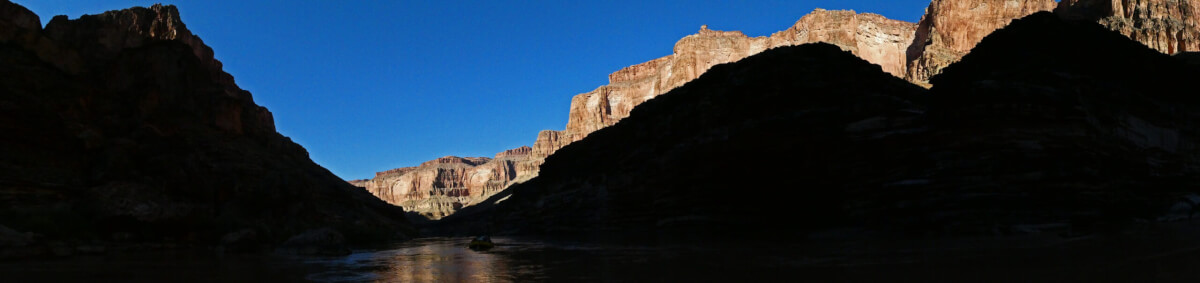


 Going down the Colorado in a dory will remain one of our most treasured memories.


Nearly 25 years ago Claire and I rode our tandem, Zippy on a two month 5,000 k route of British Columbia and the mountains of Alberta. It was the first of three summer tours across Canada. This is the first installment. This is a draft, almost done but not perfect. It’s been sitting around too long.
To our Canadian friends, you will see a few of your country’s warts. I wrote what I saw and what many Canadians chose to share. I’m sure much has changed in 25 years. And as you know America is far from perfect too! But you will also see how much this neighbor loves your country.
You will find the page link directly above this post.

Lizard brain eye candy
How did we get here? I don’t mean just the pandemic, or the great recession we only recently came out of, or the great depression we may be going into. i mean that America doesn’t work anymore. Not in any meaningful way. Not in a sustainable way.
We’re in the middle of a pandemic like mankind hasn’t seen in 100 years, and yet we still can’t get it together to fight this thing. Oh, scientists are working on a vaccine, a year away maybe. They’re working long sleepless nights and thinking always about the goal, the magic bullet. Not so much the rest of us, the populous, the politicians and preachers; we’re at each others throats looking to blame someone, someone else. Some wear masks and wash hands and clean clean clean. Others wave the flag and brandish guns and declare the freedom has been lost, because governments have finally failed them utterly, shuttering their businesses, depriving them of Nascar or reality programing.
How did we get here? Darwin failed us. Well no, not Darwin, but our brains. Our lizard brain has well prepared for for, ah well not much: simple tool and fire making maybe, escaping from the saber tooth tiger, reproducing, gaining protein for our clan. Lording over others. But its singular purpose is acquisition, and it can easily overpower the thinking brain if we let it. Modern Americans are glad to let it do its thing, and it’s damaging our society, and our real economy, perhaps beyond recovery.
First some perspective, some history. Our brains went into overdrive when homo sapiens created agriculture. The thinking part of our brain began to grow, not from physical challenges, but from mental challenges, opportunities. We learned to teach, not just copy, and each generation improved on the last. Then we discovered certain grunts, sounds shaped by our tongues and lips, could be given meaning. Language evolved and it allowed teaching to evolve exponentially. And our brain grew in size and in ability to make inferences across time, to imagine the future and invent tools and systems to shape our environment. Social evolution took over from physical evolution. But we retained our lizard brain. We don’t need it much anymore, but some of us have learned to use it to control and direct others of us. Not so good.
Our lizard brain is the never-enough part of us. Never enough food, never enough sex, never enough spear points or digging sticks. That served us well a million years ago when life was brutal and short. We didn’t live long enough for the acquisitive desire to get us into trouble. Now we do.
Over millennia we became amazingly well suited to science and used it to become by far the most powerful species on the planet. We acquired so much physical wealth, grain, oxen, carts and horses, spears and gunpowder, that we had to invent money to manage the transfer and control of this wealth. All well and good, until some of us began to think only of money, not where it came from, or whose labor, We began to trade in pieces of paper instead of manufactured goods or food. We disassociated well-being with how many, or what, pieces of paper, or things, we own.
We trade the pieces of paper for huge caves, uh houses, with a bath and a half per household member, and two televisions, a robot that listens for our every whim, transfers some of those, now digital, pieces of paper to a warehouse somewhere and our joy arrives the next day. But the new appliance, set of dishes soon lose appeal and are put into storage; pieces of digital paper forgotten.
But they still have a cost. The money has to be replaced with labor, time, life, so we can accumulate more unnecessary objects that we soon forget. Lizard brain. We trade life for things. Sometimes we trade life for big things, like the house big enough for a dozen people, for two, or one. This requires a wonderful thing called debt. Debt allows us to have what the lizard brain desperately wants instantly instead of waiting for the money to be earned. This wonderful new thing, debt, requires an institution or person called a bank or lender to go between the owner of the house to the buyer of the house. For this the bank keeps a not-so-small, though it looks that way to the borrower’s lizard brain that is only thinking how wonderful it will be to live in the new house, portion of the borrowed money. This portion, through the magic of compound interest, can double the cost of the house. But the lizard brain ignores this and overrules the thinking brain. Of course we need our cave, er house, for shelter, but perhaps not one for a dozen. But the lizard brain doesn’t think like that; more is always better.
Back to the pandemic. How are we going to pay for this, who’s going to figure a magic way to wish away the piles of debt we’ve accumulated as a group because no single person can think away the foolishness of easy money. Who is going to buy this debt? You. One way or another. Sooner or later. And you have your own debt load to carry. Is it heavy yet? Do you have enough stuff yet? But I just got a big tax cut you say. I can spend that or use it to get the bank to lend me more. And the big debt. The one we all owe?
With the advent of mass media, and focus groups, and psychological research, all purposed to get your lizard brain to override the thinking brain. Soon the modern economy comes to depend on the lizard brains of millions to stay focused on getting and spending. Consumption is god. In the New Testament Jesus only became angry once. He was angry at the money-changers, the bankers, in the temple. The perviors of debt, preying on the lizard brains of His people. That’s why for many years Christianity did not allow debt. I challenge you to find a modern of the faith who would disallow debt. Times change. Of course we do need the institutions of debt in the modern world. The U.S. need massive amounts of debt to fight WWII, How much government debt, corporate debt and personal debt is reasonable, necessary, good. We don’t seem to be capable of asking that question. We just listen to the lizard brain, and want more.
And politics? A healthy society? Well those are a different story.

Jika Anda adalah seorang penggemar judi bola dan sedang mencari cara untuk bermain taruhan online secara aman, maka Asianbookie adalah pilihan yang sangat tepat. Dalam artikel ini, kita akan mengupas tuntas tentang bagaimana Anda bisa memanfaatkan situs taruhan seperti Asianbookie untuk meraih kemenangan besar tanpa khawatir terjebak dalam masalah keamanan. Mari kita lihat lebih jauh tentang apa itu Asianbookie, cara kerjanya, serta beberapa tips untuk memaksimalkan pengalaman Anda.
Apa Itu Asianbookie?
Asianbookie adalah salah satu situs taruhan online terpopuler yang menawarkan berbagai pilihan taruhan, termasuk judi bola, di berbagai liga internasional. Situs ini dikenal karena menyediakan berbagai jenis taruhan, mulai dari taruhan handicap hingga taruhan langsung selama pertandingan berlangsung. Dengan demikian, para pemain bisa merasakan pengalaman berjudi yang lebih mendalam, dengan berbagai opsi untuk memasang taruhan di berbagai pasar.
Sebagai salah satu asian bookies terbesar, asianbookie prediksi memberi Anda kesempatan untuk memasang taruhan di banyak jenis olahraga. Salah satu fitur yang paling menarik dari situs ini adalah sistem asian bookies handicap, yang memberi peluang bagi pemain dengan berbagai tingkat keahlian untuk tetap bersaing dalam taruhan dengan cara yang lebih adil dan menguntungkan.
Keamanan Bermain di Situs Judi Bola
Ketika bermain judi bola online, salah satu kekhawatiran utama adalah keamanan. Banyak situs judi bola yang tidak dapat dipercaya, yang bisa saja menipu pemain dan merugikan mereka. Namun, Asianbookie hadir dengan sistem keamanan yang sangat ketat untuk memastikan para pemain dapat menikmati pengalaman taruhan yang aman dan terpercaya.
Dengan adanya sistem proteksi yang kuat, Anda tidak perlu khawatir tentang kebocoran data pribadi atau transaksi yang tidak aman. Selain itu, Asianbookie juga memiliki kebijakan yang ketat terhadap penipuan dan kecurangan, sehingga Anda bisa fokus pada taruhan tanpa harus takut kehilangan uang Anda karena masalah keamanan.
Menggunakan Asianbookie Prediksi untuk Meraih Kemenangan
Salah satu keunggulan utama dari asianbookie prediksi adalah kemampuannya memberikan analisis yang mendalam mengenai pertandingan yang akan datang. Dengan memanfaatkan prediksi ini, Anda bisa mendapatkan wawasan lebih mengenai tim mana yang lebih unggul, strategi yang mungkin digunakan, serta faktor-faktor lain yang bisa mempengaruhi jalannya pertandingan.
Meskipun prediksi tidak menjamin kemenangan mutlak, namun dengan menganalisis data dan statistik yang disediakan, Anda bisa membuat keputusan taruhan yang lebih cerdas. Jika Anda seorang pemula, fitur prediksi ini akan sangat membantu dalam memahami bagaimana taruhan bola bekerja dan memudahkan Anda dalam memilih pasar taruhan yang tepat.
Asianbookie All: Platform Terlengkap untuk Taruhan Online
Di asianbookie all, Anda akan menemukan berbagai macam pilihan taruhan yang bisa disesuaikan dengan minat dan keahlian Anda. Apakah Anda tertarik untuk bertaruh pada pertandingan sepak bola internasional, atau mungkin ingin mencoba peruntungan di olahraga lain seperti basket, tenis, atau balap kuda? Semua itu bisa Anda temukan di Asianbookie. Dengan antarmuka yang ramah pengguna, Anda bisa menjelajahi berbagai pilihan taruhan dengan mudah, melakukan deposit, serta menarik kemenangan Anda tanpa hambatan.
Mengapa Memilih Clickbet88 untuk Bermain di Asianbookie?
Salah satu cara terbaik untuk memaksimalkan pengalaman taruhan Anda di Asianbookie adalah dengan bergabung bersama clickbet88. Situs ini telah terbukti menjadi mitra terpercaya bagi para penjudi online, menyediakan akses mudah ke platform taruhan seperti Asianbookie. Dengan menggunakan clickbet88, Anda bisa mengakses berbagai bonus menarik, promosi eksklusif, serta layanan pelanggan yang siap membantu Anda kapan saja.
Selain itu, clickbet88 juga menawarkan sistem pembayaran yang cepat dan aman, memastikan setiap transaksi yang Anda lakukan terjamin dan bebas dari masalah. Dengan berbagai keuntungan ini, tidak ada alasan untuk tidak memilih clickbet88 sebagai pilihan Anda untuk bermain taruhan bola di Asianbookie.
Kesimpulan
Bermain taruhan online bisa sangat menguntungkan jika dilakukan dengan cara yang benar dan aman. Dengan memanfaatkan platform terpercaya seperti Asianbookie dan menggunakan berbagai fitur yang tersedia, Anda bisa meningkatkan peluang kemenangan Anda. Jangan lupa untuk selalu berhati-hati dalam memilih situs judi bola yang tepat dan pastikan Anda bermain dengan bijak.
Apakah Anda sudah siap untuk mencoba keberuntungan Anda di dunia taruhan online? Jika iya, pastikan Anda memilih Asianbookie sebagai situs taruhan pilihan Anda dan nikmati pengalaman bermain yang aman dan menguntungkan!

Americas very best friend in the World is our neighbor to the north, Canada. We don’t always treat her with the respect due the second largest country in the world. Rich in resources and diverse in cultures, she is held in high reguard everywhere, yet too often ignored by the United States.
Beginning in 1997 we bicycled the lower provinces over three summers, a total of 15,000 kilometers, or perhaps I should write kilometres. We got a feel for the imensity of the country, but mostly we experienced the warmth, hospitality, and fun-loving ways of the people.
Someday we will do complete page on our Canada travels, but for now, Happy birthday! We love you.

Eddie McMaster at a firehouse Ceikidh

Cruising through a tunnel of green beside the Main River today, sweating through my shirt, I was drawn to look at my handlebar bag, my hands on the brake hoods; the view shared over the past seven weeks with rivers, …

We’ve looped back to cross the Donau River again from the Inn River, a bit of Austria, and some little visited country in the south of Bavaria. The canal provides us with an interesting way to return to the Main …

Peach, biege, stone, glass and blue and gold. The light of early evening is different in every German village or town.The buildings angled by the cruve of streets inside the medieval wall play with the lowering sun. People on the …

As the dams got higher and the glacial flour turned the Inn River seafoam green, we turned away to the mellow Alpine foothills farms of corn, chard and hops.We didn’t stay on the Inn for long, but were treated to …

A broken tooth (not my first) set us off on a search for an English speaking hopefully, dentist. First searches were two to three days away in Munich and no answer by email. Claire found two within walking distance. The …

Our first day up the Inn River began with a touch of sun, and hope the weather searches were correct in offering scattered showers. Soon the crushed limestone trail plunged into the deep forest of a preserve, and we felt …

A rainy, muddy last day on the Donau. We stopped at a ferry shelter to watch the rain on the brown river. We never did see a Blue Danube. But we did see the clear riffles and white rapids of …

Vohburg is a fascinating small City on the Donau. It was a walled city that has retained the historic wall gates and the central walled castle. The castle walls now hold a contemporary cemetery as well as a church. It …

Bavaria dates to the Roman Empire as this temple to the god Apollo. As we rode along Euro Velo Six in a small village, Claire noticed a small brown sign that directed us to a reconstructed ruin surrounded by residences. …

When we left the Rhine, we climbed small hills into rolling farmland, oats, rye, grapes, soy beans and corn. Later we saw large fields of onions, Swiss chard and carrots, ready for harvest. Often these paths share narrow farm roads …


A stop at the cathedral in Strasbourg turned into an epic effort by Claire to get a room booked for the night with the help of staff at the tourist office in the square.
Then what seemed like 100 turns later, and several stops to take in the sites, and ride around busloads of guided tourists, (How we knew where the important sites were) we got to our hotel. It would be well into the next day before we got back into the wine, and small village country, our goal.
Finally after a morning on a canal bike path, and fields of corn, we could see grapes on the slopes ahead.

First however, Claire and Ms. 100 Percent (phone GPS) took us on a little cross country excursion to our guest house in Dambach de Ville.
After settling we went out for a little wine tasting, and came home with a nice Gewurztraminer, bread and goat cheese. After dinner we took an evening walk around the village.


 A stop at the cathedral in Strasbourg turned into an epic effort by Claire to get a room booked for the night with the help of staff at the tourist office in the square.Then what seemed like 100 turns later, and several stops to take in the sites, and ride around busloads of guided tourists, (How we knew where the important sites were) we got to our hotel. It would be well into the next day before we got back into the wine, and small village country, our goal.Finally after a morning on a canal bike path, and fields of corn, we could see grapes on the slopes ahead.First however, Claire and Ms. 100 Percent (phone GPS) took us on a little cross country excursion to our guest house in Dambach de Ville.After settling we went out for a little wine tasting, and came home with a nice Gewurztraminer, bread and goat cheese. After dinner we took an evening walk around the village.

We continued to follow the Euro Velo rout system, and local bicycle trails. These follow canals for the most part, and in rural areas with small villages every five to fifteen kilometers. By watching several boats go through the locks, …
We rode up a ridiculously steep cobblestone street in the lovely village Saarsburg, Germany. We found a cafe overlooking the waterfall that bisects the village. It was early for lunch, but what the heck. We couldn’t resist two of these …

Pruning season on the steep slate banks of the Mosel. Street in the neighborhood. A Reisling and a pino noir rose. Guess who? He was born on the Mosel, and was inspired by the plight of the vinyard workers. Understood, …

Photo of a day in Cochen.

We are still learning how to post from our phones. We’ll get it! …

Beginning our ride up the Moselle River. One good wine so far.
I’d just left a medical appointment when I saw a young woman pushing a stroller in the rain. She was near a bus stop, but something made me stop. Maybe it was her bright African dress setting off, her lovely deep black skin, or the cute toddler she pushed, or my memories of Africa. I rolled down the window, “Do you have far to go?”
She quickly handed me a piece of wet paper with the name of a clinic and a simple map. It was five miles away, with a bus change. “Have go here. Have boy there 8:45.” It was 8:40.
“I’ll take you.” We loaded the stroller in the tiny back space of our Geo Trakker. I called the office to tell them she would be late for the appointment, put it on speaker so she could say her name, and they assured her she could be late.
During the drive we talked. Her English was quite good. She is a refugee from South Sudan, via a camp in Kenya.
I said, “Welcome to America. I am happy you are here.”
“You are very kind,” she said.
“I’m an American,” I said.
I’m old enough to enjoy looking at young women without guilt, and she was the most beautiful I’ve seen in a very long time. Her son was cute, animated and had curious bright eyes. My rainy day turned sunny.
“God bless you,” she said, ” He will reward you.”
I don’t believe in a god who protects or punishes, but I will treasure that blessing for a very long time.
The problem, as I see it, with love-of-lawn is that it damages the environment and wastes resources, including the mower’s precious life. How about spending that 70 hours with your children, your spouse, volunteerism, gardening for food, cooking for health, fishing, golf, or aerobic exercise (mowing is not)?

One of the best things about traveling the way we do is meeting new people, some who unselfishly help us, others fellow travelers who understand our passion. Some pass out of memory with time and distance, some change, as we do, and slowly drift away. And there are those who linger in our memories, and hearts, for many years.
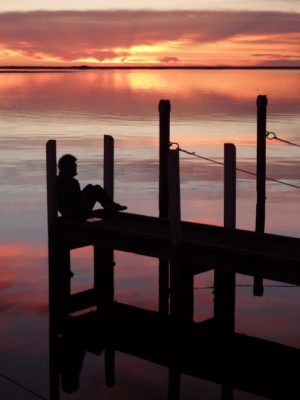
I am several posts behind, but will catch up soon. When this is published we will be somewhere over the Pacific, after an adventurous and sublime three months crossing half of the red center outback by bicycle, and from Indian Ocean to Pacific by vehicle. The photo Claire saying goodbye at one of our favorite seaside camps. This is our third goodbye to Australia. Will we come again?

Claire has a magazine assignment to write about Australian working dogs, and that brought us to the Old Sniff Classic sheepdog trials at Dean, Victoria. That is the reason we were there, but the most memorable story for me was …

After weeks of wind and rain in South Australia and Victoria, we finally got a beautiful, if cool, day in the delightful Mallacoota coastal town and Croajingolong National Park. Much of the trail was along cliffs above beaches, surf and …

Gusty winds began to batter our little van as we turned from the Nullarbor south on the Ayer Peninsula. Our plans to find a bush camp near the Southern Ocean were forgotten as the gusts increased to gale force, according …

Sixteen years ago we rode our tandem, Zippy, pulling a B.O.B. trailer, right-the-way-’round Australia, around 19,000 kilometers. By the time we reached Perth and beyond in Western Australia, we had perfected our outback riding and bush camping technique and …

Our first reason for coming to Australia was to bicycle The Great Central road, Australia’s longest. At over 1000 miles of outback Australia with up to five days of riding between minimal services, it was right up our alley: requiring …

September 16, Laverton, WA: Finished The Great Central Road (and some add on) 1834 kilometers, something over 1,000 miles, not sure how much, most of it sand and rock. Twenty-three wonderful bush camps. We’re knackered, Don’t let this first section …

Warburton to Tjukayirla (chuke a lara) From Waraburton We still have a couple of weeks on dirt and we have been on the road for a month. We do take rest days, four at Ayers Rock, but it is just …

The Aboriginals we encounter are a bit shy, but friendly enough, waving vigorously through broken rear windows when they pass us on the road; big laughs and a cloud of dust.
Photos of events and places on the Great Central Road in australia

Claire: Big Weather When we realized we would get to Docker River just as the store was closing on Saturday, and that we’d have to stay an extra day to wait for opening on Monday, we decided to take our …

Yulara to Docker River On our last bit of bitumen before The Great Central proper, we realized that at by the time we reached Kata Tjuta (The Olgas) late in the day, the few overlanders and locals would be long …
so we soldier on, making our own decisions, hauling our own stuff, and alternating suffering with the elation of being free in one of the world’s great places. Ah, decisions.

Bob: We left Glen Helen Homestead loaded with three days of water and food. The bitumen soon faded into the distance behind us, and we began what would be an unexpectedly horrible road. Good thing Claire found a nice Aussie …

By late afternoon we were knackered and found a quiet acceptable spot for bush camp, built a quick little fire and put our first billy to boil, set up the tent and were chowing down on beans, tinned chicken and raw yam and two cups of tea laden with sugar and milk powder.

Australia 2016 As soon as we left the airplane in Alice (August 4, our 26th anniversary) Claire asked, “Do you know which way is north?” It was mid-day, and I pointed at the sun. Yup. So far we haven’t felt …

We rode The Great Central Road dirt track (one of Australia’s longest) across The Great Victoria Desert in the direction of Perth. 1600 kilometers of dirt with very little in the way of services, food or water. We had five weeks of outback cycling and camping adventure, followed by a tiny van road trip from the Indian Ocean to the Pacific Ocean revisiting old haunts, and both new and old friends.
Several years ago our friend, and inventor, Ed Rios made a prototype drag parachute for tandem use. His stoker, Jane, wisely refused to participate in the test, and of course we volunteered. Stoker Claire wore and deployed the chute which, after a bit of a jerk on deployment, worked to bring our speed to reasonable levels on a descent of Mt. Lemmon just outside of Tucson, Arizona. We loved it! It would need to be bigger for touring less smooth roads, but for day rides, perfect. Ed, how about making it double as a tent fly/tarp?
I’m republishing this video from 2009 from our In Search of Shangrila journey. Public discourse about economics, and Capitalism in particular, is distorted by a lack of depth about just what constitutes both. By removing politics, and expanding the conversation to include the people who do the real work of the World’s economic production, we expand our understanding of just how much we share.
[httpv://youtu.be/dKokmEgIKSE]
The Wall Street Banker creates wealth with Ones and Zeros on a computer, the vendor at this market in Kampong Chong, Cambodia, creates wealth with sweat and skill. Both seek the same thing, a better life for themselves and their families. Is one superior? Who is happier? Is the pursuit of happiness worthy of being included, and measured, in the world of economics? After traveling 43,000 plus miles around the World at 12 miles per hour on a bicycle, I think it is a worthy goal. Maybe we might just find the vendor is Kampong Chong is just as fulfilled, happy, as the Wall Street Banker. If so how would that change our economic policies?
What do you think?
Ken Steinhoff and I worked as photojournalists at the Athens Messenger in the late 1960’s. He stayed in the newspaper business, but got bumped up to a desk jockey job, I went on to other things. In retirement Ken went back to what he loves most, telling stories about people, places and history. He posts most of these at http://www.capecentralhigh.com/ We recently got together in Athens and spent a day driving around Southeast Ohio, trying to remember sites of some of our old stories, and catching up. Ken’s new van interior resembles the Volkswagen Squareback he wore out on those same roads. The only difference is it’s fitted with the latest in digital equipment instead of short wave and scanners and the best digital cameras. Oh, and there is more of the driver, and he has less hair than I remember. I’ve aged my share too. Ken has projects planned to keep him busy for the next forty-five years. I hope the road warrior has as many years as he needs. He does really good work. Check out that site.
When visiting Monticello most visitors crowd together tightly, with twenty others, for a view of the main floor of the house and call it good. We of course spent most of our time in the gardens. We had our own personal guide and had an audience with the chief gardener, who answered the few questions our guide was unable to answer. We had no schedule, no groups awaited our departure, and we had the space to absorb all that we’d learned about the creative, scientific garden experiments of perhaps our favorite Founding Father.
If you visit Monticello, do take the house tour, but leave a couple of hours for the orchards and gardens. They give as much insight into the mind of Thomas Jefferson as his eclectic approach to architecture. The man who wrote our Declaration of Independence was a scientific thinker, and that should tell us something about how we should guide the future of the Republic.
Ride our tandem with us over the highest road pass in the world (18,380 feet) from South Asia into Central Asia. Pedal thirteen days across The Great Himalaya Range (passes to 17,558 feet) from exotic Tibetan Ladakh in the far north. Take a train to far south India and then bicycle with us from the Arabian Sea on the west to the Bay of Bengal on the east. Stories, photos, videos and music.
We hope you have enjoyed reading the reports of our progress and adventure on our India trip during 2014. All of our original blog articles are now organized in sequence as a complete web series on our adventure.
Immersing ourselves in our Chennai neighborhood has been made more interesting by the onset of the Northeast Monsoon. We dodged the main monsoon in the far north and the west of India, well most of it, but didn’t even know there was a monsoon on the east side. It started with a cyclone, which missed us, but the rains have come hard, making walking the muddy, cow shit and trash strewn streets a bit of a challenge.
People here take it in stride, they have to, they know the drill, keep to the less dirty narrow pavement as much as buses, trucks, cars and motos allow, wade the mud and poop when you have to, rinse your sandaled feet in the least muddy water you find, carry an umbrella at all times; it’s a hard rain that falls brother.
Claire’s Walk in Chennai
We followed blogs of many independent travelers in India, cyclists and non, and many of them cut their trips short because of the intensity of the experience: crowds everywhere, no personal space, gastric illnesses, noise and filth. Some very experienced travelers have not been able to take it, and left early. There were times that tested our resolve, or reason for being here, but as is often the case, when one of us is down, the other bucks them up and we soldier on until we feel comfortable.
Mostly we avoided large cities in favor of villages and agricultural districts. But now we are embracing the Indian urban experience of huge Chennai with some measure of enthusiasm, enjoying the cacophony of street noise, the color and relaxed intensity (yes, I meant those words to go together) of the people. We’re even used to getting ripped off (rarely) because each instance is made up for by a dozen smiles and small gestures of welcome. Even cow shit between the toes doesn’t bother us anymore.
We fly home soon, and are ready after three months, but we’re enjoying opening our senses and memories to an India we’ll most likely never see again. But as with all of our adventures, we come home with an overflowing storehouse of memories.
We got here a few days early, finished packing Zippy for the flight home, and are now “enjoying” a real Indian city, Chennai. It is seven million people and not very well organized.
We’re in an area called Pallavaram, a mix of mostly low end hotels, open markets, mixed businesses, a few beggars, wandering shitting cows, mostly mud streets (the monsoon just hit) and the constant noise of all manner of vehicle horns, and a few bicycle bells.
More to come here later. Here is a sample of a reasonably orderly scene just as school let out.
 The longer we’re here the less we understand.
When looking up the history of a nearby temple, I was directed to the specific references from the Ramayana related to this site. Rather than when the temple was built and how, this history is how it fits into the Hindu creation story.
When life is seen as cyclical, eternal, what is history?


 “India, the new myth–a collective fiction in which anything was possible, a fable rivalled only by the two other mighty fantasies: money and God.” – from Midnight’s Children, by Salman Rushdie.
As I read, I always look for the sentence that seems to encapsulate the premise of an entire book, and this sentence did it for me. Rushdie loves to mix metaphors, but so far he hasn’t compared describing India to nailing Jell-O to a wall.

The colors of India are beautiful; splatters of yellow pigment splash our door. Three white stripes with a red dot are smeared on cars, trucks, elevators and windows; nearly every place the eye comes to rest. The entryway of most homes and businesses are decorated with white and colored chalk rangolis. After awhile the colors meld into a background brown and a new design is drawn.

We’ve come into the densely templed region of the ancient Chola empire, and a part of India that is devout and fervent in their beliefs. Most temples are brightly painted, a few are dilapidated with vines growing through them. Some appear to be newer temples built over the foundations of old ones.

The people have been gracious, if enigmatic. Not just the indecipherable head wag, but many other gestures, exclamations and attempts at questions continue to mystify us. Though we understand so little, we continue to strive and hope we can at least promote good will. As my Dad says,
“A smile is understood in every language.”
Claire: This is India: anything, any day. One day it may be a strike, the next it may be a holiday. Every day, we’re clueless as to why the shops, restaurants, and banks are closed today. On our way up into the Western Ghats, we were enjoying fairly quiet riding with no buses to contend with and a few motos full of boisterous young men. Stopping at a touristy roadside, we wondered why all the stalls were closed. “Stick,” someone said. “Band.” Finally, I recognized “bandh”, the Hindi word for strike. (Probably the first word anyone considering traveling to India should learn.)When we checked into our hotel, we could only order room service, and fried rice was all that was available.
This is India, just roll with it, everyone else does. We later learned the strike had something to do with corruption.
 There is so much we don’t understand, here, sometimes life seems much harder than it needs to be. We met a father who was very motivated to speak to us. Very politely, he asked in stilted English, if he could speak with us. Then instead, he pulled out a letter written by his wife in pretty good English. The letter explained that their nine-year old son was hearing impaired and had a cochlear implant. It was a heartening thing to read how the boy had come out of his shell because of it. But then a wire broke and the part is no longer available. Now, the boy will need a replacement/upgrade. We thought the father was asking for money, and though it was only a fraction of what he would need, we were ready to hand some over when he said, “No, no, foundation.” We got the impression he hoped we might know of some aid organization that could fund the $6,000 surgery. We said we would try, and then he shared some coconut, cumin rice dumplings with us. Luckily for us, and for Joseph, we heard a quick response from Beth Alberto and Mickie Burrows. They’re already in action!
The Cardamom Hills, maximum road elevation of 6,000 ft, though still warm, were blissfully cooler than the lowlands. The tea and coffee plantations were very scenic, accentuated with blooming flame trees and bright red poinsettias lining the road. In Munnar, we inquired about heading toward Tamil Nadu and were told we didn’t want to go there. Violence and bus burnings because of a protest against the jailing of Tamil Nadu’s chief minister Jayalalithaa for having assets disproportionate to her income (presumed corruption.) The interpretation we heard indicated that she is well liked because of subsidies to food and water.
Within a week, all of India is celebrating Gandhi Jayanti, Gandhi’s Birthday on October 2, as an International Day of Non-Violence. Whew, that’s a relief.
So, we’re in Tamil Nadu, approaching the Kaveri River, and we haven’t seen any violence yet. The descent down off the mountains was a beautiful, quiet road through a wildlife sanctuary and tiger preserve. We saw no tigers or elephants, but some impressive elephant poop; it was nice to hear so many jungle birds and a see a couple of nice waterfalls.
Along the agricultural flats, we cruise at a clip quick enough to keep a steady breeze going…and an energizing flow of cheerful waves and enthusiastic exclamations. When we spotted a cricket game in practice, it was too much to resist. We steered up to the edge. Bob said he only wanted to sneak some pictures of the game, but I knew better. As soon as the boys spotted Zippy, the game took a break and we were soon surrounded:
Bob here: I should have known I wouldn’t get to watch a Cricket game; Zippy is a male magnet, particularly young boys. They ran at us yelling who-know’s-what in Tamil and circled us waving Cricket bats and smiling. Claire manged to communicate how much I liked the game of Cricket. (It’s the only English on TV here, and I DO love the complex game), and they invited me to give it a shot. I had never held a cricket bat, and had to feel the ball (smaller and softer than a baseball) before giving it a go. The oldest looking boy was the bowler, and was kind to me with slow deliveries; I still missed two before connecting and being caught out. I finally could connect and hit a boundary, good for four runs in a game. Of course the boundary was set for twelve-year-old boys. Fair enough I guess, for a 70-year-old man.
After the match we tried to answer questions about Zippy, where we are from (everybody knows USA and America) and where we came from in India. Claire handed out Bens Bells “Be Kind” stickers (a Tucson non-profit), and I gave the bowler and the teacher the last of my business cards, just in case they had access to internet (doubtful).
Of course all of this transpired without any common language, just a common love of bicycles and Cricket. What more do I need to have fun half a world away from home?

The Western Ghats are behind us, and in a few days we’ll have crossed the southern part of the Indian subcontinent (no big deal), and spend some time on the Bay of Bengal.
We’re adapting to the heat by riding early, and Claire has developed a great talent for finding us air conditioning every day since we left the mountains. We’re getting soft, winding down.
As we rode in the cool morning shade of a narrow coastal road north of Alleppey, I was reminded of our riding the narrow lanes of the Mekong Delta during our Shangri La trip. This time we were riding along the Arabian Sea coast of Kerala, India.
The clean brightly painted houses, set back among lush coconut trees and tropical flowers, flashed past between glimpses of open ocean. Girls and boys in school uniforms, smiled in surprise as passed them on our long bike. Women swept the sand in front of their houses bent over with the traditional short broom while men gathered at tea stands, or began the work day, mostly building new houses.
Half way through our morning we decided on a short detour to the harbour (how it is spelled here). We were so glad we did. The “harbour” was a beach, a beach with just the right slope, and probably protected by an offshore sandbar, where local fishermen were landing their long open boats, stern first, after a long night of fishing. Locals gathered to help land the boats, impromptu auctions of squid dotted the beach sand, and particularly successful boats shared with the poor.
There was color everywhere, in the sea, the sky, the competitively painted boats, women’s kurta (overdress), men’s lunghi (bottoms), and the silvery shine of fish scales. Life. Life here in India is people, everywhere, many people, interacting in ways often undecipherable to us. As the heat of the day descends on two sweating farangs, we ride away, energized.

Zippy vs. Ta Ta Taxi
A few kilometers on we combined a bush break with watching what here are called, Chinese fishing nets, rise and fall in a narrow backwater, pausing briefly, in hopes of lifting a passing school of fish.
A stop for a cold drink led to a comparison of Zippy’s length with a Ta Ta taxi. Zippy’s wheelbase is definitely longer. We “talked” vehicles while downing a liter of cold fizzy drink and then rolled on to find an old growth marigold and more fishing boats.
We added a new body of water to our list. India bicycle touring on a very good day.
“This is grim,” I thought. We were taking shelter from the steady rain under a roadside lean-to tarp shelter and I had just added my last precious few layers of clothing, save one. Bob had nothing left to put on.
Just to come upon this shelter was a fortunate turn. “Bicycles?” As we climbed around another switchback, I saw ahead what appeared to be touring bikes, one laying in the rain, the other parked under the shelter our current refuge. According to these other tourists, we were a kilometer and a half from Rohtang La, or Dead Body Pass.

I’d had a bad feeling about this pass anyway and the weather had turned much worse than we’d hoped. Forecasts indicated showers with minor amounts of accumulation. We stood just out of reach of the gusty rain, dripping puddles and watching the fog banks blow over the pass above us.
Then we heard a rhythmic whistling coming up the slope behind us. It wasn’t a bird, was it an animal? Soon, our shelter was surrounded by goats and sheep, led by a whistling shepherd wearing only a soggy, woolen shawl against the weather. A few working dogs and other shepherds brought up the stragglers, one sheep hobbling on a bandaged leg. This is one of the same herds we saw down in the village of Koksar; they’d paced us up the mountain, going up straight-line, cutting through the long, sweeping switchbacks we were making. We would see them again, in even less pleasant circumstances.
Out of curiosity, I ducked through the flapping door of the small tent that the other cyclists had disappeared into. It was roomier and warmer than it looked from the outside and I finally encouraged Bob to park Zippy and come inside. The familiar, acrid fumes of the unvented kerosene stove burned our eyes and lungs, but at least here we could get warm before charging out again. The two other cyclists, Indians from Pune, made space for us among the crowded benches, their feet wrapped in bread bags; I remember we used to use bread bags too, before we chose to stop riding in rainy places.
The yellow tarp, fully enclosed, with no windows to see out, sucked in and billowed out as the wind blustered around outside. I watched the rope-joined, post frame shake and wondered if it would hold. So amazing to me that such a paltry little place could offer so much relative comfort.
In between bits of conversation, we listened to the rain, hoping to hear evidence of some easing. Instead we ordered tea, something to huddle our hands around and distract us. Next, a bag of chips. Could we sleep here? I wondered, picturing our sleeping bag on the hard, narrow benches. Time didn’t matter anymore, but eventually our clothes dried a bit and our bodies warmed. We were all restless and ready to try again and we imagined that the rain had eased up a bit.
It really was only a kilometer and a half to the top of Rohtang La, but today, it was a cold and lonely place. We needed to get down off this mountain as soon as possible and we had no idea how rough the road was below us.
To generate some heat, we had to pedal on the smooth parts, but soon the pitch steepened and we used all our braking power to slow for the muddy switchbacks. We rounded one bend to encounter the goats again, the full herd restricted to a single lane that cut across a cliff. Here, the road narrowed to two deep, mud ruts, one full of nervous animals, the other occupied by a spasmodic tandem trying to stay upright.
The traffic was light, but the heavy rain sent streams across each switchback. One truck-sized puddle that stretched across the road soaked us up to our ankles, but I remember noting that at least that water felt warm.
More switchbacks and more confused goats and sheep at each turn. I’m sure the herders were as exasperated as we were, but none of us ever stopped moving.
The other cyclists had advised us that the settlement of Mahri was only 14 kilometers down from the pass and that the Chamba Dhaba had a tandoori oven and served good food. We could see the cluster of shacks from 10 kilometers above, and it was still a soggy, high elevation outpost, but it would have to suffice for a night.
We arrived stiff with cold, dripping into the restaurant. Only after a cup of tea did my face warm to a smile and then we turned to the question of whether a room was available. Dank and moldy, a large room offered enough space to bring in Zippy and enough blankets for Bob to climb under while his clothes hung to dry by the tandoori oven. We stuffed our shoes with old pages from a magazine and lit a candle to hover around.
Come next morning, our clothes were still not dry, but damp and tolerable enough to get on. The long overnight rain abated and we could see blue sky far to the south. Manali, and the end of this part of our ride in India, was a 34 kilometers away.
The mind-boggling switchbacks continued precipitously down the steep green mountainside. The improved weather and the proximity to Manali meant increased traffic and though the greenery and waterfalls made for very scenic riding, we weren’t looking forward to higher population areas.
Our ride done now, we’re both a little blue, missing the beautiful, high, arid open spaces, but somehow aware that we may have dodged a serious cold weather front. As it turns out, we were pretty lucky in many ways.
Two days after arriving in Manali, we had lunch at a busy corner near a big hospital. I turned to see a woman I thought I recognized from a group of nine Indians riding toward Leh a few days ago. But, of course, it couldn’t be her because she and her friends should still be on their way.
They weren’t. They were back in Manali, some at the hospital. They’d run into trouble near Baralacha La; snow and hypothermia for some. They’d had to abandon their plans and catch a ride back. They’d heard from a southbound bike tourist that even the low points had snow further north.
The truck they’d hitched a ride in made it to five kilometers from Manali when it rolled off the road in a nasty construction zone. Several had cracked ribs and some had to have head stitches. We expressed our regrets for all their trouble and thanked them for all the guidance they offered us.
We were so glad it wasn’t more serious for this group and are now especially relieved to be done with this part of the ride. The bike has taken a real beating, the brakes are very worn down and the rear wheel took some very hard hits. Most of the drivers along the route had been very considerate, though we had one close call and we noticed much more aggressive driving as we approached Manali. It was time to be done.
Claire Rogers
www.newbohemians.net
(520) 591-5176
A plaintive singing drifted through the camp; similar to the Buddhist prayer songs we had heard while staying with a family in Kham, the easternmost cultural kingdom of Tibet, on our In Search of Shangri-La journey.
The singing was strangely moving, and unusual for mid afternoon. We walked in the direction of the pit toilets so our path would take us near the old woman. She sat beside a cow on the ground, singing to it, and feeding it fresh green hay. In our experience it has been the oldest woman of the family singing prayers. And it was again, the grandmother of the family owned parachute camp at Whiskey Nalla, half-way between Leh and Manali, in a 15,000 ft Great Himalaya Range desert valley.
Something was not right. Cows stand when they eat.
We pantomimed the question, “Why?” She understood and made a chopping motion across her thighs with one hand, then a breaking motion with both. The cow had broken both hind legs. It was beyond our communication to know the “how,” but the gravity of it was clear: a cow with broken legs will not live long.
She had milked this cow twice a day for years, put her out to graze, helped her give birth, brought her treats and became – as we now were – lost in her huge liquid eyes. The woman would share as much time with this old friend as possible, until the end. It is the Buddhist way.
I pantomimed that I had known cows as a boy, knew how to milk (although not very well), and felt sad for her. She looked at me with thankful eyes and saw mine fill with tears. We left her with a namaste and namaskar, and went back to our tent.
I sat in the back of our tent and lost control. Claire comforted me. I saw Mother and her cow, Pet, a Jersey, similar to the doomed cow. I felt a memory of the love she had for that cow, and how hard it was on Mother when the end came. After so many years without her, Mother was with me again. It was hard. And beautiful.
We talked about what we could do. How could we ease her pain? In Leh, we had been given two white scarves, gifts with great meaning we were told, by a special friend there. I wondered if we could pass mine on to her, if that was acceptable, the right thing to do? We decided to try. We walked out, and with what we hoped were properly folded hands, presented the scarf to her. She understood it was a special gift and took it with a smile, put it around her neck, held it to her lips, and resumed singing.
Claire and I walked back to our tent crying together. Yes, it was the right thing to do.
An hour or so later, the teenaged grandson sought me out, held my hands in his, looked me in the eyes, and bowed a thank you. She had shared with her family. We were showered with smiles and little gifts of food the rest of our time with them.
Some people wonder why we do the trips we do and face the challenges that take us to places like the middle of the Himalayas. Why suffer physically? Why endure doubt and sometimes fear?
Now you know…
We rode out of Leh, a long downhill we would pay for later, with growing excitement and more than a little trepidation. Facing us were four passes, one of them the second highest in the world, several days between 15,000 and 17,000 feet with potential for altitude sickness, bad weather, and little information about services. We also would be seeing a dramatic part of the highest mountains in the world; if we could handle the physical and mental challenges.  We have gained confidence over the past 20 years of bicycle touring around the world. But much of it was when we were a lot younger. At 50 and 70, we couldn’t expect to perform at earlier levels to tackle arguably the highest most challenging road in the world. Or could we? We had ridden Khardung La, highest motorable road in the world at 18,380 ft. But that didn’t include remaining at high altitudes for well over a week.
Khardung La offered only 15 kilometers of rough road up (after 24 kilometers of pavement), and another 14 down. Much of the nearly 500 kilometers we would face could be (was) deep dust, mud, streams and sharp or slick rocks. Would the only food available be Maggi noodles? Would there be parachute camps at reasonable distances? (We only had a sleeping bag and a minimal bivy sack, because we prefer to stay with, interact with, and leave some money with Asians). We had some information, mostly from motorists, bus passengers and, best, motorcyclists. Much of this proved less than useful; nothing interacts with a bad road surface like a tandem bicycle.
Our first night out was no gain, down 1,000 feet from Leh and back to 11,000 feet, at an entertaining transit village, Upshi: dog infested, buses disgorging Ladakhi and tourists for noodles and a piss, sacks of potatoes and flour, young men hanging around, smoking, drinking tea, waiting for something to happen; usually a dog fight, and as always in the background doing the work, colorfully dressed Ladakhi women. Our room had thin mattresses on the floor, never washed quilts and pillows and best of all, windows on three sides, the better for observing the circus in the street below. 300 rupees, $5.
Day two was a fairly nice guest house in a beautiful location in the foothills of The Great Himalaya Range at a little over 13,000 feet.  Day three we rode a steep, short nine kilometers to Rumtse at 14,000 feet. At both places we had long afternoons to walk higher into the mountains along streams and to Buddhist stupas. This was our successful acclimatization strategy: a bit of moderate exercise and sleeping as high as possible, before the 17,500 foot Taglang La (La = pass) on day four.
  Day four – Taglang La gave us a scare: a sleet storm, with thunder and lightning; had us pedaling furiously at something near 17,000 feet for a half hour; not pleasant to be afraid and exhausted concurrently. The world’s second highest road pass was anti-climactic, one young man in a car waiting for another car; no tea stand, just one stupa and a cold wind. I had been experiencing severe gut pains each time we stopped for a drink or food the whole climb; when the descent proved to be dust and loose rocks, it got much worse and by the middle of the 20 kilometer pounding, shoulder-straining descent, I made a hasty trip into the rocks; when ya gotta go ya gotta go. To add to the concern over my health, the chain and freewheel seemed to be clogged with the fine dust, and we had to pedal, downhill against brakes, just to keep the chain from wrapping up. I’ve never experienced such an issue with Zippy, and fortunately the pedaling eventually put enough stress on the system, and the problem resolved itself. It took a little longer for my gut to resolve, but it did, without antibiotics. Claire kept my spirits up through all this.

That night we experienced our first parachute camp at Debring, a collection of four “establishments.” Usually a parachute covers the cooking and eating area, and sometimes communal, large tents provide basic thin mats on rugs and masses of wonderful warm, if sometimes odoriferous, comforters. The food was basic dahl and rice and chapati (flatbread) and sweet milk tea; no expensive meal ever tasted so good. 80 rupees, $1.20 for two, a little more for the tea. The hard board and rags mattress with ripped comforters aided the finest sleep imaginable, even at over 15,000 feet.

The very very basic outside toilet, requiring but one more visit for my temporary illness, had a view to match Edward Abbey’s outhouse (now sadly, burned) in S. Arizona. It did face traffic along the dusty road, with no door, inspiring the shy to time their ablutions. A water bottle was left out overnight and contained a large ice cube the next morning, but we were snug in our tent and comforters.
We met an Indian cyclist at this camp who was undertaking the adventure of his young life. We often meet these men and women in our travels, they seem attracted to us, to tell us their stories, why they felt the need to take on an, adventure, usually solo. They always say it is changing their lives, that just the decision to pursue the unknown was a life changing event. We understand. Perhaps they see it in our eyes. Perhaps it is Zippy, maker of magic.
Day five was a long climb, on mostly decent bitumen, across the most beautiful More Plateau to a pass-high–not technically a pass–summit and a switchbacking plunge into a gorge containing a dozen or more, not so nice, tent camps at Pang. The food was mediocre, the prices higher and at least a few of the proprietors indifferent; so much for competition improving quality.

Day six was all very bad road, no pavement except broken, and steep. Lachalung La was a bit lower, at 16,714, but didn’t feel lower after so many mountainous days. But, the rough descent into Whiskey Nalla brought both the center of the journey, in days and distance, and an unexpected emotional high. It was also the highest we slept, at nearly 16,000 feet. This was a bad thing for the French couple, the only other tandem we heard about, who were both experiencing fairly severe altitude sickness. Fortunately an Indian group of cyclists, traveling with a sag vehicle, included a physician who had medication. Another cyclist who was an NGO health director had mate de coca, a South American tea that helps with altitude sickness. We don’t know if they made it, but suspect they did after a day’s rest; there was no down to go to without going up first. I think it would take a very high performance military helicopter to hover and land at that elevation, and road evacuation would be hell for someone with a severe headache. We still did not feel any altitude effects, except for hard breathing nearing the passes.

Most of these camps are run by Ladakhi families, and we got attached to this one during our afternoon/one night stay. Claire and I had reason to develop a particular emotional attachment to the grandmother; stay tuned for the story in a future post. We’re still processing it. This brought us close to the grandfather, parents and grandson also. It’s amazing of how little importance language can be when universal emotions erupt.
Day seven started with pictures all around, and a very late start. Oh well. Worth it. After the relatively short bad road up Nakee La, and long twisty, bad-road descent (I should just say they are all bad and be done with it! I’ll mention the memorable paved sections), we came to the supposedly famous Gata Loops, 21 switchbacks in a few kilometers. We were not too impressed with more steep, rocky, sometimes wet, truck-infested road. After that a few kilometers upriver on a paved road, part of it very steep, to a hard rain welcome at Sarchu. We’d decided to go on a few kilometers to tent camps closer to the next pass, but first we had to negotiate a couple of washed out areas, ankle deep on Zippy, with rounded slick rocks under tire. The Nepali road workers gave us a cheer for managing to ride the worst of them.
At an Army road block we were run off the road by a truck. It could be that Captain Bob should have learned by then that all trucks have right of way over smaller vehicles. Stoker Claire was not happy, and the Army officer offered the curt, “Prepare to get off the road.” This is India. I was somewhat chastened, but not enough apparently. I got in trouble again on Rohtang La. Deserved.
At our tent camp, it rained all night, and day eight dawned with snow on the mountains around us, and rain. It looked really bad toward Baralacha La, so we decided on a rest day, our only one. After the rain showers eased, we took a walk on the mountain behind camp, enjoying the marmots, wildflowers and multi-colored scree rocks. We tried to find the reason for the camp’s lack of water, and did find one small leak, but it took another all night rain to get the pipe flowing again.

Day nine looked hopeful, if cold, and we set off for Baralacha La at 16,434 feet. After the pass, we began to see green on the slopes below us and passed some glaciers; we were coming into the wet side of The Great Himalaya Range. Since it is still monsoon season, we’re hoping for not too much wet, we’re desert rats.

Day ten was a long descent through a glacial valley with remaining hanging glaciers in side valleys, a beautiful glacial flour green stream with rock walled paddocks and small villages. It was very green and there were streams across the road at intervals, some of them rocky and blown out. The views were more Alpine green and white than the desert high country we’d been in for the previous week plus. I would say I liked the wet side, but for what awaited us on day 12. Our stay in a government hotel in Keylong is forgettable.

Day 11 was more of day ten’s views, but with little chance to look since the roads were so bad. We think they are letting some sections of the Manali-Leh Highway go because a new tunnel is under construction that will negate the need for these roads, except for locals, cyclists and motorcycles. Koksar provided lots of end-of-day entertainment: A truck had broken through one of the main cross beams on the only bridge over the Chandra River, and emergency repairs were underway. Every male in town was standing around the hole in the deck, offering advice to the lift operator, while women in need of crossing took amazing risks to do so, toeing a narrow beam wet with water leaking from an overhead line. Traffic was snarled in two directions, waiting. By the time we got around to looking for accommodation, all the motorcyclists had booked every room. An Aussie and two Russians with rooms, let us know they were leaving their room, and we grabbed it. We made friends with a happy kid (goat), and had an interesting conversation with an English-speaking drunk who, at 63 was bemoaning that he had too many bad habits to do what I was doing. No kidding, he smoked too, though we talked him out of it while we ate our dinner; smoking is common at meals here.

Day 12 began well with an exciting crossing of the “repaired” bridge, including a 4 x 8 tacoed sheet of loose steel flooring stopping all truck traffic, and riding with a herd of goats until they found grass. It began to cloud up about a third of the way up Rohtang La and was raining lightly half way up. Construction and truck traffic made going tough, and it seemed steeper than other passes. I got way too close to one of the trucks coming downhill; impatience at the increasing rain and cold, and Claire and I had a tiff, then silence for a few kilometers. By one and a half kilometers to go we were soaked and the rain and wind was increasing at an alarming rate. We saw three yellow tents–one of them unoccupied–tea stalls. We huddled and shivered wondering what to do next. We were too cold to go on into the increasing rain and fog. We ran to the most enclosed tea stall where we talked with two Indian cyclists headed to Leh. We had tea and some chips and finally decided it wasn’t going to get better, and we’d best give it a go, knowing we had 14 kilometers of downhill facing us after the summit. Our tiff was forgotten for the time being, as we needed all our combined resources just to survive.
We both had all our clothes on and were still cold; the short uphill to the pass helped, but the cold and wet soaked in quickly as we began as fast a descent as Zippy could manage with reasonable safety. The first couple of kilometers was paved, but soon gave way to broken pavement, then rocks and streams running in muddy ruts with invisible bottoms. The front end bounced back and forth between walls of ruts, slithered over rocks and the rear bounced uncontrollably. I’m not sure how Claire stayed on. We had to share the ruts with a goatherd, a cow herd and several pack horses; they kept shortcutting the switchbacks and we’d be back in with them again! It was almost funny. Almost.
The downpour continued and we slogged on, stopping a couple of times for me to rest my shoulders. There was so much grit that the brakes were bottomed out with the drum brake full on; good thing the slope wasn’t any steeper or we would have been in deep doo-doo, and I don’t mean cow shit.

We rolled into the village of Mahri looking more bedraggled than the goats who were just arriving too. I wish we could go down as steeply as they can, we would have cut our time in half. We had the name of a restaurant and guesthouse and it mercifully appeared just as we stopped. They invited Zippy under cover and us in for tea. A couple of sweet black teas helped a little, but we were still shivering since Himalayan restaurants don’t bother with doors until November and the cold wind blew all the way to the back. Some kind soul invited us into the kitchen where we huddled around the open-topped tandoori oven. It helped, and would prove essential to getting us going the next day.
We took a room and stripped in the cold, jumped under the comforters. It took forever to warm just a bit. Claire had a spare dry upper and I gave her my nylon bottom layer long pants (one of three, all wet) and she took the rest of our clothes to hang in the kitchen by the oven. They smelled of smoke the next day, but they were a little bit dry, and at least not cold.
Day 13 we descended deeper into the green forest of the Himalayan foothills; lots of switchbacks and tourist traffic since the weather had cleared. The road narrowed as we approached Manali, and I got a taste of what Indian drivers consider safe, and learned to find a way out of the way when necessary, which was often. At 7,000 some feet it felt like we were swimming in oxygen. We felt like we could fly up steep hills without breathing. I sure wished I could have a shot at Mt. Lemmon now!
We were not impressed with Manali at first, but have come to enjoy wandering the back alleyways where the interesting shops hide between the makeshift squatter tents of the poor.
We have train tickets from Chandigarh, 300 kilometers from here, to Kollam in far south India, where we will again take to Zippy, this time in the tropics.
We have several single subject posts coming soon. There was more depth to this trip than most of our other short ones. Stay tuned, please.
Robert Rogers
We’ve often said on these trips abroad that we would like to stay in one place for a while and get a feel for the place and the people. To give the locals a chance to get a good look at us, how we interact with them, how comfortable we feel with their circumstances.

We’ve done it a couple of times: Melbourne and Cairns, Australia, Istanbul, Turkey and Bangkok, Thailand (twice). All but Melbourne were at the end of a trip, and all but Cairns big cities. With well over three months for India, and no great epic mileages planned, we hoped for such a stay on this India trip. What we had in mind was another end of trip stay, probably in or near a city.
But our first stop, Leh, nestled between the Himalayas and the Karakorums and just off the tip of the Tibetan Plateau, captured our imagination. It’s walkable, half tourist town, half agrarian regional center, mostly Tibetan Buddhist with a mix of Muslim, Hindu and a few Christians; countless stupas and monasteries and two mosques. All these people seem to get on famously, as far as we can tell, while nestled in one of the hotspots of sectarian/political tension, the India/Pakistan border region. There were shots fired a week or so ago, not close to Leh, but not that far away either. However it was more talked about in the Delhi media than on the streets of Leh.

Before we left home, Claire found us a guest house on the internet. There were many to choose from, most of them beginning with A or another early letter of the alphabet. So she went to Z, found Zeepata, and booked it for the first couple of days. Except for our Zippy trip across Khardung La into Central Asia, we’ve been here. Besides comfortable rooms and good food, for a very reasonable price, the main reason was Mom. She earned the honored title by how she has treated us. And her smile, and laugh, broken but earnest English, made us feel like we were home. If we built a third seat on Zippy, she’d willingly come along and we’d be glad to have her. Though we have to say goodbye to her, we’ll still be friends on Facebook.
There are lots to recommend Leh as a destination: a long history including many conquests and kingdoms, crossroads of religions and an important branch of the Silk Road. It is the nexus of three world powers, India, China and Pakistan. They have managed an uneasy peace for the past fifty years, but visitors to Leh will soon realize the Indian Army presence is huge and you’ll feel safe. The six flights into Leh each day means there are facilities for many levels of need.
You’ll be able to read more about Leh and the Ladakh region in an upcoming Desert Leaf Great Escape column.
 By the time you read this we will have turned south over the Great Himalayan Range (yes we are north of them) for a seven to ten-day, four pass ride to South Asia proper, hot and wet India.
The internet will be silent for a while as there are only a few small villages and parachute tent camps along the way. Worse than the passes – one of them the second highest in the world – is the news that there is nothing to eat along the way but Maggi, Ramen style noodles. Gag. Wish us well.
We thought that sending a package from Almaty, Kazakhstan was pretty entertaining back in 2005. We’d heard it was relatively inexpensive to send from India, so yesterday we gave it a try.
We waited patiently in line as people crowded the window. That is to say, Indians crowded the window and the Western tourists just didn’t know any better, so we hung back with some mental tracking of whose turn it was next.
I knew the clerk expected to look through the contents of what I wanted to send and I wasn’t sure if they had mailing supplies there, so I put my small pile of clothes on the counter and said I wanted to mail them. I gathered more from other tourists than from the clerk, that I needed to go find some fabric, take it to a tailor to have it sewn into a bag, and come back.
A South Korean just steps ahead of me in sending his package, mentored me through the process. Bob and I walked a few shops down to a fabric store and bought a yard of “parcel cloth.” It was more than I needed, but at 50 rupees a meter (probably the tourist price), I wasn’t going to quibble.
I borrowed the South Korean’s marker, wrote the address, borrowed a needle, and began stitching up the side. I could have taken it to a tailor and further supported the local economy, but I had a vague, inexplicable feeling that the further I went from the post office, the less likely my package was to be sent.
The South Korean had by now gone to a copy place to get a copy of his passport (4 rupees), and was filling out a blank form with carbon paper.
I don’t know what I was thinking going to the post office without a marker, tape, sewing needle, thread, passport copies and the address of the guest house, but I did, and now we would have to walk home and get the passport copies. Well, I thought we did, because I thought they wanted the copy of the visa also, but I’m not certain of that. I always carry a laminated photocopy of my passport and may have been able to get by with just a copy of that.
We told the South Korean we would have to come back, but he was preoccupied; he looked like he was going to cry. The clerk told him they couldn’t send his package to South Korea because they only had postal information for North Korea.
We came back after lunch and waited outside for the clerks to come back from their lunch, though we weren’t certain of that because there was so sign posting the hours and only the little-man-with-no-legs-sitting-on-a-homemade-skateboard-out-in-front told us that the clerks would be back within an hour. And they were.

I showed the clerk my carefully stitched bag and its contents and she approved it to stitch closed. I’d hoped for effusive praise of my tidy stitching, but no luck. Next, they weighed it, .320 kg. I filled out the blank page with my name address, address of the guest house, value of the items and my passport number, in duplicate. I transcribed the tracking number they gave me onto the muslin, (in case the sticker comes off). For just 270 rupees, I could mail my souvenir clothes home.
On our victorious walk out, we passed some packages on the floor, one was addressed to South Korea.
I love the U.S. Postal Service.
Yikes! My armour fell apart. The steel colored shirt that I bought back in 2005 is disintegrating. This is the plain grey shirt that shows up in most photos of me while we’re on tour; it’s my second skin. Though it has gotten softer with the nearly daily washings, it remains my warrior wardrobe, my shell. The two strategically placed front pockets hold i.d., money, notepad, pencil and business cards; with all that, there is no need for a bra. On the left arm, it has a stitch-witch repair from a bushwhacking snag, the same spot that a gypsy girl grabbed in Tblisi, Georgia and wouldn’t let go until Bob found me struggling and yelled at her. On the right forearm, I’ve stitched the placket closed, so my camera slips into the wristband and hangs out of sight.
As we’ve worn these shirts (we match, of course), across Central Asia, through Southeast Asia, in the Andes and on the Amazon, they’ve faded considerably so the back is a sun-bleached pastel grey compared to the putty grey under the pits and the collar. As fresh as the shirts are in the morning, they quickly wilt in heat and sweat, and by the end of the day, they show grimy bands of oil and dust around the neck and wrists. So they get washed in the shower, everyday that water is available.
I shouldn’t have been surprised when, after wringing it out on the rooftop, I hung it up to the clothesline only to see the peak of the beautiful 6000 meter Stok Kangri right through the tear in the back. At first, it was an uncomprehending disbelief, so I traced my finger along and through the hole. Next, I tugged the wet fabric, only to find that the ripstop nylon was as delicate as a thin pie crust dough.
Moping through dinner, I tried to imagine continuing the tour in any other shirt. This shirt dries so quickly, it only needs a few minutes on a clothesline. It has velcro pocket closures and rubber buttons that have stayed on ever since I reinforced them. Worn together, they make the most drab, and unassuming couple in any crowd. I could never find another shirt like this here.
Then a dinner mate at the guest house, a long distance hiker visiting from the Midlands, suggested an embroidery place down the street; maybe the guy could patch it. The next day, we walked down to the shop selling patches and T-shirts for tourists who came, conquered and got the T-shirt as proof. The craftsman took one look at the series of six-inch tears and suggested a large Tibetan design that would cover the hole. So we could still match, we pulled out Bob’s shirt as well. “Come back 6:00 tomorrow,” the man said.
His automated machine is capable of wondrous designs, but the small oriental looking man admitted to having trouble with the shredded fabric. He even put a little satellite flourish on a small tear beyond the main damage. Bob’s patch is prettier than mine, but that’s okay because from the back of the tandem, I get to look at Bob’s. Both shirts are beautiful and will, we hope, now make it to the end of this tour. Reminds me of a saying that I believe came from the Amish: “Use it up, wear it out, make it do, or do without.”
Of course, any sewer knows that to put heavy stitching over a delicate fabric will only endanger the fabric more, so I’ll have to be extra careful washing it and won’t wring it at all. Most days, I’ll just wash the pits, wrists and collar, and with luck, I’ll have a souvenir to retire once we return home.
Claire Rogers
www.newbohemians.net
Our main goal in coming to Ladakh was not to bicycle over Khardung La, but to experience the evolving culture of the western Tibetan Plateau in India.
Kardung La was just sort of in the way, or better put, in our path.
But when I learned of the geo/political import of Khardung La, I was enthused for us to ride an important crossroads of history and geography, and for us it proved serendipitous: Over the Khardung La summit is the Tibetan Plateau, which extends to far eastern China in Sichuan and Yunnan provinces where we cycled in 2009. It is also the line between South Asia, and Central Asia where we traveled the Silk Road in 2005, and it was, until the 1962 Sino-Indian War, the main Silk Road trading route into South Asia.
Our immediate goal was to explore the valley of the Shyok River to the disputed political boundary with Pakistan just past the mainly Sufi Muslim village of Turtuk. This requires an Inner Line Permit which we got in Leh; the limit of seven days was an issue for a somewhat remote valley with questionable roads, on a bicycle.

If you read the last post, you know we slept on the floor of a restaurant at the check station at North Pullu after arriving in the dark. The next morning we had breakfast (always scrambled eggs, with some vegetables if you are lucky, and chapati, which is called an omelette), checked through with a copy of our permit and passports and cycled down the small stream leading to the Shyok River.
We stopped and sat on a concrete guardrail to write in our journals; we tend to attract gawkers and talkers while we eat, so we needed some quiet. While we wrote, a herder passed below us with his goats, up to share the streamside green with the yaks at North Pullu. To the north and east, the high Karakorum in China stood out sharply in the morning sun against the deepest blue high altitude sky. Yes. That, “we’re really here,” feeling that only comes with a bit of effort.
It was a steep drop on lumpy bitumen, twisty, Indian Army truck infested road to the village of Khalshar with a brief stop for a warm soda at Khardung to settle the grease from breakfast. The views of the Shyok River were riveting: ever higher desert mountains hemming the string of slate gray silted maelstrom, with pearls of green agricultural alluvial fans and attendant Tibetan villages every few kilometers. This would continue until nearly Turtuk.
Khalshar is a sad-looking little place, donkeys wandering aimlessly looking for fresh food wrappers to eat, restaurants serving the same limited menu side by side, and dust. Tibetan’s summer tents dot the alluvial of the raucous glacial-flour aquamarine side stream, their yaks wandering, looking for scant grass. The bring-your-own-door-lock “hotel” had quilt-on-board beds, flickering electricity from 7 to 11, squatty potty, cold river water from a barrel bathing, and a sleepy old man as guard.
But the view! Such are the rewards of travel.

We had dinner and breakfast at two side by side restaurants where we had to poke the dogs from under the table lest we catch fleas, and the server jostled a very cute baby for us to admire. We “talked” to the old guard as he prepared his blanket on concrete bed. Our neighbor in the hotel brought us two of the ubiquitous Chinese plastic chairs for comfortable street watching from the balcony. We watched a large group of motorcyclists work on one of their Royal Enfields for two hours before loading it into a truck for the embarrassing ride back to Leh.
Everybody of course knew about us, and gave us a going over as we walked; on a loaded tandem you do not arrive unnoticed. More than one English speaker told us they had only seen such a bicycle on television. By morning the sad little village felt a little like home as they watched us pedal off to what they knew was the end of the road; they would see us again.
We coasted downstream, closer to the river, passed the turnoff to the main tourist attraction in the area, a hot springs at Panamik. We had a few climbs along the way, where the river cut into a cliff; all cyclists know downriver does not mean down or flat. We passed on the largest village in the valley, Diskit, for the small tourist based village of Hundar, where comfortable western style accommodations are reasonable, and you can ride a Central Asian camel for a few hundred rupees. Our guesthouse was surrounded by huge flowers and colorful birds and the food was passable.

The back way out of Hundar, to avoid the Army trucks, was rocky and flooding in places, but cool, shaded, and went close to the local’s homes. As we turned to the main road, we encountered the local Indian Army garrison (every village has one) bagpipe corps trudging up a 15% hill after morning muster. We got an enthusiastic reception, but no bagpipe music, they were worn out, and we were gasping at the hill, which proved just short enough for us to top it with dignity.
The day was a total of 85 kilometers to Turtuk, with as it turned out some significant climbing above the river. One such climb took us to a view of K2, second highest mountain in the world. It looked very close. We would see it again at Turtuk, if a more distant view.
We’d heard there was no accommodation at Bukdang, and were about to find out why. As we rode through the village we noticed a change of dress from Buddhist Tibetan to Muslim, and from the ever present friendly greetings to being ignored, even frowned at, something we have seldom encountered in our Central Asian travels. We had crossed a line, and though we both were dressed in long pants and shirts, were not really welcome. Women walked with women, men walked with men; we were just too different. Another issue might be that the few tourists this far out were being driven to Turtuk, and not stopping and spending money in their village.
A crowd of uniformed middle school boys were gathered at the bridge leading out of the village. As we approached they ran at us yelling and grabbing at Zippy. One boy grabbed my front break lever and almost took us down. We pedaled hard to get away, their manner was not friendly, the timing chain was thrown off by hard peddling and rough rocky road, and we coasted around a bend. I stopped to put the chain back on and they surrounded us. They harassed us, one using a little English to demand I let him ride Zippy, throwing his leg over the top tube. Several of the boys grabbing and touching everything on the bike they could reach despite my emphatic, “Don’t touch.” They were not physically threatening to us, but defiant and aggressive in speech and manner. I do wonder what they are being taught in school. It seemed to be that foreigners are fair game. We later heard that taxis had been detained by boys hanging on and not allowing passengers to close the door.
We rode away and were immediately confronted with a long caravan of trucks on what had become a single lane rocky road. To make any progress at all, and get away from Bukdang, we had to squeeze between the trucks and the roaring river. Not so much fun.
After a bridge (always photos forbidden) and a huge climb up to yet another Indian Army post, and a permit check station, back to the river we were stopped at a second bridge by the Indian Army. The caravan of trucks, 70 or so, were all hired by the military. “We’re moving out.” said the officer who came to talk to us. The trucks were allowed to cross, five kilometers per hour, one at a time; it was an old steel bridge with loose, sometimes broken, wooden flooring. We waited our turn and followed an Army truck going back for a new load I presume. I would like to know why they are abandoning their most forward large base as far as we could tell. When I asked he just smiled and shook his head. I hope it is because the Indians and Pakistanis are talking about resolving the disputed areas, and this was part of the negotiations.

Fifteen more kilometers and we came to Turtuk which immediately had a different feel to Bukdang. The clothes were similar, but the smiles returned. The village was built on a high bench above the river, and there were no roads up to or in the village. After a grunt of a climb we pushed Zippy across a footbridge, up steep steps and through narrow paths, shared with irrigation ditches.
On the way to our home stay, we passed through the center of Turtuk which was the swimming pool; not like any swimming pool you know though, but an irrigation fed concrete lined water storage pond. The children used it as a swimming pool, despite the leaves and sticks, and the adults used it as a meeting place.
Further along we encountered a fixed thrashing machine, filling the air with dust and noise from the engine. Women brought sheaves of hand cut grain, which was fed into the thrasher by a man, two older women gathered the grain as it came out, and more women made sheaves of straw to carry to the far reaches of the village. Several men sat and watched all this work.
 People smiled as we pushed Zippy past, moved out of our way, or we out of theirs if they were loaded; the few tourists were folded into the life of the village. The sound of running water, glacial water, fills every field, every bedroom in the village with peace.
The favorite place at our homestay was the roof: expansive views of mountains (including K2) and river, a beautiful patchwork of yellow grain and green vegetable fields, apricot orchards bursting with orange, tall poplars, three busy thrashers, people walking, hauling loads. The sounds of birds, occasional bray of a donkey and ever present water.
We walked to a Buddhist shrine above the village for even better views, and to see the very unusual cemetery with rusted oil cans outlining the graves. There are few Buddhists here, all are Muslims, and I was told most are Sufi, though there are two competing calls to prayer. The Sufi influence could explain the compelling divide from Bukdang to Turtuk. If these are Sufi’s, they are very friendly people; perhaps being a shunned minority in your own religion has that effect.
On the walk home we sampled some ripe apricots from the tree, luscious. We had a long lazy late afternoon on the roof soaking in the views while listening to young backpackers talk about where it is safe to smoke ganja. It doesn’t take too long for dope talk to get boring. But they were pleasant, and very mellow, passing around their exotic pipe. I just can’t see going to the effort to get to a remote place, and miss it in a fog of marijuana. I want my full attention on the experience of the moment.
It is an interesting feeling to know you are seeing a scant seven kilometers into Pakistan, and if you raise your gaze a bit, there is the summit of K2 on the China/Pakistan border, not so far away.
To be hemmed in by high mountains and three countries distrustful of each other, is just a novel feeling for us, but having to live in the shadow of this uncertainty, as the Turtuk people have for 52 years, must be unsettling.
The people of Turtuk are under more threat from tourism than Pakistan or China. The village has been open for visits by outsiders, with Inner Line Permits, for only three years. So far the less than optimal dead-end road, and Kardung La, has kept tourism subdued. I hope it doesn’t change the idyllic life these hard working people have enjoyed for so long.
Claire:
Up early, before the alarm, I was already fretting about the day ahead. I’d ridden up 7,000 feet fully loaded in one day before, but never by starting at 11,000 something and going to well over 18,000. Would I be able to breathe in air that thin? Would Bob? He was eager to get going and we were on the road by 8:00, a little later than planned.
The first 25 kilometers went well on smooth road and we had a delightful visit with day bikers at the tea stall just past the permit check station. We should have kept moving as the clock would somehow speed up at higher elevation. I briefly considered asking Bob if we could camp at a grimy road workers’ shelter that smelled of fuel. It was already around 3:00 and we still had seven kilometers to go.
Higher up, I remember visiting with a downhill biker/motorcycle guide who confirmed that the rest of the way up was rough but no steeper, though when you’re tired, some pitches feel steeper. By four kilometers from the top, we were stopping every half kilometer, just enough to catch our breath. I didn’t notice the decrease in traffic, I was focused on breathing and probably wasn’t eating as much as I should have. Bob was still peppy and encouraging all the way to the top.
By 6:00, the sun was getting low and we’d made it to the pass, 5602 meters, 18,380 feet. In our ten hours on the road, we’d been pedaling 5 hours and 44 minutes. Except for us and a few motorcyclists, the pass was deserted, cold, and a weird kind of lonely. We posed for pictures, donned our jackets and started down the back side.
We’d mistakenly thought the backside was paved, but it was actually in worse condition, partly because of the snow-melt from enduring fields draining onto the road. The wind from the snowfields chilled us through and it was getting dark.
Bob:
You would think I would be glad to see downhill after such a climb, but you are probably not a tandem captain. Sometimes down is worse:
Loose dirt, hard to see rocks, round, sharp, slick? Embedded boulders, roller baby’s heads, water how deep? Brakes maxed, scan, scan ahead, how far? quick dodge close rock, scan and miss medicine ball buried bolder, scan. Getting darker. Cold, two pairs of gloves. Neck and shoulder clenched for an hour now. Please hold front wheel, please. Don’t go down. Don’t go down, Whatever, don’t go down.
 We stop for a break. Claire is shivering. She can’t work her upper body like I am, just her fear muscles. We have to get off this mountain.
Every moment, over and over, don’t go down, focus, focus. Nearly two hours now. Dark. Out of the gloom; like dark furry rolling boulders, darting heavy, across the road, rolling to a stop, unpredictable: ghost donkeys. Dodge. They roll down to the next switchback, waiting, then flee at the strange specter Zippy presents: no motor, long, two heads.
We round a steep switchback and are blinded by an oncoming truck, and car wanting to pass; the lights dance with each other, spectral highlights in Himalayan black. Night blinded, we stop to rest, then roll slowly into North Pullu, the first Inner Line (disputed territory) check station. We hope there is shelter, food, though we have a minimum of both. No lights. Can’t read the signs, or see anything, donkeys. We stop and push Zippy, feeling the road. Looking. Looking.
Finally figures emerge, human figures. One wears the red robe of a monk, one camouflage of the Indian Army. No English this far out. Pantomime. 
They talk, then direct us into a closed restaurant, move tables aside and point to a two person space on the floor: home. They show us the squatty potty. We have water and food. A straw mattress appears which we lay over our own sleeping pads and crawl into our old familiar sleeping bag: home. At well over 16,000 feet we snuggle and sleep like babies: home.
Sometimes home depends on the kindness of strangers, strangers without a common language, without a common culture (who are these strange people on this strange contraption), but with a common humanity. The core of my life’s passion has been to share one thought:
Humans: we are so much more alike than we are different.
We have had it proven to us so many times, in so many small and important ways. It is one major reason we put ourselves into uncertainty, to discover again this truth. I hope one person reads this and understands. Pass it on.
We just returned to Leh from a week in the Himalayas/Karakorum range located in the disputed territory between India, Pakistan and China, protected by the most friendly Indian army.
On the way we cycled over the highest motorable road in the world, quite a challenge surprisingly well met. The moniker, “Top of the World” fits here, but there is more – much more – to the story than just the physical challenges. As usual it is the people who live here, their culture and their challenges, that draw us to places like this.
Much more coming soon, given the vagaries of the internet gods. Please subscribe on the home page.

Mom told us a way to the Sankar Gompa,
“You go up, up, up beside water, at bridge right [hear the trilled r?]; follow path on on, other way [hand gesture left] go and go little more, then get!”
With this description, even given with her signature smiling nature, we of course had little hope of actually finding the gompa. But we enjoy exploring lost. We always find a way to what we need, if not what we sought.
We started through the local warrens of walled compounds and cow enclosures, wood yards, tool storages and clothes lines. Dodging the ever-present cow pies, some fresh, not yet picked up and stacked on the walls to finish drying for winter fuel. The snowmelt is picking up and many of the ditches run over; sandals sans socks are always a good choice.
We found the main stream, clear glacier water falling over rounded polished granite, stones with increasing power, still contained by garden walls showing damage from flooding. The banks were green with grass and fragrant with mint. Claire said the grazing cows had minty breath.
We rounded a bend where the stream narrowed and the banks widened and saw people washing clothes, and bodies. Naked little boys washed and then ran rolling bicycle tires with sticks. Mothers smiled and scrubbed carpets, “juley” as we passed. Sunday is laundry day in Leh.

Others worked scything hay from the verges of a grain field, hauling to dry for winter. They paused under streamside willows to have tea and savouries at mid day.
 The sun was kind, warm enough for bathing and for clothes drying on the stone walls of canola fields and stream rocks. We were surrounded by contentment.
At the gompa all was quiet. Flowers and bees. Whitewashed walls and bright door curtains. We circled chortens, clockwise, accompanied by a shaggy black dog. Another dog lay by a gate, not guarding it as it allowed me to open the gate for our companion.
At a red prayer wheel, we each made several turns, thinking of family members, friends and people we know in distress, people half a globe away, for now. It made us feel good. Perhaps it was the thinking of people we care for, or the repetition or the small bell that rang each revolution; or the day, the smiling people at happy work, scent of mint and ripening grain, meditation of flowing water, all; who can know?
Late morning sunshine dapples a small stone walled paddock; cottonwood fluff drifts slowly, incense infuses the warming air. A cow lows, already wanting her milking grain, otherwise silence.
Zeepata’s Guest House in Leh, India, exerts a gentle hold on guests: The Austrian motorcyclists postpone departure another day, for no particular reason they muse. The Eastern European/North Carolinian family of four, read and do maths and work remotely, architects, “It’s too comfortable. We have no reason to go.” The French couple return between strenuous treks to rest, recuperate, and then stay another day, and another, make plans to come back. The American bicycle touring couple delay the beginning of their tour, for acclimatization they say.
Zeepata’s is a benign Hotel California: you can come, and you can leave, but you don’t seem to want to. Perhaps the Buddhist laid back sensibility is catching, or the food is too good, the quiet village atmosphere so close to town. There is ninth-century stupa down the alley with far more ancient rock carvings to ponder, to wonder at and speculate. But, I think, it is Mom’s smile, broken English, and pampering.
We always begin our foreign tours with a few days at a guest house, rebuilding Zippy (our tandem), respecting jet lag, resting from the travel getting our bearings. This time we landed at 11,000 feet and needed to add acclimatization to our regimen. One week we thought, no more, but day ten and we dawdle, blaming it on a stomach ailment, some breathing issues, but maybe those things, yes, but more.
It will be day thirteen when we leave. No, I’m not superstitious, except we do walk around the stupas clockwise, always. Zeepata’s teaches patience; desultory days are okay, liberating. Will this sensibility follow us throughout our tour of India?
One way tickets are a good thing. . .
Robert Rogers
https://newbohemians.net
Leh is a Shangri-La with a storied past and an uncertain future. Once the center of great kingdoms and a crossroads of trade routes, Leh is now the focus of rapid growth and diminishing resources.
Situated at the crossroads of cultures from South Asia, Central Asia and the Middle East, Leh changed hands for both economic and religious reasons, finally reaching a stable peak when Tibetan Buddhists held sway, evidenced by the hundreds of sites dotting the green valley of the upper Indus valley and surrounding high Himalayas. Buddhism and an energetic and creative Tibetan populace provided the motivation, and kingdoms provided the structure for the development of a vibrant culture. Besides an amazing Buddhist architecture the most important accomplishment was a system of irrigation ditches to capture water from glaciers and snow fields surrounding the valley. This allowed for a stable growing population focused on agriculture and yak herds.
Today Leh struggles to reconcile two cultural identities: agricultural Tibetan Buddhist (and Muslim merchants) and twenty-first century modernity brought on by the booming tourism industry: You can book a week-long trek, a whitewater rafting tour, a downhill mountain bike ride from the highest road in the world or an all-inclusive Buddhist meditation retreat.
[Click on any photo in galleries to enlarge all.]
In the same modest sized town, centuries old agrarianism is practiced: From our guesthouse balcony, we see cows wandering the irrigation ditched alleyways, walled gardens and freshly scythed hay drying on flat roofs.
Our hosts prepare greens to dry for winter soups (just as we do), are interrupted to reset the wi-fi for an Austrian tourist, and check in a family from France. I joked with “Mom” that she must be looking forward to the winter cold, when all of the tourists go home, and was rewarded with a wry smile. She probably works harder than her mother or grandmother did, but she will be able to afford to send her daughter to the medical schooling she dreams about.

The small downtown is a bustle of construction, insane traffic dodging wandering cows and donkeys, tourists and beckoning shopkeepers; red robed monks walk past the mosque at call to prayer.
Less than two kilometers away our guest house sits nestled among farmer’s homes, tiny walled fields, and near a stupa. Dogs bark, cows moo in the night and warblers serenade our breakfast on the deck.
Increasingly the two worlds are competing for the same limited water in this Himalayan desert; some hard choices await.
After the new Tandem Bicycle facebook page started a discussion about how to fly with an uncoupled tandem, I thought we should share again how we do it.
In 1999, Zippy made the trip to Australia in a Cannondale tandem box which a friend saved for us for the eleven months we toured there. The heavy duty box was in good enough shape to be used once more.
Update: Zippy arrived in Leh in fine shape except for a minor chainring bend that we fixed with a Cool Tool
For the Silk Road tour in 2005, we used two cobbled together boxes that didn’t hold up well and showed evidence of having been stabbed by a forklift. By then, we’d already decided to have the paint stripped from the frame so we could see any cracks. There was no paint to scratch, but there was evidence of a glancing blow to the frame. The other problem was the Hugi hub drop out spacer that fell out of the box when it was stabbed.
Coming home from Turkey required the bike handlebars be turned and the pedals turned in or removed–for the international segment. We’ve found the domestic airlines/flights much more difficult to work with, as they most usuaally require a box and they always charge extra.
On our 2009 Shangri-La trip, we used an Amtrak box cut to such an odd shape that no one would dare stack anything on top of it. For the return, we scoured Bangkok for 16 meters of bubble wrap and provided an hour’s worth of entertainment at the airport while we wrapped Zippy.
Some South American airlines have embargoes on bulky luggage during our summer months, so we were concerned. Finding an airline without this embargo was our main concern. Again we used a heavily reinforced Amtrak bike box because we had a domestic connection.
We prefer Bob’s (now, well practiced) method of breaking the bike all the way down to just the frame, with the derailleur detatched and protected, the handlebars off and zip-tied to the frame, and the same with the pedals and saddles. This time, our concern is with the weight limit of 15 kgs on the GoAir leg from Delhi to Leh, so the wheels and the bike tools and parts go in separate boxes. It takes Bob about a week of off and on work to get this done as he wants. It does take a full day to put the bike back together, but we find the most difficult part of that is doing it under the influence of jet lag. Shrink wrap or pallet wrap, lots of it, is what holds it all together. This time, we added pieces of foam core to smooth the sharper angles. The ticket agents hate anything that looks like it could snag. [See photo above.]
We like that the odd shape gets baggage handlers’ attention, the clear wrap means they can (sort of) see that it is a bike, and once it is stripped down, it doesn’t look too oversized (and it’s impossible to get dimensions.) The latest issue we have with this method is how much trash we’re generating.
I don’t tell him this , but I’m very proud of how hard Bob works to get it right.
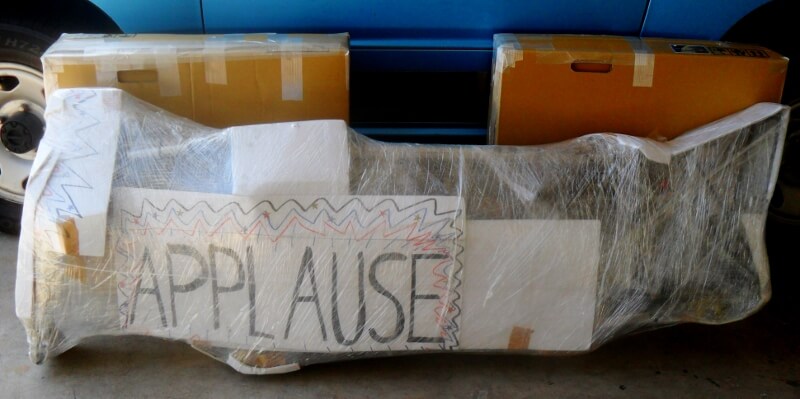
Applause, Zippy ready for India
We leave Tucson today for a few months in India. We begin in Ladakh, tight between Pakistan and China, in the Tibetan cultural, and landscape land. We start in Leh, in an 11,000 ft. valley in the Himalayas.
We’ll hang out exploring temples while we acclimatize, then test some passes, and ourselves. We’ll stay about a month in the mountains and then descend into the plains where we may take a train to avoid the most populated areas, and go to the far south. We’ll be working on stories for Desert Leaf.
We have a one-way ticket, so we don’t know where we’ll fly home from. It’s nice not to know. We don’t have a phone. We should have internet fairly often and we’ll post here.
The preparation craziness is done, so now we can allow ourselves to be excited. This is going to be fun. No doubt some physical and mental challenges along the way; hey, that’s what makes life interesting, memorable.
I expect my camera to get a workout: Ladakh is called The top of the World for good reason, with the highest motorable road, spectacular scenery, and the Tibetan people are colorful and friendly. We rode across the eastern part of Tibet on our In Search of Shangri-La trip, and want to see how the Tibetans are different here in their western-most range. We expect some differences: they are free in India, not so much in China.
My short story, Luther’s Trench was recently chosen among the best contributions to Tidepools literary magazine over the past fifty years. Luther’s Trench was the first place fiction in 1994. I haven’t seen it in years. I’m still pleased.
Luther’s Trench
by Bob Rogers
The sawdust and horse manure was cool against Luther’s face. He wondered why he didn’t hurt more. The left runner of the oak sled, laden with half a ton of concrete blocks, angled steeply across his hips and ribcage. He struggled, coughed, and spat out a bloody wad of Mail Pouch.
The Percherons hitched to the sled moved about nervously. The mare raised her tail and streamed steaming urine into the loam beside his hand.
A mob of crows squabbled from the oaks on the ridge. The scent of woodsmoke and rotting vegetation found him. He clawed at the dirt, a rock sticking out of the trench wall. No use in that. The effort made him gasp and brought the pain.
The young horse stepped on the electric cattle-prod lying near him, shied, and the team lunged forward. Luther screamed as the sled dragged him several yards. The weight settled full on him and consciousness left.
The mare shook her harness. The hardware jingled softly. He opened his eyes; shadows had lengthened, the light warmed. He could hear cars on the county road, and thought he should yell, but knew it was no use. Only the team’s heads were visible above the five foot deep trench. People were accustomed to the two horses there where he trained them to pull the weighted sleds. The narrow trench confined them when he shocked them with the cattle prod. He left them there overnight, when they didn’t pull to his liking.
No one would miss him. His wife was gone. Went to live with their girl. The grown son never came around.
“Well,” he spoke to the team. “Looks like you won this one too. You won ever pull you was in, and now you beat me.”
He vomited. Blood and bile ran back into his face. He wondered how long it would take to die. He lay quietly, smelled the sawdust and horse piss, his own dying. He wondered what a dying man ought to think about:
The farm never had amounted to much. It was a struggle just to keep from loosing the place to the bank. Everything he tried turned bad. Plowed at the wrong time. Planted at the wrong time. Crops nobody wanted to buy.
Married that woman. He never was good enough for her and she let him know it. Screamed at him. Made him sleep in the barn if anything wasn’t just right, which was most of the time. Soon as the kids came along it got worse and he took to sleeping in the barn with the horses. Put in a little wood stove and stayed out there on an old mattress. People thought he was odd and felt sorry for the family.
He knew how to pick horses. Always got good stud fees, and his foals bid high at the livestock auction. Not enough money in it for the woman though.
There were the pulling contests. Not much of a thing to think about now, laying under the horses like this.
His teams always won the county fair and then the next county over, and finally all around. Even that had turned bad. People didn’t like the way he did it. He never could figure why you were supposed to win, but when you did, they hated you for it. They could go to hell. The barn was full of trophys. Every sill and lintel had one. But, nobody came to see the trophys, to stand and chew and talk horses. Nobody.
“Luther,” said the judge, as Luther hooked his horses up to the sled. “You know you can’t use one of them damn things in a pulling contest, put the cattle-prod back in your truck. You can use it to train your horses, if you think you have to, but you can’t use it here.”
Luther spit a stream of tobacco juice into the dirt near the man’s foot. “I ain’t got no batteries in it so it’s just like any other goddamn stick. It’s legal. Now let me get about my business.”
Luther’s pulls always put the crowd down. His horses lunged against the harness when he cursed and prodded them. The other teams were eased into the load, and they pulled for as long as they could, got a pat on the neck, a lump of sugar, and warm applause.
When the judge gave the go-ahead, Luther yelled and poked the horses around the anus. He didn’t even let up when the young one stumbled and fell to his knees. The pull was long, would prove to be the winning one, but it wasn’t good enough for Luther. He beat them in the face. His curses echoed from the silent grandstand.
It was quiet on the county road, the harvest moon was high. He was cold, and the pain was worse. The dying wasn’t going to be any easier for him than anything else he ever did.
The horses shook their harness’ and stamped their feet. They stood over him and steamed in the blue light.
“Still with me are you?”
“Guess you don’t have no choice. Makes that sled hard to drag don’t it, having me stuck under it.”
Luther coughed and spit, black this time.
“I suppose I could unhitch you.” He reached out to touch the cold cotter pin. “You could sashay out this ditch without a ounce of weight to pull nor a look back; wander down the road, find some grass, maybe somebody who’d feed you some corn, ease your harness.”
“Can’t do that just yet. Might wonder why I cut you loose, and come looking for me.”
“Stay with me now.”
Luther concentrated on the breathing of the horses. The pain eased and he faded.
The mare stepped on Luther’s hand in the soft dirt. The moon was in the west and dawn not long off. There was frost on the sled. It hurt him to take the cold air in, and he was tired. It was time. He twisted the pin out and let the singletrees clatter to the dirt beside him.
“Git up. Git up now.”
The mare turned her head to look at him, turned back, didn’t move.
“Go on now. Git.”
Her breath in the cold blue air, and the sound of it, in and out, in and out.
“Suppose I’ll have to go first.”
He rested his palm on the mare’s leg and felt her coarse hair. Luther listened to her breathing for as long as he could. The last thing, was the pulse of her warm blood surging against his palm.
“I found them down by the creek this afternoon,” Luther’s neighbor told the Deputy. “All harnessed-up, dragging the singletrees.”
“What’d you do then John?”
“Like I said, Billy, I brung the team over here and hollered for Luther. I didn’t hear anything, so I led them to the barn, give them some grain. I had an idea what might a happened and I was scared to come over here to look. Luther never did nothing with his horses but shock them in this damn trench. Finally I come over here and found him like this.”
They stood for a long time beside the trench, their backs to Luther, watching the Hickories on the hill drop their last leaves.
“The Coroner is on the way, but I figure it’s not hard to tell what he died of. Horses got away from him and drug that thing up over him.” said the Deputy. “Hard way to go. I hope the family don’t want that team put-down. That’s a choice pair.”
“I know Luther’s boy pretty good,” said John. “He lives over in Kenova and works at the steel mill. He used to call me to ask about Luther. I think he’d sell them to me. Might put them on that back pasture to knock down the thistles. They don’t need to do no more pulling.”
He wiped a brown hand over his face, resettled his cap and looked to the far oaks. “Give them one last job. Take the dragline they dug it with, and fill in Luther’s trench.”
The Pima County Public Library is after my own heart. This month, I wrote in the Desert Leaf about the PCPL Librarian Files, a resource for local information that Tucsonans may have difficulty locating any other way. I love my library.
As a writer, I can think of nothing more rewarding than positive feedback. A heartfelt phone call from the art enthusiast profiled in the May 2014 issue of the Desert Leaf made my year.
http://trendmag2.trendoffset.com/publication/?i=207593&p=8
While hiking with a friend in Esperero Canyon, we found an extensive patch of poison ivy that appears to grow more vigorously each year. Claire wrote about it in the May 2014 issue of the Desert Leaf.
http://trendmag2.trendoffset.com/publication/?i=207593&p=32


One of many tunnels on the Rio Santa, Peru
Click photo, or here, to go to our latest Adventure page – South America, Trans Andes to Amazon Journey. You will find photos, videos and excerpts from our journals on our two month, bicycle, bus and Amazon boat journey. You may have caught some of our posts, but this is rewritten, and formatted as a short (an easy evening read) manuscript.
Claire has finished writing a fascinating article about people who love bees enough to keep them in urban areas. The story will appear in the October issue of The Desert Leaf. We visited with Mark Doumas as he inspected his bees and added space for them to store honey:

httpv://www.youtube.com/watch?v=TOftJ3LXm6I&feature=share&list=UUYRz3auwXFY-mXuuz7yHFQQ
The Overland Expo is an international gathering of people who love overland travel in its many forms. The attendees range from newbies, interested in the latest kit (gear) and guided tours, to solo women who’ve traveled the continents on a motorcycle. As bicycle tourists with 43,000 miles around the world on our tandem, we share much with the hard core, and can remember being a newbie. This six minute video is about the range of people and their changing passions.
While working on New Bohemians today I ran across this previous post. The quote from Jorge Luis Borges evoked memories: they flashed across my inner travel screen, not in pixels, but in soft amorphous remembered images, scents, labored lungs and heart, sweat soaked, cold shivers; wind cooled and sun warmed. Smiles from faces never to be seen again… I thought I’d re-post. Share.
“Through the years, a man peoples a space with images of provinces, kingdoms, mountains, bays,
ships, islands, fishes, rooms, tools, stars, horses and people. Shortly before his death, he discovers that the patient labyrinth of lines traces the image of his own face.” -Jorge Luis Borges

Claire found this quote In World Wide Travelers, Birds of a Feather group newsletter, of the Escapees recreational vehicle club. The editor, Kathy Howe puts together a great monthly newsletter from Escapees who travel abroad.
Ya’an was one of the first rural cities we stayed in after leaving Chengdu on our tandem to ride across Tibetan Sichuan. Luchan, a harder hit town is just to the north. The cities on a fertile rising plain that soon gives way to steep foothills leading to the Tibetan Plateau.
It is was an important supply point on the Tea and Horse Route, just before the brutal climbs into Tibet.

Tea fields on the Tea and Horse Road near Ya’an
The news is spotty, but it doesn’t look as if the quake is as bad as the large quake a year before we left. It is along the same quake fault line as the quake that killed 90,000 five years ago.
To learn how to travel the Tea and Horse Road, go to our In Search of Shangri-La: https://newbohemians.net/our-adventures/in-search-of-shangri-la

 The Needles District of Canyonlands trails range from red and orange and vanilla slickrock to thick riparian with sand and hidden springs. Many of the more popular hikes are long out and backs, ten miles or more. The Lost Hiker Trail is so named because a lot of people expecting to return to the Elephant Hill trailhead, miss a turn and find themselves at the campground instead. This usually ends in a three mile additional walk, or hitch-hiking.

Early in our stay in Needles District of Canyonlands National Park, we hiked toward the Peekaboo rock art panel, a ten mile round trip hike. I waited for Claire about half-way to rest my knee, and to give me ample time to concentrate on a unique slickrock saddle between Lost Canyon and a tributary of Salt Creek. She found the major rock art panel, a class one site, but was unable to see the class two site we’d heard was nearby. The Antiquities Act requires that rock art sites be classified between Class One and Class Four, ranging from open sites like Newspaper Rock to sites identified only to approved professionals. We’ve seen a number of Class Two’s, maybe a Class Three, though we wouldn’t know for sure since agencies will only confirm these if asked directly, and but will never give directions.
Naturally she had to go back and try to find the illusive panel. By this time I’d borrowed a hiking pole and had a couple of longish hikes behind me, and I decided to go, this time using the Salt Creek jeep road. Mistake. It had been three weeks or more since rain and the sand was deep, making the less-than-four miles to Peekaboo seem like five or six.


The Joint trail in Needles district of Canyonlands National Park is really a destination, a long crack between rock masses. It can be reached by a mix of trail loops ranging from ten to 15 miles. Any combination of these loops offers up a panoply of rock sculptures standing sentry over sage, juniper, pine meadows, perhaps even rock art if you go off trail (carefully!) a bit.


Most people drive to trailheads to begin a hike, but the distances here are short enough that we are enjoying being able to bike and hike in the same day. We get both funny looks and thumbs up from the petrol heads, but that’s nothing new. There are several ways to use mountain bikes to shorten hikes in Needles district of Caynonlands.

We’re now settled into our volunteer positions as campground hosts in Squaw Flats campground at Needles. The learning curve was steep the first few days, but we have the system down now. We especially enjoy interactions with visitors, solving their problems, making their stay stress free, which after all is why people come to beautiful places like this.
We are on four days, and off three. However we have found that if we’re around, visitors don’t seem to see the off duty sign, and come to us anyway. That’s fine with us. Twice we have hosted tent campers at our site:


Claire hiking in Needles District of Canyonlands
A week ago we spent three days hiking in the Needles District of Canyonlands National Park. We’ve visited first on Zippy (our tandem) on our first long tour and fell in love. We’ve been back a few times since, once for a memorable 14 mile hike with Jack and Mary Lange from Sequim. Each time when it comes time to leave, we promise ourselves to come back for a longer stay.
We stopped at the visitors center on our way out, and Claire mentioned that we’ve been thinking about volunteering in a National Park, and that Canyonlands would be high on the list. The woman we spoke to, Dorita, just happened to be the volunteer coordinator.

Another multi-million dollar view at Muley Point
Two days later, boondocked at another spectacular site, Muley Point, there was a message on our phone from Dorita. The volunteer slated for the autumn stint had become ill; could we fill in for as little or as long as possible? We were just a few days from Tucson to begin our “normal” winter activities, but we do tend to grab opportunities, so we said yes. We begin as soon as we gather a month’s worth of food, add some winter clothes and blankets (thrift store) and return to Needles.
If you are in the area, stop by to visit and get a taste of true high desert red rock remoteness. Our off days are Tuesday through Thursday (hike or bike) but the other days allow time for a visit.
We’re stoked. I’ll make a post or two if possible.

Colorado late September 2012. Enough said.


- Claire on Grand Mesa


Grand Mesa

- Grand Mesa

Colorado National Monument
 Maroon Bells


View from Turtle


We topped a small rise in western Kansas in Turtle. Morning light cast our shadow down a long straight road ahead of us. The colors were intense, the air sparkled, the land rolled off in wheat stubble and stone fence posts to a horizon uncut by haze. A railroad track led to a lone grain elevator. I took an involuntary deep breath; a gasp almost, of clean dry air. It’s been months since I’ve been able to see that far, months since the air was so clear, blue and white and wheat color, chocolate loam, the sky so big, so big.
I enjoyed our time in the Midwest and East, the Ozarks, Appalachians, Great Smoky Mountains; the bike rides, the friends and family, and the new/old friends of 50 years at my high school reunion. Every bit of it. Except maybe the heat and humidity, the haze and in places the traffic.
I enjoyed the trail rides: Great Allegheny Passage and Greenbrier River Trail, the quiet back road roadbike rides of the hills of Maryland and West Virginia. I didn’t miss the West. I was too busy enjoying what the East and South had to offer.
But when that expanse opened before me, I knew. The West.
 And then there was the old windmill silhouetted against the sunset sky at our boondock spot, just after dinner, before a good night’s cool sleep. Ahhhhh.
It’s hard to explain. I’ve always needed space. The East and South embrace with haze, green matter, round mountains and stringent culture. I enjoy all that. But. I need the other: the dry air, rugged rock strewn plains and high mountains, scrub and cacti, and tall trees, deep blue sky. And wide a wide open culture.
I didn’t come into the West until my mid 30’s. I knew I belonged and I was welcomed.
It’s all America, and I love it all, but the West is my magnet, drawing me back.
A few days more of The Great Plains, then the high passes of the Rockies, the Colorado Plateau of Utah and Arizona, finally in a month, the basin and range of Southern Arizona, desert.
Today and tomorrow a fly-in at a small Western Kansas airport for a little work, then we slow to the pace of the plains and mountains.

I saw this sign in the window of a pharmacy in a small Kansas town. It struck me as profoundly sad at first, and as the meaning sunk in, sick. Then it made me angry.
The word Shoppe, as used in signage and advertising is evokes certain emotions: an ice cream parlor, a soda fountain with marble counter, mirrored back bar, ice cream and soda delights, a cool place on a hot day. Evocative words and images are brought to mind: ye and olde, junque, vintage boutique, collectibles, quaint treasures, vintage clothes, treasures found in intimate spaces soothing the senses with sophisticated design and exotic scents.
Diabetes is not so pleasant. It is part of a collection of interrelated diseases: arterial diseases, heart disease, blood clots, stroke, limb amputation, loss of mobility, organ failure and others. Diabetes and it’s resulting diseases are known in the medical community as metabolic syndrome, because it involves the entire metabolic system, the most essential in the body. The consequences of diabetes cover a wide range, all unpleasant, painful, leading to early death.
Shoppe: a place where one goes to get the myriad of medical paraphernalia and drugs to slow the progression of metbolic syndrome? Sick.
There is a magazine, perhaps more than one, and hundreds of internet sites, devoted to the management of diabetes. These are also advertising mediums, and attempt to make sophisticated anything they can sell related to diabetes. Many of the paraphernalia and drugs for diabetes do help bring temporary relief of symptoms and may slow the progression. But none are a cure. None reverse the slow decline of the whole body.
But there are two things, two very simple things the diabetes patient can do to slow and reverse diabetes. But I’m sure these are not sold in the Diabetes Shoppe. That is because they cost nothing, and therefore there is no profit in these two things:
Eat a low glycemic, mostly plant based diet, and increase physical activity. Simple. Too simple. We have been conditioned to go to a pharmacy or hospital (diabetes shoppes) to fix our diabetes. Most physicians, to their credit, at least mention diet and exercise to avoid, or reverse, diabetes. I think many people just don’t believe that these two simple lifestyle changes can cure them. They can and will. I know several people who have reversed their diabetes, and associated body damage, by these two simple changes. It works. If you have diabetes, tell your doctor you are ready to commit to the cure. You can even do it yourself; the internet is full of health newsletters with ideas for diet, and exercise programs.
Stay out of the Diabetes Shoppe. You can do it!

We knew severe weather was on the way and parked turtle into the wind; 90 degrees to the wall of black looming in the west. The severe thunderstorm warning predicted 70 mph wind gusts. We’ve experienced 60 mph once in Turtle and she rocks severely if parked beam-on.
We went into the WalMart, thinking we had time to pick up a few things for dinner before the storm hit. Wrong. We were just about to head for check out, when we noticed the usual random pattern of shoppers movements had suddenly turned to a purposeful unidirectional flow. A clerk nearby said, “Move to the back of the store please. There has been a siren.”
In Joplin, Missouri, no one ignores a siren. A siren means one thing, tornado, or at least very very severe thunderstorms capable of producing a tornado. The center of town was nearly destroyed a year ago. People obey sirens.
Shoppers and staff move slowly to the receiving area, nominally protected by concrete block walls. We are quiet, the employees efficient, purposeful, calm.We stand looking at each other, and the roof girders as heavy rain pounds above. People clutch cell phones, some broadcast their own message to family: “Get yourself to shelter. Now!”
A young woman presses her phone to her ear, other hand covers her other ear. Tears gather, run down her cheeks. She is a cosmetologist from the beauty parlor. My guess is she had been working in the WalMart a year before, where many were trapped, several died. The pad where the destroyed store stood lays barren, just in front of the new store, mute reminder to all who pass it.
A woman pats her husband’s shoulder repeatedly, speaks encouragements into his ear. He is vulnerable, in a electric shopping cart, oxygen canula in his nostrils, face blanched; frustrated by his smartphone, looking for the weather radar.
A few soft sobs provide a background to quiet talk. The prayers are silent. Everyone is patient. This will pass. Hopefully.
And it did pass. This time.
Joplin is still traumatized. Some will never get over it. Each long tornado season will hold dread; each thunderstorm vivid memories of chaos.
As for us, we felt calm. Our travels have taught us that worry is useless; once you have done what you can, relax, focus, and you are prepared to act. But then, we’ve never been through a tornado.
(For a great story about staying focused amid the chaos of the 2011 tornado, read this Wall Street Journalstory.)
Calm Again in Joplin
Store staff announced the all clear and returned quickly to their stations. People rushed for the checkouts and then into the now light rain. They were going home to check for damage; winds had been clocked at 80 mph. We got a look at Turtle, still standing. Relief. When we returned our skylight had been sucked open by the ferocity of the wind and the bed was damp, but otherwise we were fine. We had parked the right direction. Claire was disappointed we missed the excitement inside Turtle; and she’s the one who gets sea-sick.
(The next day at the farmer’s market a vendor told us their greenhouse was damaged and their garage door collapsed into the garage.)

Pickup trucks were once basic utility vehicles. They carried significant loads with an in-line six cylinder engine and a three speed standard transmission. Efficient. Practical. Cheap. Definitely not sexy.
But, over the past 40 years, that’s all changed. Now they have several times the horsepower of the old pickups, automatic transmissions, surround sound with augmented bass, GPS, heated seats, and that’s on basic models. Wheels and tires specified to haul twice the weight of the old pickups often lug little more than a cooler of beer. They don’t carry cargo, they carry social messages.

Claire checks out the local pickup meet-up in Charleston, MO
After much study, traveling from Arizona to Maryland, and now heading west again in Missouri, I have deduced the unmistakably essential design element of a new pickup: high bed walls, with nice comfortable rounded tops.
A pickup is for leaning on with a couple of buddies, talking sports and politics. American efficiency.

The Great Allegheny Passage. We were finally going to experience it for ourselves, along with Michael, my brother, who is relatively new to riding. We planned to meet in Cumberland and drive to Pittsburgh where Mike and I would ride south each day while Bob drove Turtle to the end of each day’s segment, getting in what riding he could from there. What we didn’t anticipate was how steep and narrow the circuitous roads would be for Bob as he drove the motorhome through the mountains of Western Pennsylvania while we cruised on a relatively flat railroad grade.

Mike on the Salisbury Viaduct
Our first day was long even though we didn’t get in any riding. Mike had driven from Glen Burnie starting at 4:00 a.m. and reaching Cumberland by 8:00, where it was already getting hot. He cooled off in the lobby of the Marriott while waiting for his wayward sister and brother-in-law, who finally rolled in around 10:00. Nobody told us how difficult it would be to get a cell signal in the Allegheny Mountains and when we got to town, there were already two messages from Mike. We loaded up his gear and bike, registered his car for the long-term parking lot and headed off for P’burgh, stopping on the way for fuel and groceries. My poor routing made for an even longer day as I wanted to avoid the toll road. We crawled up and down the tortuous Route 40 until finally we camped at a commercial campground near Cedar Creek Park, just in time for an easy dinner of chicken salad.
Beginning at Homestead
We opted to start from Homestead on the advice of some other riders we’d met in Cumberland and we found the trail a bit convoluted through the urban areas. Sections of trail followed sidewalks, bisected parking lots and edged along residential streets until finally we were on continuous railroad grade. Bob parked at Cedar Creek Park and rode up to meet us about halfway, so he probably rode as far as we did. The last ten miles was brutally hot—in the 90’s—so we stopped often to cool down. About 29 miles, it was Mike’s longest ride yet, and that was just his first day. We camped at the same place as last night.
Enough Adventure For One Day
Our second day on the trail was about as much adventure as we would see the whole trip, which can be a good thing. Bob pumped up my front tire and we took off, hoping for the best and not quite prepared for the worst. Within three miles, my tire was low again, so Mike used his pump and we rolled on hope more than reality. By the third try, we knew we had a problem, so we found a good trail down to the river where at least we could locate the slow leak in the water. Bob had kept our one patch kit and spare tube and Mike’s kit was intact but old enough that the glue had dried up. Our only option was to hope a passing cyclist would have some glue. Instead our unnamed good Samaritan had an insta-patch, which I foolishly almost turned down. But we tried it and it held so on we went, rolling about 40 miles, another personal best for Mike. Bob had ridden up the trail but turned back, sure he’d missed us. We camped at Ohiopyle State Park, a really nice park.

We broke up our third day of riding with a stop at Confluence, where Bob met us and took us to town to shop for groceries and find access to the Internet. We finally located it at Confluence Cyclery, a really welcoming center for cyclists far from home. The second half of our day was especially pretty as we rode gradually up along the Casselman River. We camped at another nice state park, Laurel Hill, along the Laurel Highlands Hiking Trail.
Ice Cream Break and Pennies on a Railroad Track

By our fourth day, the riding was really getting rewarding and we let our schedule go slack. We took a short day in order to have one more day of riding tomorrow as well. We stopped at the Meyersdale Depot for a long lunch and when Mike suggested ice cream, we hiked down to town, stopping on the way to lay pennies on the busy railroad track. We signed the bright new walls of the ice cream shop and went back to look for Mike’s pennies. We were both pretty tickled to find them well flattened and nearly unrecognizable. Mike gave me one as a souvenir and I’ll keep it forever.
The Eastern Continental Divide
 We continued on uphill until we reached the Eastern Continental Divide, elevation 2,392, the highest point on our ride. Just beyond it, in the Big Savage Tunnel, we startled at the flash of a photographer in the middle of the 3,000 foot tunnel before realizing it was Bob, giggling and testing the features of his new camera. Stopping at Frostburg for the night, we enjoyed some trail side pizza—delivered to Turtle in the parking lot—as Mike’s treat.
Our final day was an easy coast all downhill to Cumberland, where we arrived at the parking lot three minutes after Bob, though he did stop to shop along the way. It was a nice finish to a fun tour; 140 miles in five days. Before pulling out, I leaned heavily on Mike to promise we might plan another trail ride sometime soon. The C&O Canal Towpath lay straight ahead of us, continuing for another 180 miles all the way to Washington D.C.


When Claire and I rode our tandem Zippy 14,000 miles around America in 1995-96, we took Tennessee the long way on the back roads. I remember that we visited the Jack Daniels distillery, but it was not legal to buy it in the same county.

Claire remembers most, not surprisingly given her love of all things chocolate, the chocolate gravy she had over her biscuits one morning. We asked at several eateries and were directed to various fast-food locations; none had chocolate gravy. Some remember mothers or grandmothers making the dish, but didn’t think restaurants would have it; a dying Tennessee breakfast tradition.
But, Claire does not give up easily when chocolate is involved. We kept looking, and saw a block off our route, the Family Traditions Restaurant. It looked like an abandoned fast food place, but we did a U-turn and found it semi hidden at the back of a strip mall. We saw no cars, and our hopes dimmed. Claire went inside, and not only were they open, but they had chocolate gravy for breakfast.

She was a happy girl!

Since graduating from St. Albans (West Virginia) High School I’ve probably visited the town a dozen or so times, most of them in the first few years. I returned for each of my parents funerals and once on our first tandem tour around the U.S. with Claire. I connected with just a few my former classmates, and not often; many had moved, or were busy with work and family.
I didn’t go to the earliest reunion, and became lost to the organizers when I became a Westerner: Oregon, Washington and now Arizona, shortly after.
They found me about a decade ago, and I planned to attend, when a sailboat owner/captain we’d met on our Australia journey, asked us to help him sail Songlines around the South Pacific for four months. We couldn’t pass that one up, and I faded from view again.
Thanks to a Facebook page some of us found each other a few years ago, and Claire and I decided it was time to go to a reunion. In the U.S. we travel in our motorhome, Turtle, and we set up camp at the St. Albans Roadside Park for the long week-end of the reunion. The park is one of the most beautiful city parks with camping for RVs in the U.S., and free, though donations are appreciated. Classmate Mac Gray, also an RVer joined us and we had a steady flow of visitors, and offers of rides to events. It was the perfect set up for a reunion visit, and since most of the events were at night, Claire and I got in a bike ride almost every day, one of them 60 miles, on mostly quiet roads. We’re exercise/cycling addicts and being able to get our fix was important to our enjoyment of the six days we spent in St. Albans.
I was not a little worried about the prospect of seeing people who I’d spent only a few years with so many years ago. I feared we wouldn’t have anything to say to each other, that I had forgotten everything about them, and they me. And there is also the overworked joke about reunions: “Who are all these old people anyway?”
I need not have been concerned. The reunion committee thoughtfully provided each of us with a name tag which included a photo from our senior yearbook. Imagine a bunch of folks wandering through a big crowd, squinting over, or through, glasses at the chests of others, followed by a squeal of recognition and an enthusiastic hug. That was the first official event, and it got wilder as the week-end progressed. The hard part was remembering the ones we’ve lost, some alive so recently I was anticipating seeing them.
Part of the fun of a reunion is seeing your former, younger, self through the memories of others. I knew I had fun in high school, but I was surprised at how many people remembered how much fun I had! As the reunion progressed, memories surfaced in joyous profusion, and new relationships were formed among classmates who weren’t close in high school.
Many of us learned how little we had changed through the years: the hard workers who were still doing the reunion organizing and grunt work, the shy one who was still a little shy, the show off who couldn’t help himself on the dance floor (wonder who that was?)…
Of course we have all changed on the outside: class total mass has increased by about 40%, wrinkles mysteriously appeared, and we don’t move as fast as we once did. But inside, where it counts, we’ve changed less than might have been expected, given the years of work, love, grief and change we have all experienced.
What I recognized most in my classmates is that the spark of life still shines. Dimmed in some by loss others by financial or health struggles, it still shines trough the twinkle in an eye, that crooked little smile, or wide grin I remember from so long ago.
There are is more adventure, and years to our lives, and our inner spark will carry us through, perhaps to another reunion…

 Claire suggested that our motorhome Turtle wasn’t a sports car, as we sped down a Forest Service road in West Virginia. We were being chased by a thunderstorm, and it was about 10 more miles to the Laural Fork campground near Spruce Knob. We didn’t beat the storm, but Turtle did well.

The next day we cycled from U.S. Route 33 to the summit of Spruce Knob, highest point in West Virginia, a 2800 foot vertical climb; not big by Western standards, but, steeper and humid. A good workout.
I was disappointed, but not surprised to find the summit very grown up with spruce trees, not the little flag spruce I remember, but big trees with others mixed in. Nothing stays the same
The reason for the smaller trees in the past was fire, no doubt caused by logging operations in the early part of the 20th century. The same fires burned Dolly Sods; both produced a unique landscape that is now returning to something akin to the original heavy forest cover. I’m not so sure it might be time to burn both again to regain the special character they had for nearly a century. I’m sure the idea would be controversial, but worth consideration.


In the spring of 1967, Jon Webb, with the blessing of Kenner Bush, Publisher, hired me as a photographer for the Athens Messenger. In a year or so of producing the Picture Page, the most popular feature of the daily newspaper, Jon had become a legend, an inspiration to many young photographers, and writers, who dreamed of having the freedom of self-expression Jon had created at the Messenger. I was lucky enough to grab on to his coattails for a ride that would change the direction of my life, not a small thing. Working with Jon drew out the best in me, things, thoughts, feelings, and talents I didn’t know I possessed. Jon was filled with energy, talent and an idealism that found expression through his work, in a day when such were rewarded, not with money but freedom. We reveled in it, and worked our asses off. I learned more from Jon, and that freedom, in the less than two years we worked together than I learned in all my schooling, including a Master of Fine Arts. The difference was one of passion. Jon worked and lived with a passion that was infectious. He would go on to greater things at the Louisville Courier Journal, win the most prestigious of awards, and as is unavoidable for a passionate one, ruffle a few feathers. I did a bit of that myself, and that’s probably why we both ended up working most of our careers as freelancers of one sort or another. And we’re not sorry one whit!
Ken Steinhoff (last post) had found in his storage shed (Ken saves everything thank goodness) a bunch of Picture Pages. I used the delivery of them as an excuse to invite myself, and Claire, to visit him in Louisville. As with Ken, there was a bit of bemusement at the prospect of seeing me again, one who was in his life for a very short period of time, more than forty years before.
At a distance I would not have recognized Jon had I passed him on the street, nor he I; forty plus years changes a body! But as I got closer, and the small talk proceeded, I began to notice bits of body language that hadn’t changed. As the memories of that time begat one story and another and another, suddenly there was a thing that touched me: an unmistakable Santa Klaus glint in his eye, a window into the humor and joy that is at the heart of the man; always has been, always will.
Of course we’ve had our struggles, but neither of us tend to dwell on those. I wanted him to met Claire, love of my life and partner in the continuing adventure. I could tell he fell for her. They all do.
I was able to tell him how important he was to me and to see him surrounded with family and love. Claire and I both enjoyed our time with him and left with new memories. I wish him well as the journey continues for us both.
Please don’t put off telling the important people in your life that they made a difference. You’ll both be happier for it.
For the past twenty some years I’ve been doing something that brings me great satisfaction, something I recommend to you. Express your appreciation to those who have had an impact on your life. Begin with your parents, if you are so lucky to have one or both, your siblings, teachers, work mates, bosses, old friends, spiritual guides; anyone who had an impact on your life’s path. When you begin thinking about these people, you will be amazed, as was I, at the people who helped form your present self. It’s a wonderful process, one I don’t expect to finish..
As Claire and I wend our way East this year I have sought out, or been found (Thank you Facebook) by some people I wanted to appreciate. The prospect of meeting an old acquaintance can be unsettling at first thought. After forty some years, how much have we changed, will we have anything to talk about? These feelings fade quickly, when I see a familiar smile, hear a familiar voice, and listen to the first of many stories of times gone, but not forgotten. The thank you, and accompanying hug, create a new memory.
Ken Steinhoff, and his 43 year wife Lila, found me through Facebook. I brought Ken on board at the Athens Messenger as a photographer when Jon Webb left for new challenges at the Louisville Courier Journal (a later post).

Claire and Lila on the Mississippi
Ken and I worked together for about two years. I was nominally Chief Photographer, but never noticed it. We mostly played at doing our passion, photojournalism. We worked hard, and played hard at it, often late into the night. I’m sorry Lila, that I kept him away from you so much, though I’m sure you knew his mistress would always be his camera. Ken and Lila kept this bachelor company many a lonely evening, though I was probably too quick to abandon them when I found female distractions for my few free hours. Some of those detours seem to have been engineered by Ken, probably so he could have some time with Lila.
We met Ken and Lila, and Ken’s mother Mary at her Cape Girardeau, Missouri home. Ken writes and photographs the wildly popular site (I’m not kidding): http://www.capecentralhigh.com/ about the town and surrounding area of The Cape. He is retired now from the newspaper business, where he got kicked upstairs to management way too soon, and back to doing what he loves best, taking pictures and talking to people, reporting. He’s doing his own personal form of the Picture Page he and Jon and I produced at the Athens Messenger back in the golden age of photojournalism. His readers are legion and appreciative. I wish I had 10% of the returning visitors he has for our New Bohemians. He’s giving his readers what they want and understand, what they have a personal connection and memory of; I’m just rambling on about our travels, but we’re both having fun, using old skills, not yet too rusty to make a creative contribution.
Ken took us on several road-trips to show us some of the special places he reveres in Southeast Missouri. It’s quite a place, and I understand why he loves it so.
We parked Turtle in Mary’s driveway and quickly made a new best friend. She’s a great mom to Ken and his brothers, and a friend to anyone. At age 90, she’s one of the happiest people I know; an inspiration we hope to see again. Ken said she was about to hide away in Turtle and go back to Arizona with us. I think we’ll have to arrange that Mary.
This is one of my favorite photos of the trip: Mary lost in the beauty of an historic chalice at a rural Lutheran church.

A hot summer day on the bank of the Mississippi is a place for beer and cigarettes and fishing. It’s a time for watching the float bobbing in the current, and storytelling:

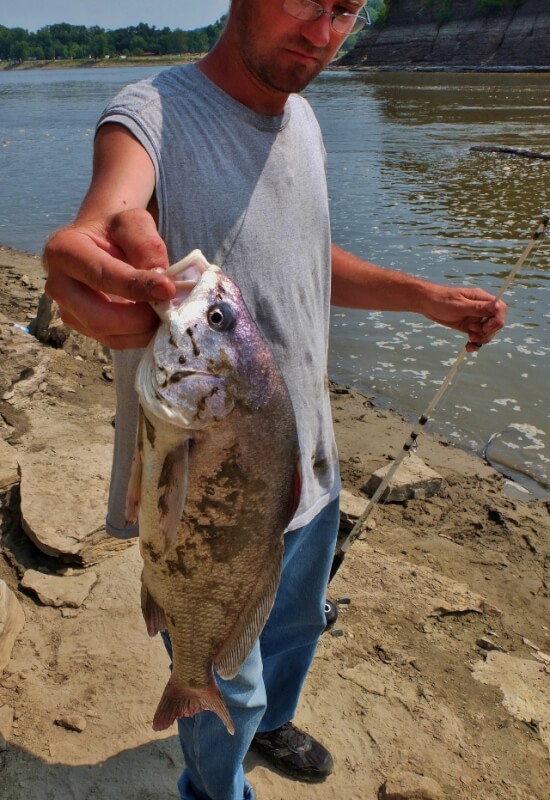
“When they was going to build the new bridge across down at The Cape, there sent this diver down to tell them where to set the pillars. Well he went down there with his tanks and all, and it’s deep, and he’s poking around and picking a spot. All of a sudden he comes a shooting back up. Said there was catfish down there big enough to swallow a man. Guess he told how he’d found the spot for the pillars and they could believe him or not, because he was not a going back.”
Somebody caught a fish, and it was time to unwind the stringer, light a cigarette, crack another cold one; tell another story.
“When the water is high there’s a whirlpool right out there. Takes up this whole side of the river. I know a man saw a cottonwood tree sixty feet long go into that thing. It turned around a couple of times, stood on it’s end and just disappeared. Nobody never saw it again.”

Around the fire roasting a mastodon long ago, or fishing with ripe hot dogs, storytelling is as old as language, as old as man. It’s the anchors we bury, story by story, into our the landscape of our lives. Our local stories hold us against the current, hold us from floating away, alone.

The farmer’s market in Joplin, Missouri is arguably the best we’ve seen in our U.S. travels. There were no crafts or art booths. Nothing against the arts and crafts, but they have their own venues, and just distract from the purpose of a farmer’s market, real food.

Above is the lunch we made in the parking lot after buying most of the makings at the market: corn, potatoes, whole wheat bread (with Claire home-made hummus) cole slaw and tomatoes. Everything from the market was so fresh it was probably picked that morning It reminded me of my Mother’s summer lunches.
One of the great rewards of motorhome travel is being able to buy fresh food, and prepare it minutes later. Oh my.
And you don’t always have to buy it! While unsuccessfully searching a forest service track (not a road) in central Missouri for a boondock spot, Claire saw ripe blackberries. We picked a quart in minutes and they were the sweetest imaginable. She made a wonderful desert: the blackberries, peaches from Joplin, her own home-made wheat germ shortbread, and goat cheese. Life it good on the road.

One of the best things about boondocking in city parks on the Great Plains is watching a girls softball game as the sun lowers.
Earlier in the day we managed to get in a 47 mile ride, only one section of a square with a tailwind. We decided we had earned a stop at a the Cardinal Drug soda fountain when we got back to Chanute. I got a big one, and it was a whopper. We had been disappointed earlier in the day when we discovered Erie, a small town where Claire had expected to find a new-to-us old fashioned soda fountain, had been torn down, a new building built and the fountain was now just a non-working display at the new high school. This is happening more and more often. The machinery, the marble tables, the back bars, still exist, but no longer have a purpose, and soon there will be no one alive who knows how to make a real soda or Green River. However, in Chanute, the two young girls waiting on us made excellent sodas (cherry for me, strawberry for Claire) at Cardinal Drugs, using the proper wrist action and a perfect balance of fruit, soda and whipped cream. Oh my. Nothing like it on a hot humid day. We had been there on a soda-fountain themed tour of Kansas several years ago, and we were happy to find this one unchanged.



When we travel in Turtle, our motorhome, we seldom stay in RV parks. Nothing personal. Yes, we are frugal, but that’s about ten percent of the reason. RV parks are in business to make a profit by providing electrical hookups, sewage, water, sometimes cable television, and usually weak wi fi. They squeeze you in with other RVs, remember their purpose is not your pleasure, but their profit; perfectly reasonable. This is not a problem for most RVers; they want to know they are safe, won’t run out of water, electricity, or miss their favorite television program. For us however, those things are not the reason we travel. We travel in Turtle for many reasons, none of them have anything to do with maintaining a normal “home” environment; for that we would stay home, which by the way is an RV park we call home in Tucson for several months in winter.
 Our first boondock, bush camp, on this trip was a favorite hidden spot in the White Mountains of Arizona. It’s high, over 8,000 feet, and cool, just far enough from the highway so we are hidden from easy view. We have it to ourselves; the squirrels and birds share it with us. We could easily spend a month there, and may someday.
In New Mexico, we returned to a former bush camp near Soccoro, but drove a few hundred meters further completely out of sight of the road. It was quiet and a bit warm until sunset, but the dry air cooled quickly and we had a great sleep.
Sometimes we can’t get out of sight of the highway. In the Oklahoma panhandle, the sun rapidly setting, getting tired and hungry, we found a roadside rest/highway equipment storage spot, beside a busy truck route and railroad. Despite the noisy location, we slept well and actually came to enjoy the regular sweep of light and rumble from the trains and trucks. Something about low frequency sounds can facilitate sleep. Our next site is of a type we particularly enjoy in the Great Plains and Midwest: town park sponsored RV parking.
In Greensburg, Kansas the city park, pool and ball fields, has several grass sites, with electricity. We enjoyed watching young baseball hopefuls practice, until darkness, thunder and lightning sent them home. They pay attention to the skies here: Greensburg was destroyed by a tornado a year after we had visited on a Zippy (our world traveling tandem) on a short soda fountain tour in 2006, another story, coming to this site soon!
After two days of exploring the rebuilding of Greensburg, and enjoying a great bike ride across the windy prairies, we moved on for a half day drive toward Missouri. Claire found a wonderful Kansas fishing lake and we got the best spot possible, just a foot or so above the lake level, close to the hopeful fishers in their little aluminum punts. The birds serenaded us as we sweltered in the increasing humidity. Finally our little exhaust fan pulled in enough cool wet air to allow us to sleep; we awoke at nearly 9am! The cool of the morning and busy birdsong made breakfast special. 
So, just a taste of why we travel as we do. We’ll have more such spots to share as our travels continue throughout the summer.
We’re on the road again! (Forgive us Willie for our howling rendition of your signature song) Not by tandem bicycle, or sailboat, or Amazon riverboat, but our comfy motorhome, Turtle. We’ll be seeing America by the backroads, stopping at special places: our hometowns, places with memories like Greensburg, Kansas, and especially, places we’ve never been before.
We’ll follow a couple of minor themes all the way; fun times and bike rides, and also special Turtle boondocks; places we find to hide away, to eat and sleep and … Mostly they’re free, though we’ll pay a few bucks for a public fishing area, town park or forest service campground.
In the first week, we found two new bike rides of just over 50 miles; fun and challenging in very different ways:

The first ride was 51 miles in the beautiful White Mountains of north central Arizona, one of our favorite places to hang out when the temperatures in Tucson decide to stay in triple digits for a week at at time.
The triangle ride begins at the intersection of 260 and 273 near Eagar at a little over 7,000 feet in elevation. We headed west on 260 into a brisk wind and climbed to well over 8,000 feet, where at about 16 miles, we turned south east on 261. The recently paved road closes a triangle between Eager, Big Lake and 260. The new road is smooth with minimal traffic. It winds through high meadows, from about 8500 to over 9,000 feet, and crosses the upper reaches of the Little Colorado River. Even though the distance was moderate, we really felt the altitude on the hills.
At Big Lake the route turns left on 273 back to Eagar, through more rolling high meadows where we saw a few pronghorns. This area was at the edge of the giant Rodeo fire a couple of years ago, but the burned areas are patchy, and interesting against the seas of blonde grass, bright green aspens and cobalt sky.
The last few miles are a gloriously fast, serpentine descent that will test your nerves and sharpen your cornering skills.
This is a new ride for road bikes, and worth a trip. It would make a great road race. Nearby Eagar and Springerville have all the services, and there is great camping in the National Forest along ride.
The second ride we took was from Greensburg, Kansas (more in a future post), is an out and back. All rides in Kansas have one thing in common: wind. You either ride with the wind first, and suffer on the way back, or the reverse, which makes sense to us. The winds are so hard usually that I couldn’t imagine fighting a side wind both ways. I guess you cold do a square (there are only right angle roads in Kansas) but most of those would be 100 miles or more, and involve 50 miles of headwind. Someday.
We rode south from Greensburg into a moderate wind in the morning to the small town of Coldwater, loaded up on drinks and carbs, and returned in the early afternoon blown along by a stiffer breeze. That strategy was planned, and made for a fun ride through the low rolling wheat and corn fields. At times we were maintaining 22 miles per hour uphill. The scenery wasn’t exactly as spectacular as Arizona, there were as many oilwells as trees, and we only saw one red tail hawk. We could see Greensburg’s wind farm for 20 miles, breaking the rolling horizon.


As each week passes word comes of another self-emulation in Tibetan lands of China. Many are young monks, and more and more are women. The grief they must feel for the slow loss of their culture is unimaginable to me. In our tandem travels across Tibet, we saw the government’s attempts at subjugating the Tibetan culture by smothering their lands with emigrants from the Han majority:

Our narrow tandem tires cut into the dust and bounce and slide from one auto-tire slickened rock to another. We hope to avoid the shattered and sharpened hidden ones, capable of ruining our day, and one of our tires. We have one spare, and wonder if we should not have brought two. A few times a particularly viscous rock (by the second day I was attributing evil intent to certain rocks) would throw the front wheel toward the abyss, necessitating a dual bail out.

Sleeping in airports is all part of the experience these days if, like us, you go for the cheap ticket, no matter what. But lots of people get stuck for reasons of weather or airline screw-ups, so if you travel much, your day will come. Don’t worry. Just go with the flow and enjoy the experience. You’ll be surprised how comfortable you can get on your own little corner of carpet. We both slept for a few hours. We almost didn’t wake up in time for our required 5am check in time.
There have been a very few times in my life when time seemed to slow, if not stand still, and this was one. I could see the car headed for us broad side, in slow motion, too late to brake, to late for our acceleration to help. Neither the driver or us even considered involving the police: He because he was Brazilian and has known all his life to distrust them, and we because we had been warned not to involve police in anything, not even an injury accident.

I hurried Bob along, holding my oversized chocolate cookie, as the stranger called out “I won’t hurt you!” Suddenly, Bob turned sharply and defensively and soon learned the man was just asking for food. He gave over some of his cookie and the man thanked him. Now I know why we haven’t understood people who we thought were asking for money. I’ve been trying to figure out how people can afford to eat here and now I feel really bad that we’ve been ignoring them.

We finally had a great day on the bike, from Boa Vista to Bom Fin on the border with Guyana. I’d always thought all of Amazonian Brazil was jungle, or rather cut down jungle, second growth, but the north is wet savannah, much like the Gulf Country of Queensland, Australia. We saw more birds in one day of 130 kilometers here than we have seen in the entire trip so far, all but one or two new to our “life list.” There were stops every 30 to 40 kilometers with roadhouses, also much like Australia but closer, where we got much needed cold drinks to add to our load of water. It is very hot and humid here just north of the Equator, and we were soaking wet most of the time. Our final stop was nearly an hour so we could cool down to a reasonable level before going on.

The Amazon River here is deep enough to accommodate ocean going ships, and they crowd the port along with the upriver barcos (many sizes and configurations) that we traveled on. We’re not exactly sure of the source of all this economic activity in the mid-Amazon, but it is no longer virgin rainforest; rather, it’s small farms and second growth timber. There is oil exploration, but it is not visible from the river

httpv://youtu.be/HQYmy3g2SxY
Claire:
Bet you thought you’d be reading about a yawning sloth and a hungry jaguar. Actually this place is the Pilpintuwasi Butterfly Farm and Amazon Animal Orphanage, a short boat ride from Iquitos, where founder Gudrun Sperrer gave us a personal tour. Pupating caterpillars just aren’t as photogenic as a sleepy sloth. The sad story is that there is even a need for this place, a place where Peruvian children finally learn that big blue butterflies don’t come from little blue butterflies; shockingly, the metamorphosis of butterflies isn’t taught in school so Sperrer hosts field trips. It’s because of Sperrer’s heart of gold that the orphaned animals have a home here. What else can be done with a pet jaguar who is no longer so charming? Her original intent was to raise butterflies in a protected environment, shipping pupae out to botanical gardens and zoological parks, now Sperrer is scaring up 25 pounds of chicken a day for a large cat’s dinner and paying dearly for vitamin enriched formula for an anteater, some sloths, several monkeys and a tapir. If you take a jungle tour in the Amazon, do NOT “rescue” an orphaned animal from anyone by buying it and setting it free. This just encourages more poaching.

Passengers are an afterthought on these life-lines to Iquitos and many small villages along the Amazon’s banks. You buy space, bring a hammock to hang crossways above the deck, vying politely for some personal space. The hammock is where you sleep, and sit during the day. We became very familiar with our hammocks over the 48, mas o menos, hours it took to Iquitos. We also met and “talked” to our close (very) neighbors and crew. One family was returning to Iquitos with a new baby, either four weeks old, or four months, we couldn’t discern,

It was quite a ride over the final ridge of the Andes, steep and increasingly verdant, filled with village roadside life. We knew the heat would come, and it has. We are resisting air conditioning, even though is is sometimes available, hoping to quickly adapt to the heat. We have kept the days short, trying to be done by early afternoon, when heat stress begins to take a heavy toll. The andes end abruptly at Tarapoto, Peru but are immediately replaced by the Andes foothills, steep and lovely.

In the village of Pongo, I ordered a common soup in Peru, Caldo de Gallina. Usually it is chicken noodle soup with a leg or thigh, sometimes an egg stirred in while cooking. Not this time. I got the real deal. I turned over the chicken back and found it filled with chicken innards. Now, I grew up on a farm, and we ate the heart, gizzard and liver of the chickens we slaughtered, but let the rest of it go to the hogs. After closer inspection I discovered a complete egg, shell and all, just ready to be laid. That was cool. I ate it,
After Cajamarca we succeeded in topping out the Andes’ first high ridge on a rocky, dusty road at 3765 meters. Claire began coughing at the most excellent bicycle resort, (an earlier post) and I at first thought it was the thick fine dust we’d been subjected to over the pass. It wasn’t dust. By the time we reached Celendin, Claire was as ill as I’ve ever seen her, coughing violently and choking. I was very concerned, and mentally planning how to store or abandon Zippy and get us back to Lima. She did improve over the next two days, but certainly not enough to consider cycling. We took a bus to Chachapoyas, and stayed for a week, where I got my current lung infection. Bummer.


Typical accommodation in Peru, former small grocery

Buying an apple empanada in Ancos

Those eyelashes!

Claire's favorite food, cacao beans, good from the bean!

Likely Inca trail

At the bull fight

Llamas guarding fortress Kuelap

Indigenous woman in Kajamarca

Shoe shiners compete in Kajamarca

Market Woman in the N. Highlands
We arrived in Celendin during a big fiesta week, on the day of the bullfight. We made our way to the still-under-construction bullfight ring. After careful consideration of the rickety contraption, that would soon hold, we hoped, a few thousand people, we selected seats (rough cut boards) on the second level fronting the ring. Our strategy, should the thing start rocking, would be to jump into the ring, and take our chances with the bulls. This was not to be. Lack of language had led us to think the event was free to all, and seating was open. No. Just at the end of this video, we were unceremoniously escorted from our seats. Apparently a family group buys a whole section, and we were trespassing. Oh well, we were able to see a couple of bloody bull deaths later on local cable TV in our (no water, but cable TV) room. That was close enough.

Cruz Conga Resort Room
It’s all part of being travelers. Sometimes things don’t turn out as expected. The day began beautifully; a 300 meter climb, on pista (pavement) for a change. Sunny, lazy dogs, Zippy behaving, and a change of landscape over the top. Our legs felt good. It was to be a short day, 40k to a village just big enough to have accommodation and food. We found the food, but wasted an hour looking for the hospedaje, and failed to find it, after being pointed to all corners of the village.
We decided to tackle the following 600 meter climb, hoping the end of the pista wouldn’t mean another shoulder and butt wracking ride. The climb went fairly well, though the fist sized imbedded rocks made the effort much greater. We began looking for bush camping spots at the cold summit. As usual In Peru, there are people living and working everywhere, and the rough hillsides are much too steep to pitch a tent. If it’s too steep to farm, it’s too steep to sleep on.

Collapsed in my luxury bed at Cruz Conga
The descent was difficult, rockier, narrower, and with heavy afternoon traffic. A couple of interactions with vicious dogs didn’t help. After a ten kilometer descent we were exhausted, and asked for a hospedaje in the village of Cruz Conga. No. We asked about setting up our tent in a bosque (small forest), and were refused. The idea of private real property is very strong in Peru. The woman we’d asked indicated she did have an unused room. Claire returned with the news that it was, “Pretty basic.” We paid 20 soles for a dirt floor, bare mattress, on a slope, wandering pigs, dogs and chickens, scraps of trash, animal feces, a shared outhouse, and the lack of a door. I collapsed on the bed, shoulders pounded tender by the rocky descent, chilled by the effort and the altitude. We ate cookies and saltines, to save the dried fruit for breakfast.
Claire set up a booby trap using fishing line and an empty water bottle. The effort, the altitude, the cold helped me to sleep soundly for twelve hours. The next morning was more of the same for half a day until Celendin, where we were greeted with a wildly celebrating populace anxiously awaiting the afternoon’s bull fight, and a concerned night with Claire’s second cold in three weeks, this one really bad. Another story.
httpv://youtu.be/akM8ORda4bk
We went to an agricultural fair in the Peruvian Andes and were surprised at just how much it was like our own county fairs. There was even a cuy (guinea pig) queen, lots of farm animals, food and even a limited but very popular equestrian jumping competition.
We had cuy for lunch. A little greasy and not much meat, but not bad tasting. Claire shot some video. Many photos coming.
PS. We love Cajamarca; brightly painted, clean, good food and music, friendly people who don’t seem to look at us a tourists. Maybe it’s because Gringoes don’t come here. More Andes tomorrow.

Lower Andes Fog

Huascaran and Iglesia in Caraz

Cactus and Tunnel in Canyon del Pato

Cordillera Blanca

Along the Rio Santa

Our View of the Rio Santa from 30 Meters

My evening Cristal cerveza seat in a $3.60/night hostal
This llama waited patiently for his “seat” to open up on the bus, had some help getting seated and settled in for the ride.

Waiting for the Bus

Finding His Seat

Settled In For The Ride
httpv://youtu.be/sw-uU0rnxww
We bused to catch up, after a long story dead end in the Andes, and were treated by this sermon, in Spanish.
We could understand a few concepts of his sermon: Music of Satan, Movies and marijuana. He appeared be genuine, coming close to tears at one point. The bus seemed to be less than half with him, some clapping and singing hymns he led. He wasn’t Catholic, and that may have accounted for the lack of enthusiasm on the part of many. Evangelicals are making big strides in South America, and Catholics aren’t too happy.
 py Zippy dust disguised at Rio Santa Bush Camp
Below: Appropriate for our 21st Anniversary today, a photo of Claire making an oh so typical marriage bed!

Claire at Bush Camp on Rio Santos

Bush Camp on the Rio Santa
Our second day on the Rio Santa was even more difficult than the first because it was long. We had nearly 70 kilometers to Chuquicara, with no improvement in the road surface, save for a few kilometers out of town. We were fortunate to stock up on large sodas and water at a small village and a roadside stand. The touring couple from Austria, Andi and Anita, told us of a bush camp spot they’d found seven kilometers out of Chuquicara. They said there was only one room in the village and it was taken when they arrived; we figured we would be so late we’d be out of luck also.
As we approached the seven kilometer mark it appeared the river was too close on one side, and cliffs on the other to allow any spot to camp, particularly one safely out of sight. But, just before the bridge, just as Andi had described, was a spot completely hidden from the road.
We set our sleeping bag out, and left the tent packed, the better to see all around us. Black mountains created a 360 degree corral for a spectacular display of stars. The Southern Cross tilted to the west as it sunk slowly below a southern mountain and the faint hints of the rising Milky Way.
As usual when bush camping, I eased in and out of sleep throughout the night, keeping time with the changing positions of stars and Milky Way. It cooled through the night and we snuggled off and on, spoke quietly about the stars, and the shadows on the canyon walls cast by the odd passing vehicle, watching for a cessation of movement or change in motor sound. We even found the fog like illumination of their dust clouds entertaining.
We’ve had a lot of experience over the years in bush camping, and have a few interesting tips for safety and comfort:
Claire’s: Not to sound paranoid, but we make a point to obscure our tire tracks going into a bush camp (some bikers call it stealth camping). We also break up the visual lines of the bike and tent or sleeping bag with a bit of camouflage. We have a silent language between us when something has alarmed either of us and we have a few decoy ploys to thwart potential trouble makers. We’ve heard people make camp near us, never aware of our presence until we pack up in the morning. We both sleep a little fitfully this way, but with 12 hours of darkness, we usually each manage seven or eight good hours of sleep. When we’re awake, we’re keenly sensitized.
Casa de Ciclistas in Trujillo
By Claire Rogers:
We rode and walked a complete spiral around the neighborhood before we finally found the legendary Casa de Ciclistas in Trujillo. We weren’t even supposed to be coming to Trujillo, but here we were, late in the day, arriving in town by bus and very disoriented. Lucho opened the door and quickly established: “Mi casa es su casa.” Lucho’s wife, Aricela warmly snuggled up to me on the couch though I was grimy and tired from travel. Bob connected with Alan, another tandem captain to talk tech and other cyclists came and went through the chaos. Soon there was a scramble to shower and fill the water basins before the service was shut off for the night. We locked Zippy to the banister before heading out to find dinner with Nedo, a Swiss cyclist who had just arrived having ridden the same 140 kilometers we’d just taken by bus. Nedo is on his way north and is planning a modified Southern Cross tour starting in October (he’s looking for riding partners, so pass the word. He’d like to go through the National Parks of S. Utah)
Casa de Ciclistas has been swallowing tired cyclists from off the gritty streets of Trujillo since 1985. Lucho, a winning competitive cyclist, keeps a workshop bulging with awards, tools and memorabilia from years of appreciative bike tourists. The front room is mostly for bike parking, but a small lounge area is the gathering place for international tourists to keep company with Lucho as he builds wheels, browse through the burgeoning visitor logs or visit and share notes with other tourists.
In keeping with the needs of touring cyclists, the accommodations are basic: a cold shower, rickety beds and a laundry wash basin and drying line. At this point in a PanAm tour, what cyclists really want is a place to spread out, repair equipment and search out stores for parts replacements. If they have the luxury of time, they’ll enjoy connecting with an ephemeral biking community hosted through the generosity of Lucho and Aricela. All they ask in return is a donation to help with costs.
The visitor logs are amazing. Entire life stories spill over the pages with added pictures and colorful drawings. Lucho keeps the first six volumes in an ammunition box and will soon archive volume seven. He also keeps a numeric record of his visitors, we were visitors number 1556 and 1557.
Lucho hopes to someday produce a book on the history of the Casa de Ciclistas. Sounds like a good project for a writer/bicyclist with excellent Spanish.
Claire’s video of our ride through Canyon del Pato and the Rio Santos:
httpv://youtu.be/rX5hgwhiTAQ


Zippy Making Friends Along the Way
Bob:
Canyon del Pato is Hell on a tandem, pretty much two days of Hell. It was the best way north in the Andes from Huaraz without backtracking to a road lined with illegal coca plantations and bandits; not our favorite type of cultural interaction.
The pista (pavement) ended a few clicks north of Caraz, a pleasant day’s ride from Huaraz. The dirt road was a combination of pale gray dust, loose sharp rocks up to fist size and babies’-heads, both could be either imbedded or loose. Basically it was medium double track mountain bike riding on a loaded tandem; a struggle for both Captain and Stoker. Thirty seven tunnels skirted the upper steeper part of the canyon, and a dozen or so more fortified the longer section below the village of Huallanca, where we spent a night.
The tunnels were long enough to be dark in the middle and our light was too weak to make out the rocks, or even the edge of the ruts. The dust was so thick and fine after trucks went through, that the light at the end was often completely obscured. We went down once in deep dust, and once in unseen mud from a ceiling leak. We just hung on hard, me to both brakes, Claire to the drum brake, and hoped for the best until the light-at-the-end-of-the-tunnel began to cast some light on the subject. Behind us, the light at the tunnel entrance cast our shadows ahead on the track and made things worse, obliterating my view of the rocks. Claire of course, always rides in the dark. I don’t know how she does it. Sometimes she even takes videos with one hand! One of these days she’s going to bounce off. Much of the route was within bouncing distance of cliffs into the river. Once a car driver forced us toward the edge and a rock bounced us closer; we had to come off the bike to avoid disaster. Parts of it were beautiful, with huge mountains on all sides and always the roaring Rio Santa.
Claire:
So, I’m still not sure what Pato means, fiend perhaps? I had seen other cyclists’ videos of this route and mistakenly thought it didn’t look too bad. It was a bone rattling two days, at the end of which we had to piece Zippy back together. The front pannier racks and mounting hooks shook loose, the drum brake cable pulled itself into the rear tire’s clearance from overuse and we lost a vital two liters of drink that we had to backtrack for, enduring an extra kilometer or two for the pleasure. At least the tent and front panniers didn’t fall off, as they did in China. Someday, back in Tucson, Bob will clean dust out of Zippy’s headset and remember Canyon del Pato.
Several days later my tennis elbow is reminding me of those two days!
Look for a video in the next post.
Cactus and Tunnel in Canyon del Pato

Huascaran and Iglesia in Caraz
By Bob and Claire Rogers
We leave Huaraz northbound eventually to Cajamarca, in hopefully less than two weeks, probably our next usable Internet. We hope to catch a large agricultural fair there. The route will stay high in the Andes, but we don’t see any passes as high as we had in Tibet. Beyond Cajamarca we will look for more pre-Inca ruins on the edge of Amazonia.
Claire is over her cold, and I hope I am getting over my respiratory thing that knocked me for several days. We had two full days of acclimatizing in Huaraz at 3,000 meters elevation, and don’t expect to over much more than 4,000 meters. If Zippy has enough gears, and the Captain has enough shoulder strength to wrestle his long wheelbase, it could be more fun than work. We’ll see.
We expected it to be much easier to manage in Spanish than in the Asian languages. Claire says she thinks she is getting through to people here in her limited, and growing, Spanish, but she seldom understands what they say back to her. They seem to just talk louder and more incessantly no matter how many times you say “no entiendo.” I could help some in Asia with pantomime, but they don’t seem to have a similar body language basis, or just look at me like I’m un loco gringo. Often we think we have understood someone, only to find what we thought they said doesn’t match what we see. They are particularly bad at judging, or communicating distances. We asked several people the kilometers to the next village, by name, and got answers from five to 22 kilometers. Eleven was the correct answer.
We found the same for elevations. Maybe it is because we use muscle power so much, but we and most of our friends, know the elevations of where they live in Tucson and all the surrounds. Most people here don’t seem to know, or have incorrect information. Our map is also not very clear, again. Claire spends lots of time gathering information, or trying to, about the road ahead, and it is difficult. We often get the time it would take by bus, which varies wildly depending on the size and power of the vehicle, and people’s personal concept of time.
Dogs have been more of a problem here, but so far we find that if we stop and pick up rocks, the dogs will falter. However, getting a heavily loaded tandem stopped and safely off the road while a pack of dogs is gaining on you is a little intimidating. From past experience, we know to be more concerned about the hounding dogs that are not barking than those that are. Lacking a wrist-rocket, Claire’s been practicing her aim with an oversized rubber band (an item which, while packing, she couldn’t justify but felt she might need “for something”). Our other problem with dogs happened when a scraggly cur lingered too close while we were talking to someone and all his fleas jumped onto us, mainly Bob. Fortunately, they abandoned us soon after, but we still, days later, have red marks and we hope those don’t get infected.
Dogs are not an issue in most of Asia. They eat them.
by Bob and Claire Rogers
It sounded like a parade, a particularly raucous parade. It seemed to be on the same alley as hospedaje Nana, in Huaraz. We love a parade. This parade, this band, was very special, from Jardin de Ninos No. 122.
As we neared a cross street, before us, goose stepping in languid unison, were squads of meter tall little people, each led by an adult woman. The children, thick black hair and angelic faces, wore the bright clothing preferred by Peruvians and painted the small street bright under a rain threatened black sky. Evenly spaced, except when one became distracted and rear ended another, they kept irregular time to the music coming from just around the corner.
And then we saw the band. Tiny like the others, they stood in two straight lines facing the marchers, fronted by an adult male who directed them with a serious professionalism far exceeding the abilities of his charges. Undaunted, he flung his baton about vigorously, pointing at the less than enthusiastic snare drummer, the distracted tambourine section, the cymbal player who missed his cue.
Both music and marching were so spirited they set off the loud alarm, and flashing headlights, of a parked SUV. It seemed not to detract, but complement the general enthusiasm of the occasion.
Rather than carry a melody, the dreamy-eyed xylophone section maintained a random din, chiming in when the mood hit them and testing the opposite end of their mallets otherwise. Enchanted by the marchers, they marched in place with more accuracy than their first order of business.
Once the tambourine section figured out that their instruments made great crowns, they were soon testing the style out on their neighbors. Though the drum section was dominant and carried the rhythm well, sooner or later, it seemed, someone was going to get poked with a stick.
Proud room mothers haphazardly tried to keep the marchers enthused, but after 30 minutes the parade was straggling. Just in time a few well placed rain drops signaled the end of the exercises. Traffic cones closing the street were removed and the assembly scattered back towards No. 122, mothers patrolling the main street, shooing errants back to the broken sidewalk.
We left reluctantly, smiles pasted to our faces, unfathomable warmth in our hearts in the gloaming rain. The best travel gifts are surprises, and free.

httpv://youtu.be/FaiqC2EI14s
Claire shot this video and hung out with these guys for the two days I was never so glad to see a bus as I was when we made our escape.
They were cute, but the ear-worm of that song will never leave me. And now it may never leave you! Sorry.

httpv://youtu.be/l0ExMLY9zB8>
After the first days along the Pan American highway, we turned inland and began climbing the foothills, and started getting sick. first Claire had a cold at Barranco, along the coast where we took a couple of days off, including a trip to the ruins at Caral. The first night out of Barranco I got a stomach thing from dinner and we couldn’t leave until late the next day. As the climbing got serious I noticed my breathing was shallow, I was producing phlem and was feeling chilled. We stayed at Kajacay for me to recover, but I didn’t and we took a bus to Huarez. It was the beginning of a serious inflammation of my lungs that would last the duration of the trip, despite antibiotics and many rest days. It required prednisone to cure upon my return to Tucson.
I will always remember the stay in Kajacay for the worst ear-worm music I have ever experienced. Check the next post to hear it for yourself. If you dare.
Peruvian town Plaza
Bob:
When we arrived in Lima, Zippy’s cardboard box, a good one, looked bad. We had to tear it off to get him in a taxi, and the pallet wrap seemed intact. That spent the afternoon building him up in Kaminu, a backpacker hotel in Barranca; several supervisors and a huge farting dog made it interesting, that and the comments on my skill or lack thereof, in Spanish. After two days in Barranca, south end of Lima metro area, we were ready to leave. We stopped at the South American Explorers Club for info, and got a little bit. It mostly seems to be pushing discounts at hotels and tourist services.
The traffic in mid-town Lima seems a bit better than most large Asian cities, but still a challenge. Claire claims I get a little macho in city traffic, and she might be right. It does take a bit of aggression to get anywhere, always with a bail-out in mind; she doesn’t always see that from the back seat. She’s the brave one, and I listen when she says “enough.”
Lunch was pollo, frijoles, rice, carne sopa and a sweet tea we didn’t recognize. $2. We were exhausted with city riding after 11k, it seemed more tiring than 100k, and we were both coughing up diesel black. We found the Hotel Europa across from an iglesia, $12 with a huge room and bright lights to write and read by. We showered and snuggle-napped. Nothing like a snuggle and a nap to make me feel at home. I much prefer the local low-end business hotel to backpackers, where you pay more for less space, no in-room shower/toilet, and have to suffer 20 year-olds and their pop music.

We both looked at Zippy, all set up for touring leaning against the room wall. I understood why people are so attracted to him; he is so perfectly balanced. Claire opined, “Your eye just is drawn back and forward, forward and back.” We sound like parents. Sort of. Familiarity, family breeds love = beauty.

We walked to dinner late and discovered the beautifully lit old buildings of the Plaza de Armas, photographed a bride being photographed, found another great cheap meal and rooted for the Peruvians as they beat Mexico on the television. We told our new amigos we were happy because Mexico beat U.S.A. in futbol.

The next day was our worst in a while. Out of central Lima, we took a parallel road to the Pan American northbound, jostling with busses of all sizes in rush hour. There were bus stops every ½ kilometer and we had to wend our way through the mess without getting pinned. It was fun for a little while, but got old very quickly with all the stopping and starting. We missed the turnoff to the Pan American and it took an hour to find our way back. The pollution and stress had us both out of sorts and ready to quit by 28 kilometers. We had fish by the sea at Ancon, tourist prices, then backtracked to Santa Rosa for a hospedaje. The freaky thing about the place was you had to ring a bell to be let in through an iron door with a huge lock. Securidad, we were told. And, this is the freaky part, you had to ring the bell to get OUT! I felt trapped. We made plans for a fire, none of them good, for getting down from our second floor room. The food in the restaurant was good, and the owner friendly, but we wonder about the excessive, it seems to us, emphasis on security. Every bank is guarded by several police, some with automatic weapons, all public squares and quite a few normal businesses. The armored trucks look like tanks on wheels.
South America seems to us so far to have a very different feel than Asia. The people are friendly, but they are very fearful. We hope it is a cultural thing, unfounded.
Claire:
That’s funny, I thought it felt a lot like Asia. I still don’t know where I am, where we’re going, or what people are saying. That and we are suddenly tall again. There are lots of horns beeping all around and they mostly are indicating “I’m here.” Our little ding bell seems not to have made the flight, I pawed through the discarded pallet wrap, but didn’t find it. My thumb twitches every time I try to respond to a beep.
So I knew we were in for it when we stopped to ask a soft-spoken gentleman for directions to the Panamericana: he blessed us when he finished. Next, a school teacher crossed the road to warn us to be careful on the Panamericana: Cuidado, muy peligroso. At our lockup hotel, the matron, who had been up answering the doorbell for most of the night waved goodbye with a concerned look on her face. The highway was not too bad, though one section without many police seemed a little more like the Wild West. We’ll be glad to get off of it anyway. Though it’s going to be cold where we’re going.
httpv://youtu.be/LuqkKZw54OE
We detoured off the highway for a night of camping in a fog forest (Reserva Nacional Lomas de Lachay). We snuggled in the sleeping bag to the soft patter of a fine mist. The gloom was quite eerie because we could hear voices nearby.

Caral is an archaeological site that has been dated to 3000 BC. According to our guide, it is second only to Mesopotamia as the most ancient civilization known. We splurged on a tour and on seeing the route in, we both felt sure we could not possibly have found it coming in by bike. We probably would have turned around at the one lane track and definitely would have had second thoughts at the low water river crossing. That’s correct, there is no bridge to pyramids that are older than those in Egypt; though there is not much point if the site only gets six visitors a day, as was the case the day we visited. Ruth Shady is the archaeologist who developed this site starting in 1994; early on she was attacked by bandits on the access road (she survived). Today, a hand painted sign along the road says “Ruth Shady, No Te Quieres”. The surrounding Supe Valley, lush with irrigated agriculture, is set among 20 known settlements that were contemporaneous with Caral.
There’s a story here.


- Our first sunrise over South America


- We almost didn´t get out of Tucson

Just as we were about to leave the gate at Tucson, a large monsoon thunderstorm hit the airport. All the ground crew were removed for fear of lightning, and we had to wait. When the aircraft began to shake, nobody seemed to mind not flying for awhile, including a relieved sounding pilot. It made for a tight connection at LAX, particularly since I was pulled aside for four ounces of zinc oxide. Cyclists will know why I brought that.

Shakedown Ride for Zippy
So, will this be the tour that starts in a monsoon and finishes in a hurricane? Claire here, so far all I’ve forgotten is my hairbrush, but I`ve decided that for now I don’t need it. Bob put the bike back together in record time. We arrived around 9:00 and he was done by noon. We slept the rest of the day, had cold showers and went out for dinner (burger and fries). Today we took a shakedown ride and everything works. Zippy appears to have an especially romantic appeal here.
We’re back in the land of sticky-keyboard and dim-bulb-hostels. I didn’t think the garua, or seasonal coastal fog, would bother me, but already I’m looking forward to sun. I understand it is just 25 kilometers inland. After recently writing a piece on candles, I couldn’t help asking the staff to put out the candles before I went to bed last night. Now all I have to worry about is earthquakes.


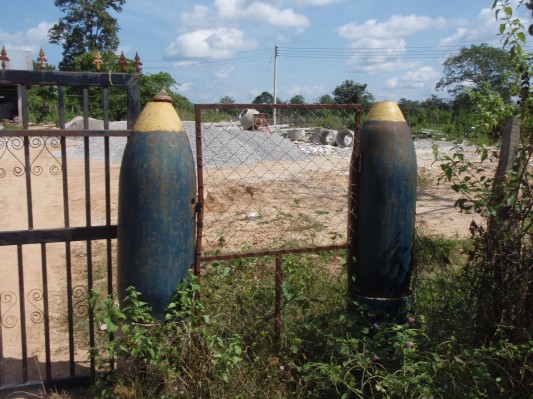


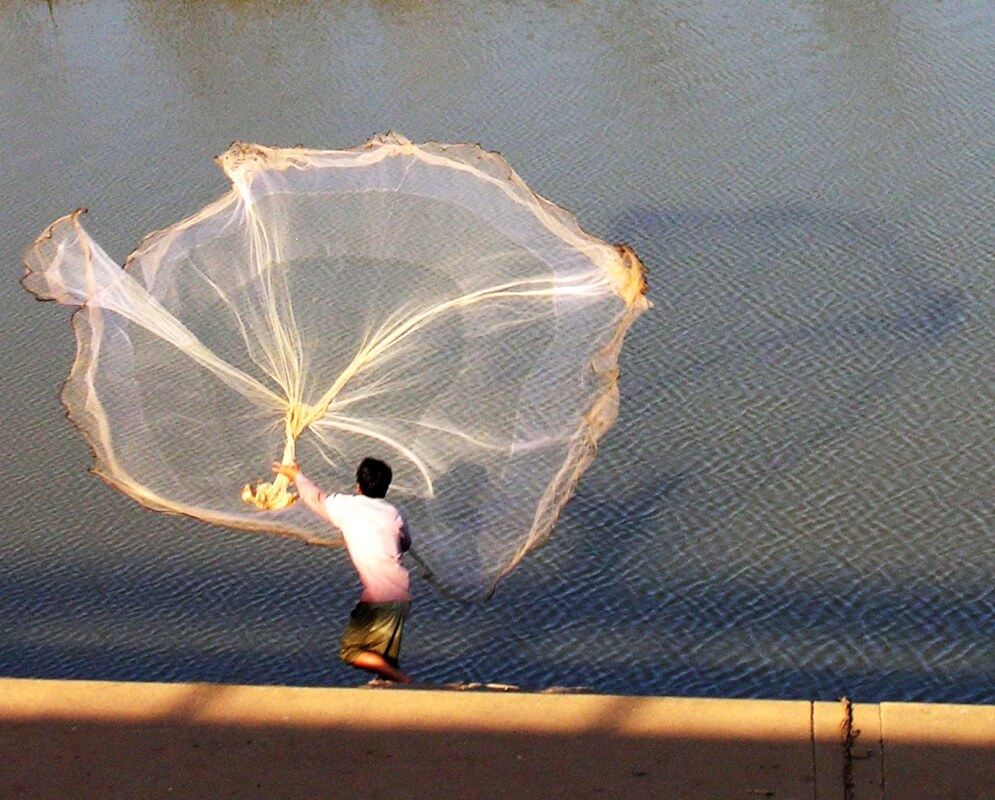


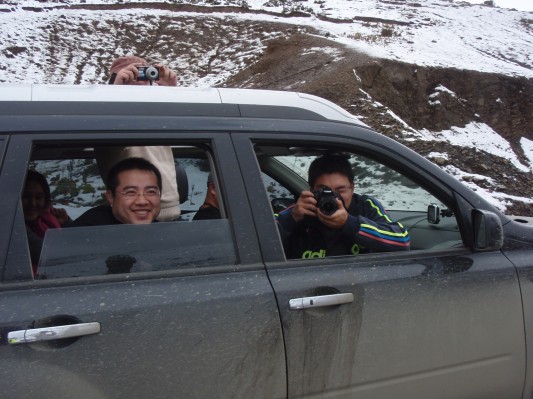


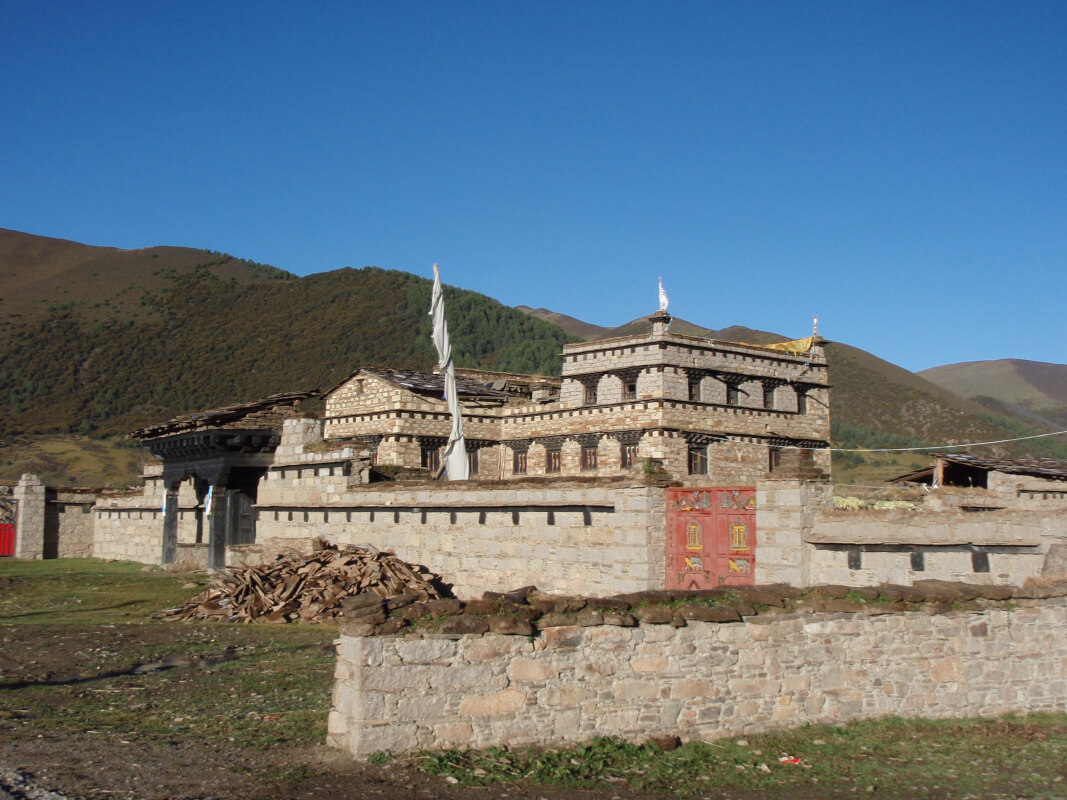


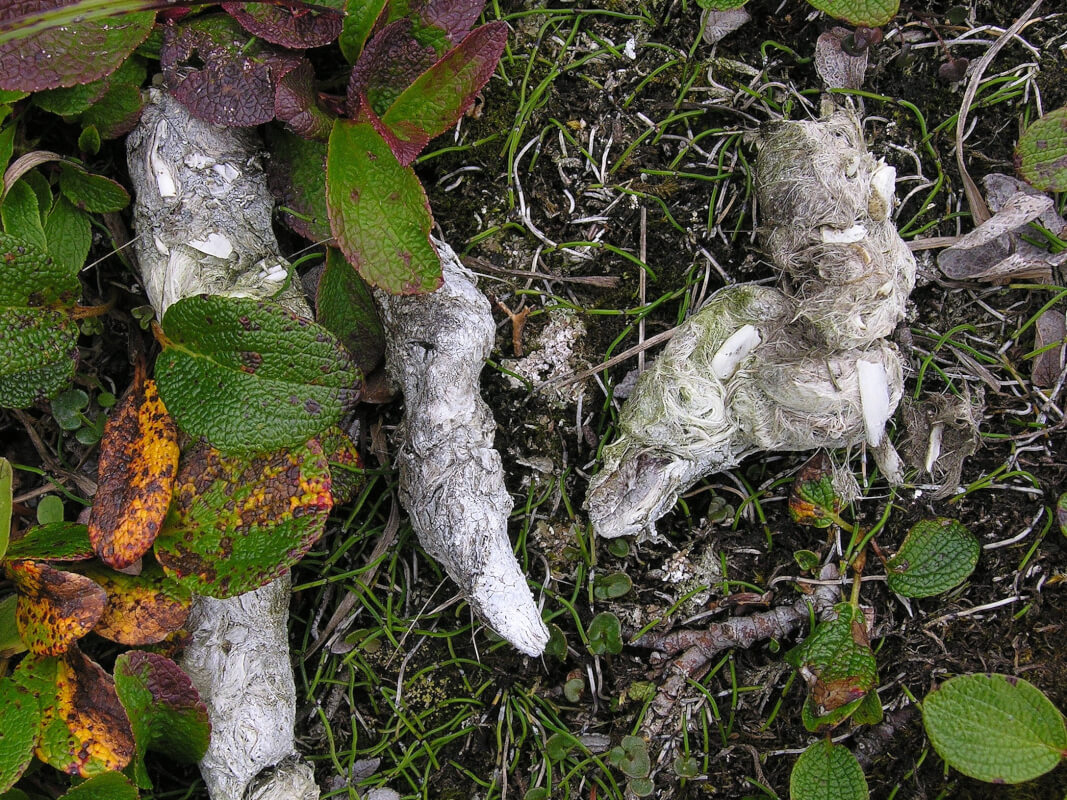


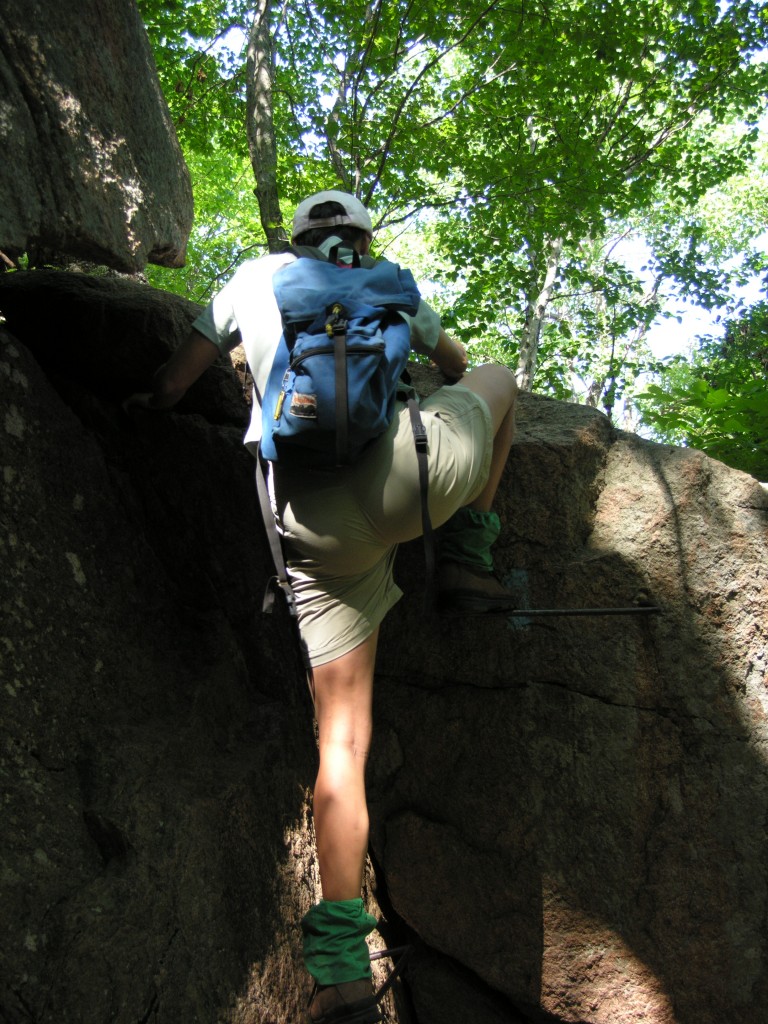


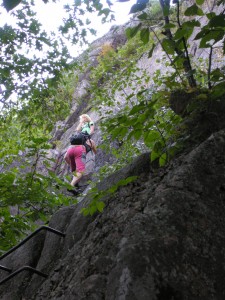
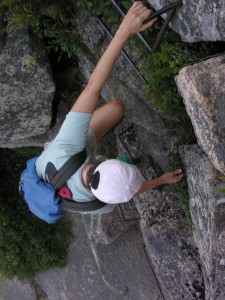


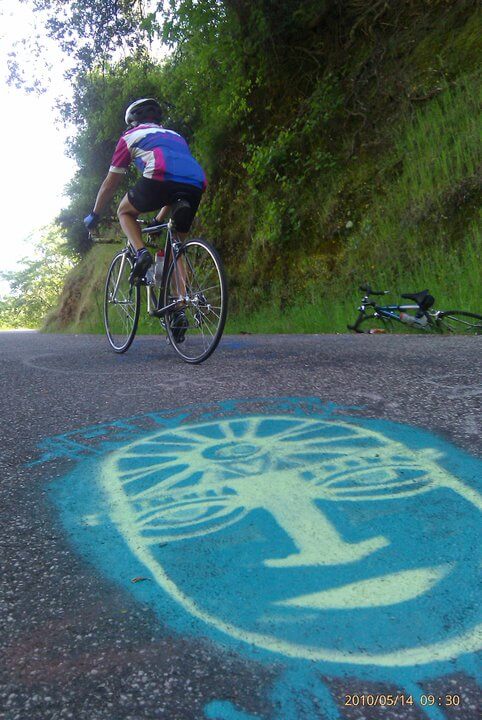




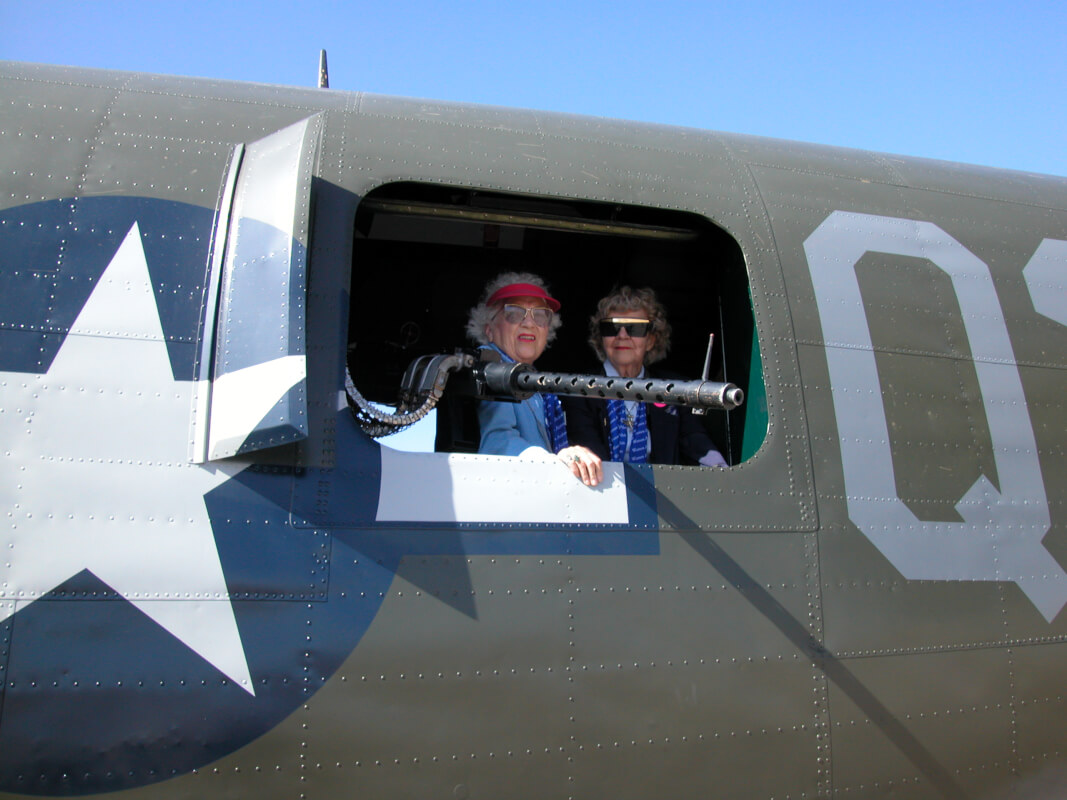


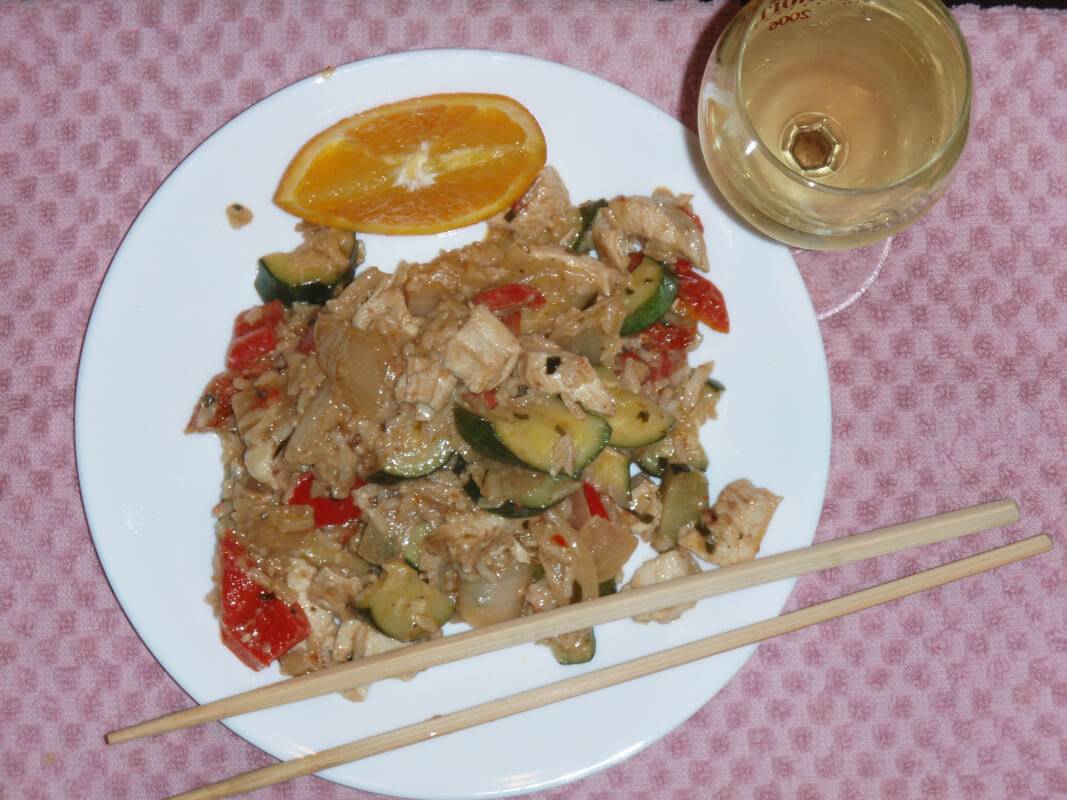


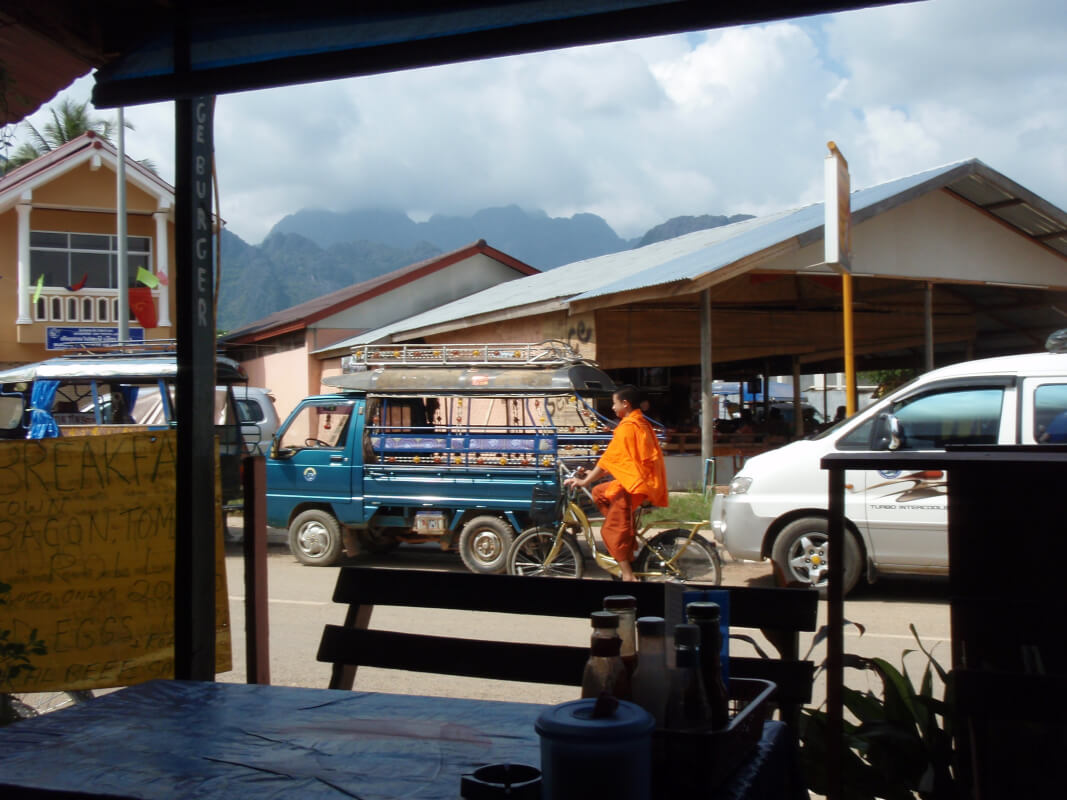




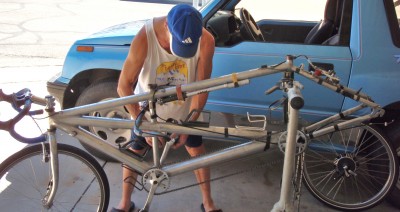
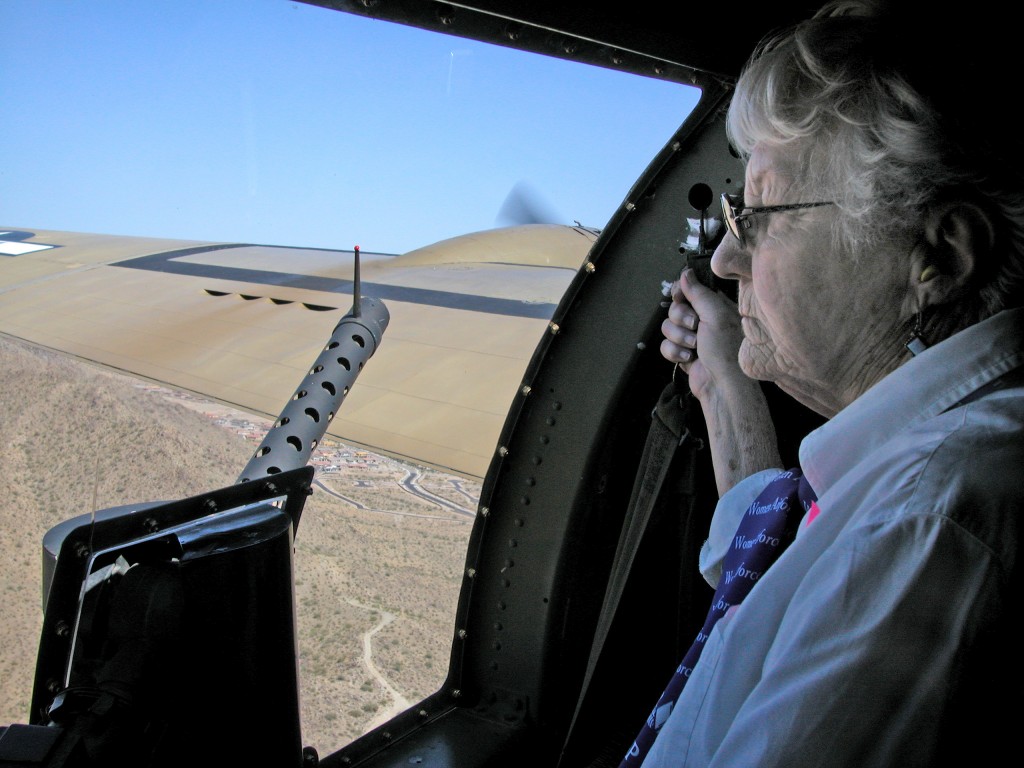


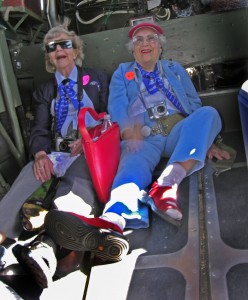


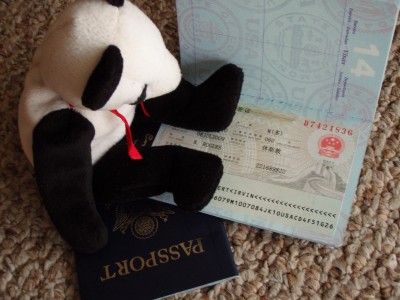


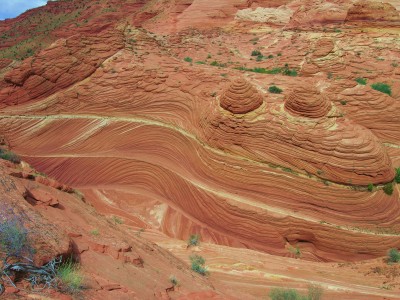


![[P7190213[7].jpg]](http://lh5.ggpht.com/brogers644/SIuprVMw1sI/AAAAAAAABHc/PRurtLYQ8zs/s1600/P7190213%5B7%5D.jpg)


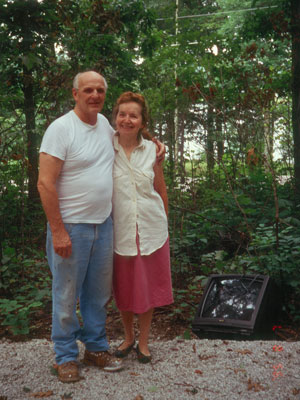 We were invited for dinner and a bed by a wonderful couple in Indiana who were curious about why we would do such a dangerous thing as ride a bicycle around America. They followed a preacher who told them Armageddon would come, at the year 2000. Their house had bars on the windows, several locks on the doors and weapons. They couldn’t explain how any of this would help in the great conflagration that we are told will come with Armageddon. I respect other’s religious beliefs, as long as they respect my lack thereof, but it seemed strange that their god did not give them comfort, but fear. We told them we had no fear because we were living our dream, and if something were to happen to us, we would have fulfilled our lives. I hope our lack of fear made them question their own excessive fear.