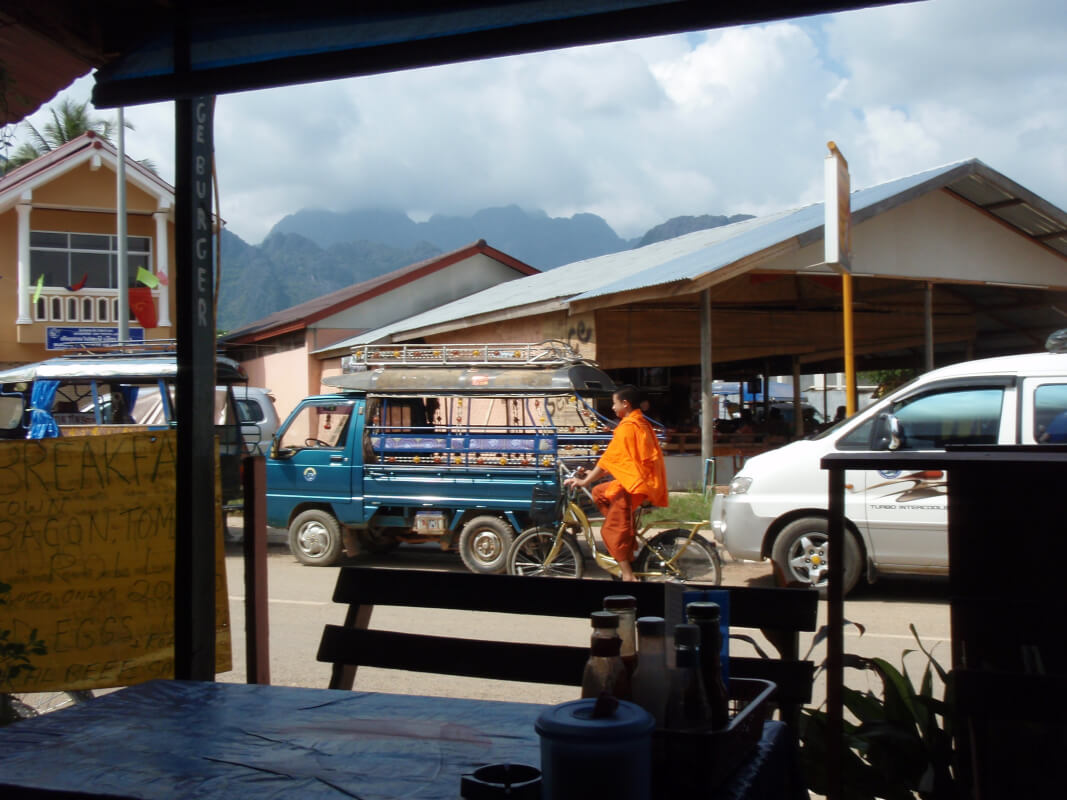
Battle, Lam Son 719: Tchepone, Laos and the Hoh Chi Minh Trail

From supposedly reliable intelligence, Abrams was able to follow the progress of troops and supplies south, and judge where and when the North planned to attack over the border into Vietnam. To paraphrase from A Better War, Lewis Sorley: Troops advanced south in waves 500 to 600, moving at 12.2 kilometers per day, mostly by foot, the trucks saved for supplies and ammunition. We were able to move perhaps 60 Kilometers on the unimproved section, partly because our load was not on our feet, but on our bicycle, and partly because we had no backup supplies; we had to get out of that jungle in short order.

Read the rest of this article...

Tchepone, Laos and the Southeast Asian War

Because of our most recent travels in Asia on our tandem bicycle, I have developed a new interest in the Vietnam War, really the Indochina War of my youth. My draft board called me in 1964. I presented myself, got on a bus and taken for a physical and mental evaluation. I was just out of hospital for a bleeding ulcer. They didn’t know how to cure ulcers in those days, and they knew military food would kill me: 4F. I have always had some survivor’s guilt, partly because I have seen the toll that particular war took on many of the surviving draftees. The vets I have shared this feeling with have said I didn’t miss anything, and to let it go. I think I have. Maybe traveling there, seeing the land and the people involved has had something to do with my coming to terms with those feelings. My appreciation for anyone who fought there is deep. It was one helluva place to have to fight a war.

Read the rest of this article...

Laotian Time Bombs: A war’s explosive environmental legacy (Sierra Magazine, Feb. 2011)

Our risk was nothing compared to the average Laotian farmer, wandering children, firewood gathering women, who know their next footstep can mean death, or for some worse, maiming, in a poor country where everyone must contribute.

Some facts: 270 million of these bombies were dropped on a country the size of Utah. Of the more than 50,000 people killed or maimed by the bombings, 20,000 have occurred after the end of the war. An average of one person a day is killed or maimed in Laos now, nearly 40 years later.

Read the rest of this article...

Shangri-la Posts In Reading Order

Bob and Claire Rogers have moved their Shangri-la, 2009 Asian Adventure blogs to a First to Last blog format. Relive their adventures from Tibetan China through Laos, Vietnam, Cambodia and Thailand.

Read the rest of this article...

To Your Adventurous 2010

prayer flags in tibet

“With coarse rice to eat, with water to drink, and my bended arm for a pillow – I have still joy in the midst of these things. Riches and honors acquired by unrighteousness are to me as a floating cloud.” Confucius

Before we began our Asian tandem bicycle adventure, I read Confucian quotes and often couldn’t relate.  This I chalked up to lack of depth on my part, and perhaps the enigmatic (to us) nature of Eastern thought.

Muddling my way through jet lag on our return, and as one friend opined, postpartum depression at the end of another adventure, I pondered the above Confucianism anew, and discovered I suddenly understood. Oh, I had known the surface meaning, from earlier adventures involving discomfort, danger, but not the full depth of his thought. I suddenly noticed that he says, “…have still joy…”  not “…still have joy…” as I had first read it. His meaning was hidden from me until I had eaten enough coarse rice, drank enough wood smoke infused water and slept sufficient times with my bended arm for a pillow.

To have a still joy, a quiet joy, a joy devoid of external condition, of riches or renown, is to have a profound joy, a lasting joy. I will look back on the past four months for as many years as I have left. I will remember the struggles, the discomforts, the challenge of the unknown, even the moments of  near panic, and I will smile. Confucius traveled China, seeking knowledge, seeking deep understanding. And Claire and I did also.

On this blog we have shared the light moments as well as the challenges and discomforts. I hope in coming months, as we integrate the lessons learned and share them, that you will be enriched through our seeking. And then I hope some of you will open a new path for learning, and seek out the adventure that fits your nature and capabilities. We all have the desire to continue to grow, to explore the previously unknown, no matter our age or condition in life. To suppress that desire is to suffer loss.

Here’s to your adventurous 2010, and beyond.

Happy New Year

Ho Chi Minh Trail: Six of Six

[httpv://youtu.be/FS8KuXoCseo]

This is final video about our search for one of the branches of the Ho Chi Minh Trail. There were many branches of the trail, in Laos as well as Vietnam. We wanted to see if we could find one of the branches, or at least have a better understanding of the experience those who traveled on the Laos portions of the trail lived. We got more than we bargained for…

Ho Chi Minh Trail: Five of Six

[httpv://youtu.be/ZEe1msNS_2E]

This is one of a series of six videos about our search for one of the branches of the Ho Chi Minh Trail. There were many branches of the trail, in Laos as well as Vietnam. We wanted to see if we could find one of the branches, or at least have a better understanding of the experience those who traveled on the Laos portions of the trail lived. We got more than we bargained for…

Ho Chi Minh Trail: Four of Six

[httpv://youtu.be/LpG2kWDnhKY]

This is one of a series of six videos about our search for one of the branches of the Ho Chi Minh Trail. There were many branches of the trail, in Laos as well as Vietnam. We wanted to see if we could find one of the branches, or at least have a better understanding of the experience those who traveled on the Laos portions of the trail lived. We got more than we bargained for…

Ho Chi Minh Trail: Three of Six

[httpv://youtu.be/loKiD3nCDU8]

This is one of a series of six videos about our search for one of the branches of the Ho Chi Minh Trail. There were many branches of the trail, in Laos as well as Vietnam. We wanted to see if we could find one of the branches, or at least have a better understanding of the experience those who traveled on the Laos portions of the trail lived. We got more than we bargained for…

Hoh Chi Minh Trail: Two of Six

[httpv://youtu.be/Mt1TvXtL4X4]

This is one of a series of six videos about our search for one of the branches of the Ho Chi Minh Trail. There were many branches of the trail, in Laos as well as Vietnam. We wanted to see if we could find one of the branches, or at least have a better understanding of the experience those who traveled on the Laos portions of the trail lived. We got more than we bargained for…

Ho Chi Minh Trail; One of Six

[httpv://youtu.be/NA0VMYO1Lw0]

This is the first of a series of six videos about our search for one of the branches of the Ho Chi Minh Trail. There were many branches of the trail, in Laos as well as Vietnam. We wanted to see if we could find one of the branches, or at least have a better understanding of the experience those who traveled on the Laos portions of the trail lived. We got more than we bargained for…

Watch for one each day.

Vientiane

Lotus Blossoms

Lotus Blossoms

A couple more mere blips of hills, and we are now in the valley of the Mekong, for the next week, before turning toward Vietnam. We arrived in the Capitol, Vientiane yesterday and applied for our Vietnamese visa. Claire got a bit of the last day of the Full Moon festival on video, and we will enjoy this small city for a day, possibly two. She’s over his gastro-intestinal episode, and ready to pedal. She finally found her French Toast! Unfortunately the only syrup they had on offer, was honey. Maple syrup comes from Quebec, for the French, and there are few French to be seen in the former colony, though we do see some of the language, Lao and English appear to be dominant. I can imagine that upsets the French.

Wahoo!

Wahoo!

We saw a single cyclist on the way into the city, met a couple just beginning their tour last night, and another this morning, heading south ahead of us. All are European and speak English. It was enjoyable to converse about our shared passion, places we have been, and share information about the road ahead. The single male, has cycle toured 100,000 kilometers.

Cemetery in Laos

Cemetery in Laos

Steve Wilson just passed 100,000 miles bicycling; congratulations Steve! So there is your new goal Steve. He was probably about your age, but started many years ago. But, it’s only 62,000 miles.

I don’t believe I have the desire for another 40,000 kilometers. Claire said we could do two more loops of Australia. We’ve been talking a lot about Australia on this trip. I think it may be our favorite, though North America still has some unexplored, by us, wonderful places.

We’ll post pictures of the last few days below. We  have scheduled some short videos, one from back in China over the next few days. John Hoyle pointed out that I can schedule posts ahead, so you hear from us, even while we are out there pedaling the Internet-less countryside.

Small Longtail in Laos

Small Longtail in Laos

Frangi Pangi

Frangi Pangi

Rice Fields

Rice Fields

Drum Tower at Wat in Laos

Drum Tower at Wat in Laos

At the Full Moon Festival

At the Full Moon Festival

National and  Party Flags of Laos

National and Party Flags of Laos

Symbol of French Colonialism in Laos, Vientiane

Symbol of French Colonialism in Laos, Vientiane

Sunset on the Mekong

Sunset on the Mekong

Bikinis, Tibetan Mountains and Stone Jars

Claire: Nothing makes us more stubborn than being told we can’t accomplish our goal.

Stone Jar and Bomb Crater on Plane of Jars, Laos

Stone Jar and Bomb Crater on Plane of Jars, Laos

The nice German tried to break it to us gently that we would probably have to stay with a Lao family because we would not make the big climbs ahead, 1600 meters for the day and it was already noon. He was almost right, we almost didn’t make it. Though we wouldn’t have minded staying with a family, we pushed on a little longer than usual because of his remark. It was a two Nescafe day.

We took a bus excursion to Phonsavan to save ourselves pedaling two days out and back to see the Plain of Jars. The massive, ancient stone jars are intriguing, but what really struck me with awe was envisioning them bouncing and shattering from the impact of the bombs that left huge, diving pool size craters. Some of the answers to the questions surrounding the 2500 year old relics may have been blown to bits.

Soapy Boy Chasing Zippy

Soapy Boy Chasing Zippy

I never did get credit from Bob for pulling off a perfectly timed one day excursion: We rode 50 kilometers by 12:30, found a guesthouse, unloaded and locked Zippy, showered, packed an overnight bag, found the bus ticket seller in the village and were on a bus to Phonsavan by 2:00. Once in Phonsavan, we teamed with Lorenz and Alex in a tuk-tuk to the Kongkeo Guesthouse where we booked the tour for the next day and even arranged for them to drop us back at the bus station at the end of the tour. We made it back to Zippy by 8:30 that night. Okay, it was all just dumb luck.

Bad luck did find me in the form of some foul lettuce. That took a day and some fat out of me, but I’m sure glad Bob didn’t get sick, he doesn’t have any fat to spare.

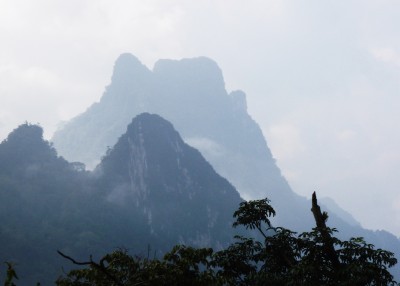
Though the karst topography is scenic, we’re looking forward to a few less hills. Once in Vientiane, we’ll be riding along the Mekong; the lower elevation will mean warmer temperatures. Let’s hope the roads are good.
Lao Karst Mountains

Lao Karst Mountains

I thought Lonely Planet was joking when they said Vang Vieng was full of backpackers all watching Friends reruns in the bars, but they’re mostly right. It is a strange scene to come upon overfed, tattooed and bikini-clad western girls when the most flesh we’ve seen lately has been on dark, skinny, naked Lao children bathing at the standpipe.

Bob: Claire is not kidding about the fat girls. A bit of weight that comes naturally with age is fine, but to jiggle like Jello at 23, and flaunt it, is bad form. The boys are just pale and flaccid, and drunk by noon. Bah Humbug. I’m getting old.

Mountains

It does appear we are mostly out of the mountains, finally. I think, but I have been wrong before. I looked at our stats, and we will be a little over 1,500 miles for two months. That is very slow for us on tour, as we usually do more like 1,000 to 1,500 per month. Now we are getting older, we would expect our average to come down a bit, but never have we had so many mountains. Of the 1,500 miles, 1,300 were in mountains with climbs of 2,000 to 7,000 feet per day, and many of those climbs were at very high elevation. Neither of those numbers is too bad, except when they come day after day after day, with no let up. For two weeks in Tibetan Sichuan, we were doing those climbs at elevations of 13,500 to nearly 16,000 feet. That was, to put it nicely, hard.

Mountain Panorama of Laos

Mountain Panorama of Laos

When we got to Northern Yunnan, we thought it would ease off, but it was not to be again. The climbs kept coming, just at a bit lower elevation. After the bus ride to Southern Yunnan the mountains continued into Northern Laos, where we were again sure they would at least become hills. It was not to be. Just three riding days ago, we climbed 1,600 meters, or 5,250 feet. This is not a bad day for us in Tucson, on our old but still fairly light road bikes, but on a loaded tandem, in heat and humidity, with 3300 feet waiting the next day, exhausting.

Karst in Central Laos

Karst in Central Laos

I look back at our first tour of the U.S., and the Rockies were with us for a long time, but the top elevation was just over 12,000 feet, and there were rolling plains between the ranges. The Himalayas of Southwest China gave no breaks, and Northern Laos the same, just lower in elevation. British Columbia and Alberta have a lot of big climbs, but the top elevation was 8,000 feet or so, and most of the climbs under 4,000 feet.

So, who is to blame for all these mountains? Me. I could have researched the route and known how hard it would be. But, my natural optimism led me to believe whatever mountains China and Laos threw at us, we would be able to handle. Well, it was close.

But, Stubbornness is our name, tenacity is our game. Now it gets easy, just heat and humidity, and I think there might be some little hills on the border with Vietnam, and some in Cambodia. Not to worry; can’t be much.

A few pictures from the last few days:

Net Fisherman in Laos

Net Fisherman in Laos

Home for Lunch
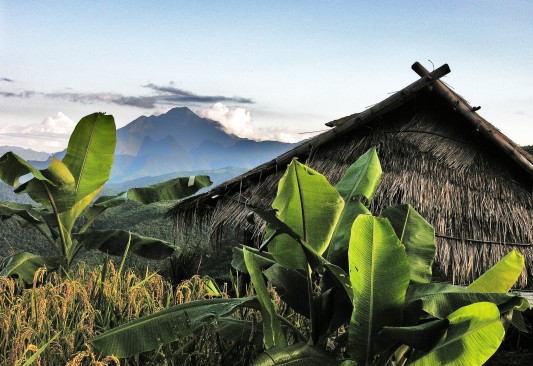
Home for Lunch

Laos Mountain Scene

Laos Mountain Scene

Working the Rice

Working the Rice

Monk on a Bicycle in Laos

Monk on a Bicycle in Laos

Helping Dad

Helping Dad

Hey! That's My Frog!

Hey! That’s My Frog!

He Found His Shangri-la

His Shangri-la

His Shangri-la

His Shangri-la is Lao

We stopped in the middle of a four hour mountain climb south of Luang Prabang, for a cold drink and some shade. A man came out of the house next door, and I glanced his way. Nah. He looked farang (Western) but it couldn’t be, this far out of the city, in a tiny village. Something about the way he moved about the house, helped a small boy with his shoes, said he belonged here, lived here.

I saw the beard, the nose, yup, farang. He turned to us and said, “Hello.” We spoke, he in a vaguely European accent with excellent English. He said he was German, and had traveled by bicycle, for five years, around the world. We shared touring stories, favorite places, bicycles. He said we could never make the climb by the end of the day, and the worse one waiting after that. We hoped he was wrong.

I wanted to know how he ended up in Laos, and how long he had been there. I waited. It would come.

He began his story: He got food poisoning in Laos. After five years of bicycle touring around the world, he was stuck in Luang Prabang. Then he met her, and his life changed forever. They married, have two children, and he has been in Laos for seven years. He manages a pig farm for his father-in-law, and the family spends half the week in Luang Prabang, where their children can get an adequate education, and half on the farm.

I asked him if he would ever go back to Germany, take his family. He smiled, “Never.” He is Lao now, family man, farmer, happy, healthy. He found what many would call his Shangri-la. His is real. A beautiful wife, comfortable home, two much loved children. So, for some seekers, Shangri-la becomes more than fantasy, an ideal, but a day to day life, real.

He traveled alone those five years on his bicycle; we know just how many pedal strokes that is. He was searching for something, Shangri-la maybe. He entered Laos from Yunnan China, mythical location of mythical Shangri-la, as we did. He hadn’t found it there, lovely as it is. Food poisoning brought it to him, it brought him love and purpose.

Where he lives is beautiful, very, very beautiful. The people are poor, but they laugh at, and with, we crazy farangs pedaling through their lives. They bathe by the roadside at a cold water stand pipe, and instead of complaining, laugh. They expect little, and appreciate much. Perhaps our German friend, now Lao, saw that, and the light of his love’s eyes, and knew he was home, in Shangri-la.

We didn’t get his name, but he has this site and we hope he will e-mail us. We will publish his name and correct any miss-perceptions. We’d also like him to know we made it to Kiukacham, just before dark. It was our hardest day in Laos.

Christmas? Now in a Lao Shangri-la

Christmas? Now in a Lao Shangri-la

Lucky Visits the Plain of Jars

There were all these big things made out of rock in Laos on the Plain of Jars. I got to look at the jars and saw myself in the water. Lorenz and Alex from Germany laughed. The other two nice people from England were Will and Jo. They introduced me to Eeyore. He is in a famous book called Winnie the Pooh, who is a bear. Eeyore is not a bear. He is a donkey. He is the nice people’s traveling companion. Just like me! We had a visit about our travels. He has his own web page. He doesn’t have to share one with his people, like I do.

Read the rest of this article...

Luang Prabang; World Heritage Site

Here are some photos from a morning walk around Luang Prabang. It is a World Heritage Site for the French Colonial architecture. We found much of that architecture degraded, but the town is very lively. Looking at the pictures, we are obviously more into people and food than architecture!

Sun Umbrellas

Sun Umbrellas

Text Messaging

Text Messaging

Fish Market

Fish Market

Interesting Food!

Interesting Food!

First Breakfast

First Breakfast

Morning Ferry Unloading in Luang Pabang

Morning Ferry Unloading in Luang Prabang

Laid Back Laos

We’ve been in the mountains of South Yunnan, China and Laos for several days. Our border crossing between China and Laos went smoothly, but we were unable to find accommodation on the Laos side; there were several hotels in Boten and all were filled with workers building two new hotels.

Lao Scene: In the northern mountans of Laos, near here, we saw men walking with  primitive bows and arrows.

Lao Scene: In the northern mountans of Laos, near here, we saw men walking with primitive bows and arrows.

The genius of central planning; in a year, all the workers will have gone elsewhere and the tourists will all be staying on the China side. Brilliant.

So, we were forced to head down the road in the afternoon sun, hoping for a place to lay our heads. As usual all the land is either too steep to camp on, or has crops growing.

Lao House

Lao House

A short 10 kilometers further, we started asking for accommodation, by pantomiming with two hands beside our heads for sleeping. People kept pointing back the way we came, and we feared they meant China, where we could not go, since we’d had single entry visas.

Finally a woman on a veranda nodded in the affirmative, Claire began her magic, and we soon had a nice clean room for $4.80. It was a very nice traditional Lao house. We left our shoes outside, per tradition, and entered a sanctuary of cool tile and warm wood. We were lucky we couldn’t find a Chinese style hotel in Boten; better to stay in a traditional Lao house in a small village on our first night in Laos.

We immediately headed for the wash up room: tile floor, two barrels of cool water, and a scoop to ladle water over our head and body. It sounds unpleasant, but after a day of difficulties, heat and humidity, it felt wonderful. There was a large metal basin on the floor for washing clothes, and a bar of laundry soap. I remember my mother doing a pre-wash in Fells-Naptha before throwing everything in the old ringer washer. The Lao haven’t gotten to those yet. Everything was very clean and our hostess went to the local store for a mosquito net once we found how to ask for it in the phrase book. We had noticed that the other three rooms were equipped with them.

Next on the agenda, was to find my first BeerLao, supposedly the best lager in SE Asia. It was certainly good, and cold from the closest store, 650ml, $.48. I’ll let you know if it’s the best after a few months.

We sat on the veranda of a woman who was old enough to have learned French under French rule in Laos, and Claire obliged, to the limits of her memory.

I enjoyed my BeerLao, and a fast developing sub-tropical rain storm beating the tin roof, releasing new exotic plant scents, and setting off the family rooster.

Welcome to Laos

Welcome to Laos

We slept well and awoke to the largest grasshopper I’ve ever seen gracing Zippy’s stem. We had a long day today, with more mountains, beautiful mountains, fecund and fragrant, so different from the Tibetan Plateau. The road turned awful; fist sized embedded rocks for kilometers at a time, or worse, a maddening 100 meter patch of bitumen every 500 meters. This was a county connector road, and we expect better very soon.

Claire has mixed emotions about leaving China. She was getting pretty good at carrying on basic conversations (I smile a lot) and now we have a new language to learn. We only have 30 days in Laos, so we won’t learn much before facing yet another language, Vietnamese.

The Internet is rumored to be slow in Laos, appropriate for a third world country, but we hope not so slow as to preclude the videos and photos we enjoy sharing with you. (So far it has taken one-half-hour to upload the grasshopper – we will hope for better in tourist towns a few days from here).

Claire:
I was kind of blue at the thought of leaving China. Twice, we’ve been here now and I wonder if we’ll ever be back again. The people have been very kind to us and I hope we’ve brought them some joy, at least a giggle or a good belly laugh as they take a break from the never-ending work. I wish the best for them.

I was glad to be finished with the countless tunnels along the new highway, some of them as long as nearly four kilometers and some with no lights. Poor Bob had to just aim his light at the yellow line and try to keep his balance. The worst tunnels were the ones with bollards to keep cars from overtaking, which meant we had to stop and pull over to the right as far as we could to let trucks pass. It wasn’t a shoulder, but rather a covered drainage ditch, with some of the concrete covers broken through, so Bob had to pick the right spot to stop. The noise was deafening sometimes and the fumes were thick.

The Xishuangbanna region is definitely more Southeast Asian than it is Chinese, environmentally and culturally. It’s a good transition for us. Though we’re sweltering hot by 10:00 a.m., we expect it to start getting a little cooler over the next month.

So far, I love Laos. We’ve seen all sizes of electric blue and neon yellow butterflies; we can hear insects buzzing, frogs chorusing and birds singing; bright flowers bloom and scent the air. The children are delightful; the little ones run naked after us, scattering chickens, waving and squealing “Sabadee, sabadee!”

Zippy is ready to roll!

Zippy shrink wrapped and ready for China. The wheels are in two other boxes, along with tools and sharp objects, a third bag will carry tent and sleeping bag for the high mountains. We’ll carry cameras and the computer in …

Read the rest of this article…

On the road again soon: Shangri-la and Beyond

We leave September 1 for Chengdu, Sichuan, China to begin a tandem bicycle tour of SW China and SE Asia. We begin in Chengdu, Sichuan, where the earthquakes killed thousands last year. We will visit some pandas and probably visit our first important Buddha statue before heading into high country where the Himalayas transition from the Tibetan plateau, giving birth to all the great rivers of SE Asia. After a long crossing into Yunnan, we will drop into the sub tropics of Laos, Vietnam, Cambodia and end probably in Bangkok, one of our favorite cities.

Read the rest of this article...