Jorge Luis Borges, and The New Bohemians, on Life and Travel

While working on New Bohemians today I ran across this previous post. The quote from Jorge Luis Borges evoked memories: they flashed across my inner travel screen, not in pixels, but in soft amorphous remembered images, scents, labored lungs and heart, sweat soaked, cold shivers; wind cooled and sun warmed. Smiles from faces never to be seen again… I thought I’d re-post. Share.

Read the rest of this article...

Jon Webb; Glint of Humor and Joy

At a distance I would not have recognized Jon had I passed him on the street, nor he I; forty plus years changes a body! But as I got closer, and the small talk proceeded, I began to notice bits of body language that hadn’t changed. As the memories of that time begat one story and another and another, suddenly there was a thing that touched me: an unmistakable Santa Klaus glint in his eye, a window into the humor and joy that is at the heart of the man; always has been, always will.

Read the rest of this article...

Preparing a Tandem Bicycle for the Andes and Amazon 1

I am beginning to dismantle Zippy, world touring tandem, in preparation for our next self supported tour, this time South America. Before each tour, I completely dismantle Zippy for three reasons: to find our which parts need replacing so I can order them and fix the worn parts, catch any impending failures of frame, rims or drive-train, and to re-familiarize myself with every part. Since many of the places we tour are hundreds of miles from a proper bike shop, I have to be able to fix pretty much anything. Anyone who owns a tandem will tell you tandems need more attention than single bikes; I might have to rebuild the hub somewhere in the high Andes, or the middle of the Amazon basin, while being munched on by ants and mosquitoes and critters we’ve never seen before.

Read the rest of this article...

Battle, Lam Son 719: Tchepone, Laos and the Hoh Chi Minh Trail

From supposedly reliable intelligence, Abrams was able to follow the progress of troops and supplies south, and judge where and when the North planned to attack over the border into Vietnam. To paraphrase from A Better War, Lewis Sorley: Troops advanced south in waves 500 to 600, moving at 12.2 kilometers per day, mostly by foot, the trucks saved for supplies and ammunition. We were able to move perhaps 60 Kilometers on the unimproved section, partly because our load was not on our feet, but on our bicycle, and partly because we had no backup supplies; we had to get out of that jungle in short order.

Read the rest of this article...

Laotian Time Bombs: A war’s explosive environmental legacy (Sierra Magazine, Feb. 2011)

Our risk was nothing compared to the average Laotian farmer, wandering children, firewood gathering women, who know their next footstep can mean death, or for some worse, maiming, in a poor country where everyone must contribute.

Some facts: 270 million of these bombies were dropped on a country the size of Utah. Of the more than 50,000 people killed or maimed by the bombings, 20,000 have occurred after the end of the war. An average of one person a day is killed or maimed in Laos now, nearly 40 years later.

Read the rest of this article...

The Many Faces of Buddha

Southeast Asia is made up of several compact, densely populated countries. Along with a change in currency and the sound of a different language, visitors to the region know they’ve crossed a national border simply by looking to the Buddha. Buddhist imagery and the philosophies it reflects are remarkably different from region to region worldwide, but the differences are especially pronounced in Southeast Asia.

Read the rest of this article...

Traveling Today’s Tea Horse Road

We`re hauling only one pound of tea on our aluminum horse built for two, a tandem bicycle we’re riding along the same course as an ancient trade route between the Tibetan Empire and the Chinese dynasties. Our cargo includes another 69 pounds of gear weighing us down as we angle up switchbacks and pound through potholes and washouts. Why would we subject ourselves to this arduous endurance test? To glimpse one of the most treacherous and lengthy trade routes on Earth. At least that is how the route was described by Jeff Fuchs, in his 2008 book, The Ancient Tea Horse Road: Travels with the Last of the Himalayan Muleteers. Fuchs has revived interest in the route after scouting its remaining traces to find clues to the people who last walked it.

Read the rest of this article...

Looking Back On Time an article by Claire Rogers in Desert Leaf

Because the Earth’s magnetic poles wander erratically over time, the magnetic orientation of artifacts from a site can be tied to specific dates in the geologic time scale.
Archaeologists love a good mystery, and they have found one at the base of the Tucson Mountains. One quarter mile from the West Branch of the Santa Cruz River, near what is now the intersection of Mission and Irvington roads, a complex of ancient settlements bears the markers of abrupt change. From A.D. 950 to 1140, agriculture in the area appeared to be on the rise and the population in flux. Initial archaeological research at the West Branch site began in 1984; nine years later, additional inquiry added volumes to what was previously known about the boom and bust of this period in Tucson’s pre-history.

Read the rest of this article...

The Finger Rock Trail, Tucson, Arizona, January 2011

Leftover snow with underlying ice made the going a tad slow in places. Seven miles and 3,000 vertical feet to Linda Vista, a good hike for my feet. Nice to be breathing in the fresh scents of the desert plants and stimulating conversation with friends. A new trail for me. Maybe next time,after the ice melts, The Finger, a thousand or so feet higher.

Read the rest of this article...

Making a New Year’s Resolution? Don’t!

It’s good to have traditions for the New Year, but not all traditions are positive. One I have done without for many years is to make a New Year’s resolution. Here’s why:

You will break it. Sad to say, nearly all New Year’s resolutions are broken, probably within a few weeks to a couple of months of their making. Oh, the motivation is pure. Say, you really, really resolve to lose that ten pounds you gained over the holidays, not to mention the three to five pounds that crept up on you over the year, like they have each year since you passed twenty-five. Don’t be too hard on yourself, it happens to the purest among us. It’s just the natural aging process, our wealthy society, our holiday binging philosophy, and just plain human nature.

Read the rest of this article...

Motorhome Boondock view of Kluane Lake, Yukon Territory, Canada

Kluane Lake, Yukon in late August, 2010 from the window of our motorhome. In Yukon Territory, you can pretty much “camp” wherever you can find a flat spot to park. Our Winnebego View is small enough to park just about any place you could park a van, yet has the essentials of any home. We watched the view morph to mellow evening light. We followed animal tracks in the rock and sand beach, and returned “home” to stir fry vegetables and pasta and a glass of wine. Darkness came quickly and we watched night displace day with billions of stars through our skylight. Simple pleasures are best.

Read the rest of this article...

Phillip Ashley: R324, Nazareth, Ky 40048 Important Person

In late 1995 we were riding our tandem, Zippy across remote Rio Grande, West Texas. We were 30 miles from any town, enjoying the warmth and sun, racing winter in New Mexico. A seventies era car passed us slowly, dented and rusted, and pulled over on the opposite shoulder a hundred yards ahead. Being alone, on our bicycle for about 11,000 since leaving our home in Washington State six months before, we naturally looked carefully at unusual cars and unusual behavior. As we neared the car, a man in his late 60’s emerged from the car and waved us down. He looked harmless, even cute, so we stopped and smiled as he approached with his antique camera, and took this picture.

Read the rest of this article...

The (Chinese) Communist Party Are Eating Their Young

Our world is becoming complicated. Cold War ways of thinking about Asia in particular are useless, damaging to our foreign policy. I wish more Americans would use their wealth to see, really see, our World, and understand that it is not as we were taught in school. Go and experience for yourselves, the lives of people, who except for accident of birth, are not that much different than you. Remember that; not that much different than you.

Read the rest of this article...

Litang, Tibetan Sichuan, No tourists here!

Litang is far from a tourist town. The roads are so bad that the Han Chinese find it quite an adventure to travel there via modern SUV to view the, strange to them, Tibetans. They found it quite strange to find two Westerners, a couple, riding a tandem bicycle, on the roads and elevations they found so daunting. They are daunting, and took a physical toll on us, leading to a well deserved rest in a town we came to love, and found difficult to leave, despite the high elevation and wonky weather.

Read the rest of this article...

Cambodian Disaster: Sad Event For A Fine People

So sad to hear of the crowd disaster and all the deaths in Cambodia. In our three weeks or so in the country we found the people to be hard working, cheerful and generally happy despite sometimes difficult living conditions. Like most Southeast Asians, they love their festivals, and the Water Festival is most beloved. This is an unusual occurrence and should not deter anyone from visiting this wonderful country. We’d go back in a minute. เทศกาลน้ำ

Read the rest of this article...

Ear Wax Removal Guaranteed, and Safer than the Vietnamese Barber’s Method

I do have an ear wax removal method you can do yourself. Before you shower, fill one ear with vegetable oil and let it soak by lying on your side for five minutes, or more if you can stand it. Absorb the oil with a paper towel when you stand. Shower with a moderately strong stream of warm water into that ear. After a couple of minutes, turn your ear to the bottom of the shower, jump on your right leg and bang your head on the opposite side, gently.

Read the rest of this article...

From Thomas Jefferson’s Inaugural Address: Listen to Our Founding Father

This is a very old speech. A speech by one of our founding fathers. We hear a lot about these men in recent years. Few of the people evoke their greatness have ever read their writings, know their opinions. The short excerpt from Thomas Jefferson’s inaugural address is just a sample. Follow the link to read the entire address, and please, before you invoke these brave, intelligent men, read their words, don’t use them to divide us.

Read the rest of this article...

Dr. Andrew Weil’s Integrated Wellness Program at Miraval

Claire snared a press invitations to the official opening of Dr. Andrew Weil’s Integrative Wellness Program at the posh spa Miraval in Tucson. We met Dr. Weil and had a tour of the facility with resident physician, Dr. Jim Nicolai and his nurse Sheryl Brooks. The idea is to combine the integrative medicine concepts of Dr. Weil with the exercise, stress and relaxation activities of Miraval to plot an optimal lifestyle and wellness path for clients.

Read the rest of this article...

Petrified Forest National Park: hidden gem just off I-40 N. Arizona

Recently Claire and I were lucky enough to catch a hike guided by the park paleontologist and an interpretive ranger. The short, two mile or so, hike took us away from the road and interpretive signs and into the washes and flats where dinosaurs died 225 million years ago in the late Triassic Period. We found pieces of bone and Claire even found an intact tooth. The stark landscape adds to the mystery and amazement of the realization that you are holding a thing, that was once part of a living Stagonolepis so long ago. Nothing like science to put one’s lifespan into perspective.

Read the rest of this article...

Crater Lake, Oregon; another BIG ONE only a matter of TIME

Mount Mazama, once over 12,000 feet in elevation, went through a half-million years of alternating eruptions and quietude. Between seven and eight thousand years ago, Mount Mazama erupted violently numerous times, covering eight states and three Canadian provinces with six inches of ash. These eruptions produced 150 times the ash as the Mount St. Helens eruption in 1980.

Read the rest of this article...

A Re-post of: A Thorn Tree Grows in Shangri-la

Finally we waved and pushed off, our 26 inch prayer wheels spinning out thousands of goodwill messages up his mountain; but I think we might have missed the point. The farmer and his wife live Shangri-la, not just in it, but they are Shangri-la. They are poor, but well fed, and the circle of their days allows for a break when tired, a visit with passing strangers, the rhythm of weeding, or wall building when they feel like it, and the song of bird and stream as accompaniment to it all.

Read the rest of this article...

Re-post of: Entering the Back Gate to the Garden of Shangri-la

This is a re-post from about a year ago when we were still on the Tibetan Plateau. We re-post it here for those who might have missed the original. If you wish to read the complete posts of In Search of Shangri-la, click on the link under Adventures at left.

We’ve called this often grueling trip from Chengdu, the Back Road to Shangri-la. A few days ago, we entered the high gate to the garden of Shangri-la. We topped out above 15,000 feet each day, and often stayed there for hours.

Read the rest of this article...

Losang’s Litang: Good Tibetan Site

We recently had a comment from Losang about my post on Litang. He he has lived in Tibet for eight years and knows all corners. If our posts gave you a taste of Tibet, Losang ‘s site offers a feast. I’ve linked to just his Litang post, but you can follow other links to the rest of his site.

Read the rest of this article...

Lucky’s High Pass in Tibet, a 16,000 foot high bear, one year ago today

There will be more mountains to come, and some will probably seem harder than this one. Zippy is making strange noises from the drive-train, and we fear we have put him under too much strain this time.

We are sometimes tired, but feeling stronger every day. We’ve reached that magical three-week point in a long challenging bicycle tour, when we are in the zone, when we feel pretty much ready for anything.

Read the rest of this article...

Litang:Tibetan Cultural Center of Tibet

people think of the Tibetan people and the Tibetan Plateau as being only within the lines drawn by the Chinese government, the Tibetan Autonomous Region. Both the Plateau and the Tibetan people are spread over several other provinces. The government encourages Hans to move into Tibetan lands with various incentives, and by building new cities deep in formerly exclusive Tibetan lands. But the fingers of Himalayas we crossed to climb the Plateau, and the difficulty in building and maintaining roads, have kept this part of Tibetan land Tibetan.

Read the rest of this article...

Snowy cold Tibetan pass for two weary travelers

When we awoke it was still raining, spattering the mud puddles of the courtyard with discouraging regularity. We couldn’t imagine another day of near hypothermia, and more hills and bad roads. But, we didn’t want to stay another day with the road workers, nice as they were, so we packed up our filthy gear and steeled ourselves for the day. By the time we were ready to go, the rain had stopped, and there was even a hint of blue over the first hill. The road workers were spot on with their description of the road ahead, a first on this trip.

Read the rest of this article...

Shelter in Tibet for two weary cold travelers

We used Bob’s jacket printed with a map of the world on it to try to convey where we were from, where we’d been and where we planned to go. I have no idea if they’d ever seen a map before. It doesn’t really matter to them, their world is an isolated village along a road between two passes and 50 kilometers from the nearest town. It sounds romantic: going to sleep to the sounds of chanting and waking to the sounds of milking. But these women’s lives are a gritty existence that our culture hasn’t known for generations. Hauling wood, water, and food up the ladder to the living space, making butter and curds, grinding grain, hand washing clothes, keeping the fire going, cooking… Mundane, routine, weather-dependent, smoke-filled and layered with years of grime.

Read the rest of this article...

Elation, Pain, Surprise: First of Three from one year ago

We were in the middle to nowhere for three days, climbed more passes than were supposed to be there, were never below about 14,000 feet and bad weather surprised us. The road to Shangri-la is always filled with life and surprise.

Follow the whole story over the next three posts.

Read the rest of this article...

High Tibetan mountains: Thinking of food

we’re eating pork now, or any kind of protein for that matter, and we eat whatever vegetables they bring us. At the grocery stores, we study and poke the packages and hope they’ll sustain us through a night of camping. Yogurt and cookies (a whole roll) is a before bed tradition of carbohydrate loading. …push a pedal stroke for us, we’ll need it; tomorrow; (tonight for you) we climb 7,000 feet to well over 15,000 feet and hope to get down in elevation to find a camping spot low enough to allow for sleep, before dark.

Read the rest of this article...

A New High: Into Tibet in Search of Shangri-la

Yesterday we rode Zippy to the highest elevation ever for us. We started at 8,500 feet in Kangding and topped Zheduo Pass at 13,900 feet in 35 kilometers, or 21.7 miles, all under construction/repair. For our Olympic Peninsula friends, that’s like taking the Hurricane Ridge Road, raising the sea level start to 3,000 feet above the Ridge, loading 80 pounds on your tandem before beginning. Oh, I forgot, put 1,000 people and hundreds of trucks and equipment on the now gravel/dirt/broken concrete road.

Read the rest of this article...

Into Tibetan Lands: a repost from one year ago today.

We are getting into Tibetan prefectures and seeing the dress and features of the minority population. After a 13,000 plus pass tomorrow, they will no longer be the minority. We are already seeing prayer flags flying, and old women turning prayer wheels as they walk, men dressed in huge leather cloaks with cowboy style hats and daggers. Everyone is friendly, and the air is finally clear!

Read the rest of this article...

Erlangshan Tunnel:Riding with Chinese friends, In Search of Shangri-la

We caught them 1,000 vertical meters later at the entrance to the summit tunnel to great exclamations of pleasure and another round of picture taking, with Zippy at the center. Lucky was busy flirting with one of the girls and got left out of the picture, again!

There were police and army personnel all over the place, protecting the tunnel no doubt, and we had to show our passports to be allowed through. We had heard horror stories about the tunnel, but found it reasonably well lit and smooth. As usual, when you worry, it is always unnecessary.

Read the rest of this article...

Yak Parade, from one year ago In Search of Shangri-la

We have various obstacles as cyclists in America, but in Tibet the challenges are different that your usual yahoo yelling obscenities or throwing bottles. You move forward slowly, and the sea of black horned quadrupeds part like the Red Sea for Moses. After their passing, it is best to keep a close lookout for Yak bombs.

Read the rest of this article...

Chengdu China one year ago today. Series on beginning In Search of Shangri-la

One year ago today we rode our tandem in Chengdu, China traffic in preparation for our journey across Tibetan China and through Southeast Asia. We are beginning a series of re-posts remembering this adventure. Follow us as we remember, or better yet, go to the link at left, In Search of Shangri-la and read the whole four months.

Read the rest of this article...

Tiger Mountain, Washington, High Flyers

Hiked a 5 mileRT/2000 ft. trail with Bob’s sister Anne Bowlds today. At the summit we watched locals float over forests and meadows and slowly guide their fascinating craft to a gentle landing far below. Looks like fun. Nice Claire photos! Tiger Mountain Washington state.

Read the rest of this article...

Kettle Valley Rail and Wine Trail

The Kettle Valley Rail Trail isn’t all remote mountain views and trestles; we rode beside grapevines and past winery doors on a section from Penticton to cute little Naramata. I liked Naramata, lovely by the lake, but also because it reminded me of Australian names, many of which end with …ata, sometimes …atta. Homesick for Australian wine country again.

Read the rest of this article...

Kettle Valley Rail Trail

We got on the, still unfinished, Kettle Valley Railway (rail trail) bypassing Kelona and on to Penticton. The Myra-Bellevue Provincial Park is the most spectacular section of the trail, with 18 trestles and two tunnels in an 8.5 kilometer section.

Read the rest of this article...

Midnight Sun Blues

There is something about the light here this past week: soft and heavy and long nearly through the night; long and soft and ineffectual. I find it vaguely depressing, sometimes not so vaguely. An hour of blessed sunshine makes it worse, knowing it will go away and take the mountains and the spectral highlights, the sparkle, with it. The sun, slow to come, always going away, soon. I know I shouldn’t feel this way about the North. I feel guilty about, which doesn’t help any. All the beauty; moose, bears, lakes, mountains, and still snow patches and sometimes glaciers. But the light is just not there, just not right, yet.

There were days during the months we spent in Iceland

Read the rest of this article...

Whitehorse: A Busy First Nations Day and Solstice

A fun example of the cultural mixing here was the jig contest. Now, I’ve always thought of the jig, danced to a fast fiddle, as an Anglo-Saxon tradition: Irish, Scottish, French, but here it’s a local tradition, with most of the dancers of First Nations descent, with plenty of mixed and white faces giving it a go. Oh, by the way, the really really excellent fiddler seemed to be from the orient. Go figure.

Read the rest of this article...

The Eagle Has Landed

We boondocked with this van in the Bellingham Wal*Mart. It was festooned with sculptures of eagles. An older couple (like 80’s) were not shy about being noticed! Car after car drove up, rolled down their windows, and took a photo with cameras or phones. One woman left her car running in the middle of the busy lane and made a slow walk-around video.

Read the rest of this article...

Precipice Trail, Acadia National Park on Mount Desert Island Maine

There must be a lot of people considering doing the Precipice Trail in Acadia National Park again this summer. From our New Bohemians.net stat numbers it is the most popular outdoor “hike” in America. We loved it. It’s easy as long as you don’t have a fear of heights. Go for it! While you are at it, check our our links (left) for adventures of a couple who found Precipice Trail very easy: across the Silk Road, Around Australia, In Search of Shangri-la etc., all by tandem bicycle, 40,000 miles worth.

Read the rest of this article...

Deadly Bangkok, Another Side of the Story

I wrote from Bangkok that it was a Shangri-la of major cities, and despite a few inconveniences now and then, I stand by that assessment. It is a great place to get a taste of Asia without getting too far out of your comfort zone, a place from which to launch more adventurous forays into the most important continent in the coming century.

Read the rest of this article...

Good-bye Tai Shan

We recently rode our bicycle from Chengdu across the SW China mountains (Himalayas and Tibetan plateau). We began in Chengdu and visited the Giant Panda Breeding Center. Lucky, our stuffed panda, made the visit with and was not sure what to think of the really really big (to him) pandas. Tai Shan is leaving National Zoo today for the Giant Panda Breeding Center, Chengdu, China. Video of Tia Shan at the National Zoo made him the most popular Panda ever. Thousands tuned in daily to watch his clumsy antics.

Read the rest of this article...

Uighurs Make An Impact

There has been no Internet in Far West China (Xinjiang) since the violence between Han Chinese and the native Uighurs. Some reports have as many as 500,000 Hans leaving Xinjiang since the violence, and the Chinese government now allowing Hans to sell to anyone other than a Han if they leave. This could put a big time kibosh on the governments’s plans to flood the remote province with Hans.

Read the rest of this article...

Bangkok; a Shangri-la among World Cities

Guardian Figure at Wat in Bangkok; Scary eh.

Guardian Figure at Wat in Bangkok; Scary eh.

Claire: With so many temples and shrines around Bangkok, a poor tourist can’t go wrong visiting any one of them–they’re all beautiful. The best part is that the less famous of them still stand apart from the hustle-bustle of the city and provide a welcome relief of quiet and reflection without the crowds to interfere. Morning is a good time to observe Thai acts of generosity and devotion. Put down the camera, pocket the map, forget the time and just take it all in.

Golden Stupa

Golden Stupa

Bob: This is the second long tour we have ended with a stay in Bangkok. After 11 months cycling around Australia, we spent 10 days here, and this time we cycled from China and will spend eight days here before flying out on Christmas Day.

It’s very easy to lose a week in Bangkok. It is more Western than it was when we were here last nearly 10 years ago, but still exotic, still endearing in so many ways. The people are beautiful, the traffic reasonable, compared to China, and the food, the food, heavenly, and inexpensive. Oh, the weather is not bad either, after you become accustomed to sunshine and 90f.

The air quality has improved, or perhaps it is the season, with reliable winds each afternoon; there are fewer motorcycles and more cars, a bad thing, but the motos and tuk tuks are now mostly four-stroke and cleaner.

Bangkok is a great city for your first taste of Asia. Among large cities of the world, it is a Shangri-la.

Longtail Boat on Chao Phraya River

Longtail Boat on Chao Phraya River

Fertility Linga Among the Fish at a Neighborhood Market in Bangkoki

Fertility Linga Among the Fish at a Neighborhood Market in Bangkoki

Orchid, one of many found all over Bangkok

Orchid, one of many found all over Bangkok

Stupas and Offerings in Bangkok

Stupas and Offerings in Bangkok

Most Important Buddah In Thailand

Most Important Buddah In Thailand

Woman Making Offering At Market Shrine in Bangkok

Woman Making Offering At Market Shrine in Bangkok

Beautiful Wat architecture in Bangkok

Beautiful Wat architecture in Bangkok

Peppers In Bangkok Market

Peppers In Bangkok Market

Bangkok, Stupa in Wat

Bangkok, Stupa in Wat

World's Largest Reclining Buddah

World’s Largest Reclining Buddah

Monitor Lizard in Bangkok Cana

Monitor Lizard in Bangkok Canal

Morning in Kompong Cham

Mekong

Mekong

Nice Frogs For Sale; Want Some Frogs?

Nice Frogs For Sale; Want Some Frogs?

Helper

Helper

Silver Dollars

Silver Dollars

Selection

Selection

fruit

Modern Cambodian Market Woman

Modern Cambodian Market Woman

Sunrise over the Mekong and a morning spent in one of our favorite Asian markets; wonderful coffee and spring rolls at a market stand started our day off right.

We leave the Mekong for good soon, and we will miss it. The river is the lifeblood of SE Asia, and the people use it fully.

We were not far from the river’s source in the Tibetan lands of the Himalaya and enjoyed it in Laos and the delta in Vietnam. It is truly one of the world’s great rivers and we are privileged to have seen so much of it, and it’s people.

Buddhist Festival Invitation

[httpv://youtu.be/rTPvCT_ZMb4/]

“Wait! Bob, stop: there’s another temple and it looks like there must be something going on.” I’ll just dash in and take a quick photo. Soon, I was talking to Winnie, an English teacher, while Bob was surrounded by curious men. We’d happened upon a Buddhist celebration revering mothers. How appropriate that I’ve been hearing my mother’s voice telling me about Saigon before I was born. We listened to the chants and gongs and were soon invited to the feast to follow. I watched Winnie tenderly feed her animated 90-year-old grandmother. I told Winnie how lucky she was to still have her mother and grandmother. We tried, unsuccessfully, to fend off the large quantities of food that were being packed for us to ride away with. After meeting with the head monk and making conversation, Bob was able to give our translator the gift of a pair of reading glasses, which he evidently needed.

Vietnam: The Mountains

On a flood damaged road in the Central Highlands of Vietnam

On a flood damaged road in the Central Highlands of Vietnam

Life on the river, Vietnam

Life on the river, Vietnam

Central Highlands of Vietnam

Central Highlands of Vietnam

Boats made from scavanged military parts

Boats made from scavenged military parts

Quang Tri River in Vietnam

Quang Tri River in Vietnam

War Relic in the mountains of Vietnam

War Relic in the mountains of Vietnam

School Girls

School Girls

Catholic Church in Vietnam

Catholic Church in Vietnam

Disarmed bombs used as fence posts near the Lao/Vietnam border.

Disarmed bombs used as fence posts near the Lao/Vietnam border.

Incense burning on military graves in Vietnam

Incense burning on military graves in Vietnam

Bikinis, Tibetan Mountains and Stone Jars

Claire: Nothing makes us more stubborn than being told we can’t accomplish our goal.

Stone Jar and Bomb Crater on Plane of Jars, Laos

Stone Jar and Bomb Crater on Plane of Jars, Laos

The nice German tried to break it to us gently that we would probably have to stay with a Lao family because we would not make the big climbs ahead, 1600 meters for the day and it was already noon. He was almost right, we almost didn’t make it. Though we wouldn’t have minded staying with a family, we pushed on a little longer than usual because of his remark. It was a two Nescafe day.

We took a bus excursion to Phonsavan to save ourselves pedaling two days out and back to see the Plain of Jars. The massive, ancient stone jars are intriguing, but what really struck me with awe was envisioning them bouncing and shattering from the impact of the bombs that left huge, diving pool size craters. Some of the answers to the questions surrounding the 2500 year old relics may have been blown to bits.

Soapy Boy Chasing Zippy

Soapy Boy Chasing Zippy

I never did get credit from Bob for pulling off a perfectly timed one day excursion: We rode 50 kilometers by 12:30, found a guesthouse, unloaded and locked Zippy, showered, packed an overnight bag, found the bus ticket seller in the village and were on a bus to Phonsavan by 2:00. Once in Phonsavan, we teamed with Lorenz and Alex in a tuk-tuk to the Kongkeo Guesthouse where we booked the tour for the next day and even arranged for them to drop us back at the bus station at the end of the tour. We made it back to Zippy by 8:30 that night. Okay, it was all just dumb luck.

Bad luck did find me in the form of some foul lettuce. That took a day and some fat out of me, but I’m sure glad Bob didn’t get sick, he doesn’t have any fat to spare.

Though the karst topography is scenic, we’re looking forward to a few less hills. Once in Vientiane, we’ll be riding along the Mekong; the lower elevation will mean warmer temperatures. Let’s hope the roads are good.
Lao Karst Mountains

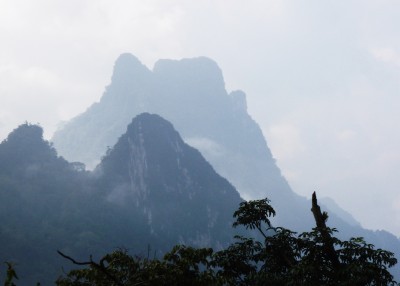
Lao Karst Mountains

I thought Lonely Planet was joking when they said Vang Vieng was full of backpackers all watching Friends reruns in the bars, but they’re mostly right. It is a strange scene to come upon overfed, tattooed and bikini-clad western girls when the most flesh we’ve seen lately has been on dark, skinny, naked Lao children bathing at the standpipe.

Bob: Claire is not kidding about the fat girls. A bit of weight that comes naturally with age is fine, but to jiggle like Jello at 23, and flaunt it, is bad form. The boys are just pale and flaccid, and drunk by noon. Bah Humbug. I’m getting old.

Mountains

It does appear we are mostly out of the mountains, finally. I think, but I have been wrong before. I looked at our stats, and we will be a little over 1,500 miles for two months. That is very slow for us on tour, as we usually do more like 1,000 to 1,500 per month. Now we are getting older, we would expect our average to come down a bit, but never have we had so many mountains. Of the 1,500 miles, 1,300 were in mountains with climbs of 2,000 to 7,000 feet per day, and many of those climbs were at very high elevation. Neither of those numbers is too bad, except when they come day after day after day, with no let up. For two weeks in Tibetan Sichuan, we were doing those climbs at elevations of 13,500 to nearly 16,000 feet. That was, to put it nicely, hard.

Mountain Panorama of Laos

Mountain Panorama of Laos

When we got to Northern Yunnan, we thought it would ease off, but it was not to be again. The climbs kept coming, just at a bit lower elevation. After the bus ride to Southern Yunnan the mountains continued into Northern Laos, where we were again sure they would at least become hills. It was not to be. Just three riding days ago, we climbed 1,600 meters, or 5,250 feet. This is not a bad day for us in Tucson, on our old but still fairly light road bikes, but on a loaded tandem, in heat and humidity, with 3300 feet waiting the next day, exhausting.

Karst in Central Laos

Karst in Central Laos

I look back at our first tour of the U.S., and the Rockies were with us for a long time, but the top elevation was just over 12,000 feet, and there were rolling plains between the ranges. The Himalayas of Southwest China gave no breaks, and Northern Laos the same, just lower in elevation. British Columbia and Alberta have a lot of big climbs, but the top elevation was 8,000 feet or so, and most of the climbs under 4,000 feet.

So, who is to blame for all these mountains? Me. I could have researched the route and known how hard it would be. But, my natural optimism led me to believe whatever mountains China and Laos threw at us, we would be able to handle. Well, it was close.

But, Stubbornness is our name, tenacity is our game. Now it gets easy, just heat and humidity, and I think there might be some little hills on the border with Vietnam, and some in Cambodia. Not to worry; can’t be much.

A few pictures from the last few days:

Net Fisherman in Laos

Net Fisherman in Laos

Home for Lunch
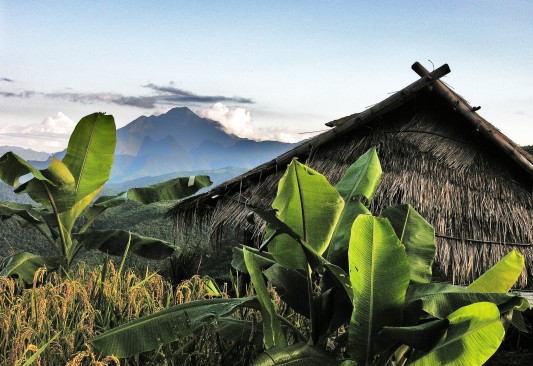
Home for Lunch

Laos Mountain Scene

Laos Mountain Scene

Working the Rice

Working the Rice

Monk on a Bicycle in Laos

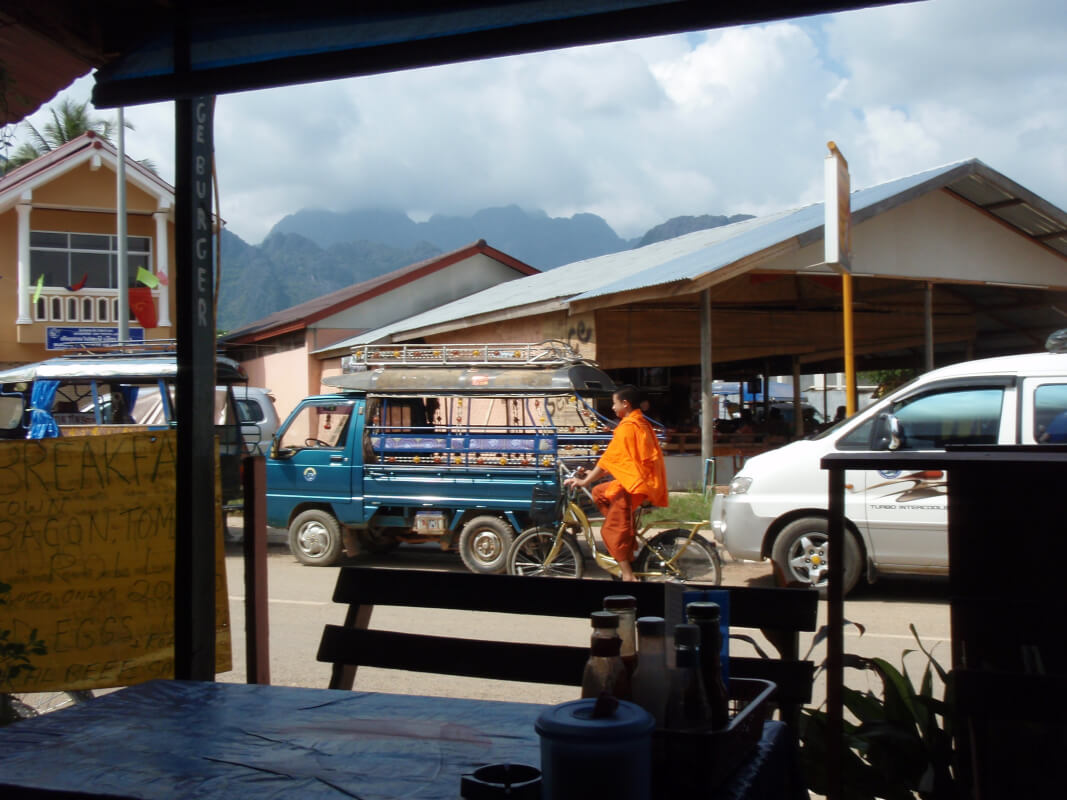
Monk on a Bicycle in Laos

Helping Dad

Helping Dad

Hey! That's My Frog!

Hey! That’s My Frog!

He Found His Shangri-la

His Shangri-la

His Shangri-la

His Shangri-la is Lao

We stopped in the middle of a four hour mountain climb south of Luang Prabang, for a cold drink and some shade. A man came out of the house next door, and I glanced his way. Nah. He looked farang (Western) but it couldn’t be, this far out of the city, in a tiny village. Something about the way he moved about the house, helped a small boy with his shoes, said he belonged here, lived here.

I saw the beard, the nose, yup, farang. He turned to us and said, “Hello.” We spoke, he in a vaguely European accent with excellent English. He said he was German, and had traveled by bicycle, for five years, around the world. We shared touring stories, favorite places, bicycles. He said we could never make the climb by the end of the day, and the worse one waiting after that. We hoped he was wrong.

I wanted to know how he ended up in Laos, and how long he had been there. I waited. It would come.

He began his story: He got food poisoning in Laos. After five years of bicycle touring around the world, he was stuck in Luang Prabang. Then he met her, and his life changed forever. They married, have two children, and he has been in Laos for seven years. He manages a pig farm for his father-in-law, and the family spends half the week in Luang Prabang, where their children can get an adequate education, and half on the farm.

I asked him if he would ever go back to Germany, take his family. He smiled, “Never.” He is Lao now, family man, farmer, happy, healthy. He found what many would call his Shangri-la. His is real. A beautiful wife, comfortable home, two much loved children. So, for some seekers, Shangri-la becomes more than fantasy, an ideal, but a day to day life, real.

He traveled alone those five years on his bicycle; we know just how many pedal strokes that is. He was searching for something, Shangri-la maybe. He entered Laos from Yunnan China, mythical location of mythical Shangri-la, as we did. He hadn’t found it there, lovely as it is. Food poisoning brought it to him, it brought him love and purpose.

Where he lives is beautiful, very, very beautiful. The people are poor, but they laugh at, and with, we crazy farangs pedaling through their lives. They bathe by the roadside at a cold water stand pipe, and instead of complaining, laugh. They expect little, and appreciate much. Perhaps our German friend, now Lao, saw that, and the light of his love’s eyes, and knew he was home, in Shangri-la.

We didn’t get his name, but he has this site and we hope he will e-mail us. We will publish his name and correct any miss-perceptions. We’d also like him to know we made it to Kiukacham, just before dark. It was our hardest day in Laos.

Christmas? Now in a Lao Shangri-la

Christmas? Now in a Lao Shangri-la

A Thorn Tree Grows in Shangri-la

[httpv://youtu.be/CUH08hlrnbM]
This is the second time small Tibetan boys have stood at attention as we passed and held a salute until we released them with a return salute. We wonder what it means? Is it serious, or is is sarcasm reserved for foreigners and police and army?


October 2, Derong, Sichuan, China: A Thorn Tree Grows in Shangri-laBob:
We left Xiang Cheng, for another long day of climbing, our last over 4,000 meters. The road had a reasonable grade (we could maintain 7kph (about 4.5mph) and the surface was good bitumen. The views back down the valley to the monastery were spectacular and the few small farms blended organically into the vertical mountains.

Tibetan valley with houses

Tibetan valley with houses

At one curve in the road, a woman looked up from weeding her small orchard, and let out with an extended soliloquy on our presence, accompanied by a large smile. Her husband, walking in the road, waved us down, and eagerly suggested, in pantomime, the we join him for a rest under a shade tree. He too beamed with joy at the possibility of enjoying our company. We had a difficult (more than we knew) day ahead of us, and I pointed at my wrist and shook my head in denial. He persisted, and we went back and forth, all with smiles.

Finally we waved and pushed off, our 26 inch prayer wheels spinning out thousands of goodwill messages up his mountain; but I think we might have missed the point. The farmer and his wife live Shangri-la, not just in it, but they are Shangri-la. They are poor, but well fed, and the circle of their days allows for a break when tired, a visit with passing strangers, the rhythm of weeding, or wall building when they feel like it, and the song of bird and stream as accompaniment to it all.

We, on the other hand, have brought our schedule laden philosophy with us. We are here to SEE Shangri-la, not be it or live it. We have conquered her mountains, seen those living Shangri-la, but have not made the truth-based myth our own. Oh, we have absorbed much more than those black SUVs that pass us by the scores each day, carrying Chinese to possess for a holiday, their most exotic locations. At least we have the memory in our legs and lungs of the place; we have the images of the genuine smiles from the minorities directed to us as somehow kindred spirits. But will we bring it home with us?

Farm in China along river

Farm in China along river

Now for that thorn tree: As you will read in Claire’s note, there are many police in Shangri-la. As we have descended the Himalayas, the number of police posts on the roads has grown with one about every 50 kilometers. As we came up the eastern side of the range’s fingers, there were few posts, and they always waved us past, usually with a smile. Here it is different. We are still in Tibetan minority area, and very close to the border with the Tibetan Autonomous Region, where we assume they are expecting trouble. We were not able to go into the TAR as independent travelers, only as part of an organized group with a minder/guide. About a week ago, even that privilege was revoked for foreigners.

Police post in China

Police post in China

To me it seems at least a few of the police on this side have taken a negative tone with laowai (foreigners). Not all by any means, most perform your passport check professionally and even smile. But, after a beautiful descent of our last 4,000 meter peak, we came to a village where we understood there was accommodation. At the police stop, in the center of the village, one young man strutted back and forth of Zippy, regaling the growing crowd of mostly Tibetans with his apparently negative opinion of us. He particularly seemed to dislike the Tibetan prayer flag we had attached to the handlebar bag, and indicated his disgust with a sneer and a dismissive flip of the flag. He also told us the accommodation was no longer available, and through a translator, that we get a family to put us up, an unlikely possibility after word spread about his dislike of us. The locals fear the police. They don’t seem to be there to solve crimes, but to watch over the non-Han population, and make sure they have little contact with foreigners.

Claire Rogers and Lucky in tent

Claire Rogers and Lucky in tent

Tent camouflaged with branches

Tent camouflaged with branches

Valley and river in China

Valley and river in China

Claire getting water from a seep in China

Claire getting water from a seep in China

Tibetan couple

Tibetan couple

Monks on a motorcycle

Monks on a motorcycle

At this point we knew we would have to guerilla camp, and bought two chicken legs at a store, and got some stir-fried egg and tomato, a huge bowl of rice, and all our water bottles filled with boiling water. While we were eating, an old Tibetan man fingering his beads, came over, touched our prayer flag, nodded his head and smiled. There is a split here and it revolved along religious/ethnic lines. Only one side wears uniforms. This could get us thrown out. Yesterday, I had to help a policeman go through all the pictures on the camera Claire uses to shoot from the back of Zippy. He was a pleasant young man, just doing his job, but to an American, it was difficult to endure. Few countries have a First Amendment. Treasure yours.

We left the village for a 12 kilometer climb to an uncertain camping spot. The mountain sides are so steep, below the Plateau, that we had to camp on a power line road, in full sight of the main road. We used a few limbs to break up the contour of the tent, made sure headlights wouldn’t hit us directly, and we don’t think we were seen. Claire had a couple of disturbing dreams, but we both slept well.

There were two more encounters with the police, including a mostly pleasant one here in Derong. We hope this eases us; even though we are getting accustomed to the delays, they are not the delays we would choose.

Stupa in far SW China

Stupa in far SW China

Tibetan women carrying stacks of hay

Tibetan women carrying stacks of hay

Fall colors in China

Fall colors in China

Looking back down a Chinese Valley

Looking back down a Chinese Valley

Woman filling sacks in SW China

Woman filling sacks in SW China

The (renamed) town of Shangri-la (here it is pronounced Shan Ge Li La) is two days away. Stay tuned.

Claire:
We watched the National Day festivities on television last night. The hyperactive, color coordinated crowds rallied for the cameras and the massive, meticulously staged production was visible only to Party members with box seats and everyone in television-land. Our celebration of the day consisted of us wishing the police well on China Day, three different times. The roadside checkpoints only grew tiresome because our day wore on longer as we waited for our passports to be returned. One lone police man called us in to somewhere, browsed through the photos on one camera (he didn’t know about the other one), then after some tense effort to communicate, made it clear we were to check in at Derong, 40 kilometers down the road. At one checkpoint, the police seemed to laugh at us for interrupting their card game.

The festivities here in town consisted of ten minutes of fireworks a few meters in front of our hotel, but I think we were the only ones watching.

We’re enjoying the light traffic and rural roads of this steep mountain country, knowing that we’ll soon come back down to more densely populated areas. Here, the land is simply too vertical to support a large population and any relatively flat space is occupied or in use for growing food.  The thin, clear air has been good for our lungs and the stiff climbs certainly good for our legs.

Into Tibetan Lands

The Himalayan foothills are turning vertical and Zippy’s long wheelbase and weight is making it difficult to hold a straight line, especially when a bus screams at us with its ear splitting high pitched horn, and the captain reacts toward the 100 ft. drop off into the river! So far so good, and the old reflexes will soon come back. The first weeks are the hardest, and these mountains are really really hard. We might have kept these mountains for the end of the trip when we are fit, but then the passes are snowed in; there is a typhoon approaching the coast, and we might get it even now. Hope not.

We have taken a day off at 8.000 ft. to acclimatize, catch up on getting some protein in; you have no idea how hard it is to get good quality protein in the small villages, and our bodies are craving it. Last night we bought a can of some kind of strange fish with a very strong flavor, and some black beans mixed in; wonderful. We have boiled eggs for morning and a bunch of greasy (tasty) pastries for the climb.

We are getting into Tibetan prefectures and seeing the dress and features of the minority population. After a 13,000 plus pass tomorrow, they will no longer be the minority. We are already seeing prayer flags flying, and old women turning prayer wheels as they walk, men dressed in huge leather cloaks with cowboy style hats and daggers. Everyone is friendly, and the air is finally clear!

Here are a few photos from the last couple of days:

Lucky Studies His First Prayer Flags

Lucky Studies His First Prayer Flags

Corn Husking Party

Corn Husking Party

Market Day

Market Day

Our Constant Companions

Our Constant Companions

A Few Minutes We Were Pedaling Up That Switchback

A Few Minutes We Were Pedaling Up That Switchback

View From Our Binguan

View From Our Binguan

Buddhist Rock Paintings

Buddhist Rock Paintings

Food

Food

First Days

Bob:

September 8, 2009

Day One: Left Chengdu to parts unknown. Encountered difficulty: finding the right post office, getting our bank card to work, finding our way out of town. Visited a nice big plaza and took pix of Chairman Mao statue. Traffic eased as we got out of town, but were almost hit by a car coming onto the street from a side street. We both stopped in time. Then it got really, really hot and the humidity was killing me. We stopped twice and I chugged sodas; the sugar and caffeine kept me going for another half hour each time. Finally found a binguan after asking at least five times. Air conditioning! But nothing else works very well. Finally got hot water after dinner which was an epic. All we could find were streets filled with hot pot restaurants and they couldn’t really accommodate us for under 100yuan, and a lot of confusion. We weren’t that hungry.

Near a street market, we stopped for a meal of baozi, and met a nice family group and a regular customer. Lots of language issues, but lots of fun communication and laughter. The regular customer bought our dinner! We presented the family with business cards. Stopped for pastries to eat on the way back to the binguan. One was filled with sweetened squash! Wonderful.

September 9

Day Two: Went back to the same place for breakfast: two tea eggs, three jiaozi, two bowls of rice soup, and pickled vegetables: 5y or 70 cents for a great breakfast for two. Claire was made happy the one person who didn’t get a business card last night, and they all got to wonder at Zippy!

On the way out of town, one missed turn cost us about 3k, not too bad for getting out of a medium sized city.

We stopped at 39K. The heat/humidity index has to be over 100 because we are exhausted early; we have four months (or more) ahead of us, and some 12-15,000-foot mountain passes not many days away, so we need to ease into this thing! We should be getting into some cooler temperatures soon; today our closed plastic bags collapsed some, so we gained some elevation, but it’s still hot and humid, though the pollution is easing.

We would have done another 20 k, but are pretty sure the next binguan is 78k more. We’ll save that for tomorrow. We averaged less than 20k/hr even though there was much less stopping for traffic obstructions than yesterday. Today was riding near the edge of a 2m concrete drop/off into trees or an irrigation (empty) ditch. My shoulders and back are tired wrestling a fully loaded long wheelbase tandem. I’ll work into it.

I packed extra hex wrenches because I wasn’t sure I had all the sizes necessary to fit every hex bolt on the bike. Turns out I had, and I had probably 200g of excess baggage. We looked for a bike mechanic all morning and found one fixing an old bike for a waiting woman. I offered them to him, “I don’t want, do you want?” in Chinese (Wo bu yao, ni yao, ma). Claire knew how to say that! She keeps amazing me, and I keep using pantomime. At first he asked me how much I wanted, “Duo shao qian” (more money, less money literally). I told him I didn’t want any money, “Wo bu yao.” He looked a little confused at first, then happy. Those tools would have cost him quite a few bicycle repairs.

That little interchange, like many others we have on these trips, helps remind us how fortunate we were to have been born in a wealthy country. A small gift, like the reading glasses I gave the Uyghur man in far western China, or those hex wrenches, makes us realize how much we take for granted the little things that most people lack.

Claire:

Today, it only took asking once for a binguan – it was right across the intersection. Bob impressed the whole front office of the hotel when a woman dropped her scooter coming down off some steps and he was able to fix something that broke. I could tell they were also in awe as he muscled the fully loaded Zippy up the same steps.

I’m learning that, in this language, context is everything. So many syllables sound so similar, (and with four tones, my chances of getting the pronunciation wrong is 4:1) that mumbling single words doesn‘t seem to work. If instead, I can prattle off a full line of words, people seem to get the gist. I’m also trying to memorize just the sounds of the last few syllables of the questions people might be asking us. Otherwise, I just get a deer-in-the-headlights look on my face.

Saw three dead pigs today – two in the river and one in the irrigation ditch. I didn’t think pigs had the chance to die a natural death here.

Pandas In China

My worst fears have been realized about not being able to connect to FB, or Twitter  I was told this morning that China is blocking social networking sites here in Chengdu, perhaps all of the country. Apparently this started about three months ago. Our FB friends can communicate with us directly by posting a comment at the bottom of the blog, just as if it were FB.

So far we are able to post on our own site, but we will be careful with words. Panda eating

We will still post still photos, and narratives of our travels. And Lucky will still be able to do his blog!

Lucky and a cousin panda

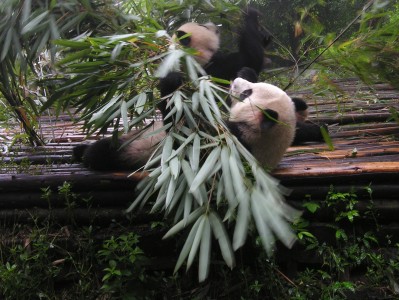
Today we went to the Panda Breeding Center to show Lucky his cousins; here’s his post:

What a day. My cousin pandas are big, even the babies are big, and they are always eating  something called bamboo. I hear my friends P-bear, Foster and Lai Lai talk about it, but they don’t eat either. The Chinese people are proud of their pandas. There were lots of Chinese there making flashes with little cameras and getting into the pictures. I got into  Bob and Claire’s pictures too. I think I’m prettier than those pandas. The old ones just laid on their backs and ate bamboo, but the young ones wrestled and pretended to bite and rolled around. One even slept in a tree. I guess they really are bears. Claire liked the babies best. I’m jealous. She coooed over me, but nothing like she did with the baby pandas! We even got to watch the bottom end of the baby feeding process. Evidently, baby pandas need lots of help with keeping their stuffing moving through and nurses are on constant display stroking tiny panda butts (theirs didn’t have tags that said Made in China). Bob and Claire cheered for that panda when he finally finished.

Claire: It was really fun to see so many pandas and yes, the tiny ones were really adorable, but the cubs, up to a year and a half were more fun to watch. In slow motion, they loll and wobble and tumble and wrestle. They gum, and paw and flop and blink and yawn. Every move they make is absolute innocence and honesty. With the adults needing most of their day just to feed, I don’t understand why the little ones, who are growing so fast, aren’t constantly hungry and lean. Their diet must be very rich.

The rest of our day was fun too. We rode into the center of Chengdu to meet with Peter Snow-Cao of Bike China Adventures http://www.bikechina.com/index.php. He was able to offer lots of very helpful advice about our route: he confirmed that it will be grueling. On the way home, we got lost three times, it was great.

Bob: Now I know why we get lost so much; Claire likes it. Hmmmm. Claire shot another video as we wove through traffic on our way home. Per the above problems, it will be awhile before you see it, but worth the wait. Most of the people we ride with in Tucson will know that I prefer hills to flat traffic rides, but that I have a fair amount of testosterone for an old guy. Well, there is something about Chinese traffic, chaotic, crazy, dangerous, that brings out the old mountain bike racing instincts and skills from twenty years ago. I get into a zone and we merge with the throngs. I absorb the pattern of traffic flow, read “body language” and know when to challenge the cabbie, and when to track stand and let him pass. It is thrilling and calming at the same time, and I can’t get enough of it. I could do without the deepening cough I get from the horribly polluted air, but it will only be a few more days before serious elevations will have me wishing for air of any kind, polluted or not. Peter says our, now generally set, route through Tibetan cultural area (better than Lhasa he opines) will reach elevations of 15,333 feet at least. Yikes.

Sichuan foodTonight we tried another of the family fandians in our local hutong, and had even more fun than before. This time Claire took photocopies of food pages from a travel guide so we would have some idea of what we were ordering. We ordered fish and green beans and eping pejo (they are big and we share) When the fish dish came it was huge and loaded with all the things I love, garlic, chillies and ginger, also tiny bones and the head and tail. The strange head meat (brains?) was tasty. When the green beans came they were peas. Oh well, 50% isn’t bad. Everything was delicious. There was a general loud banter between the staff, regulars and the lao wai (foreigners). Everything we did was watched with general approval of our eating style. One other diner loudly proclaimed that Claire was very good with chopsticks, and better than me. True.

Life is not easy for most Chinese, the average wage here is about 10 kwai ($1.46) PER DAY. Our expensive, for them, dinner this night, because of the protein, was about $6. We made their day. Our average daily expenses so far in China, $29 including the panda tour and special van from the airport. Travel doesn’t have to be expensive to be fun.

The Kimberly in NW Australia, at risk from oil spill

We rode our tandem a few thousand kilometers across and through the middle of Australia, through the Kimberly, in the far northwest. The Kimberly region is the size of California with 41,000 residents. Think of that. We rode for two to three days without seeing human habitation. There are bulbousbaobab trees and bush fires on the land, crocks and huge snakes in the billabongs and camels stomping around the tent in the night. Lovely.

We arrived in Broome probably the most remote town in the English speaking world, just in time for our anniversary, so it holds a special place in our hearts. The coast there is like all the coasts in Australia, spectacular. But the Kimberly coast is special for it’s remoteness and the austere red rock beauty and beautiful, but often violent weather.

Read the rest of this article...

Lucky Inspects Claire’s Pannier Repairs

The bags are going to look like a clown pretty soon, if she keeps putting on patches. I asked Bob why they don’t get new bags. He said they are sentimental about the bicycle and the bags. New would be nice, he said, but these bags have memories; every tear and scuff has some meaning to them.

Read the rest of this article...

Unsung Heroes of WWII; the distaff side. About time!

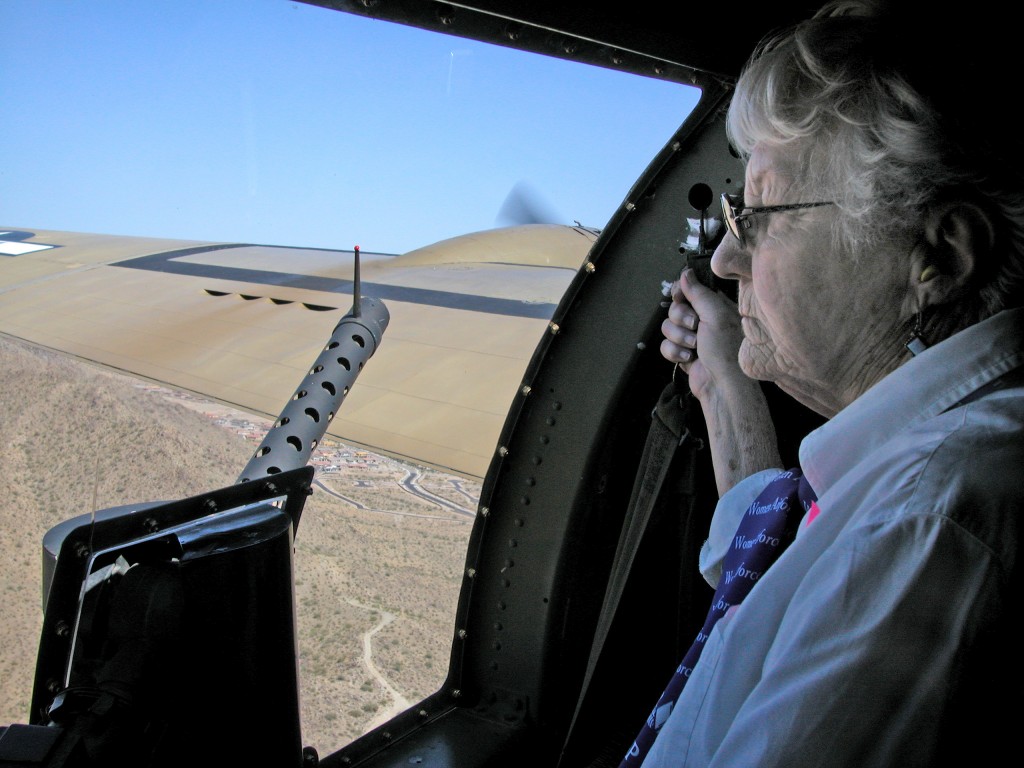
More than 1,000 Womens Air Service Pilots, WASPS, served important and often dangerous missions testing and delivering the aircraft that would fly over Germany and Japan. Seventy-nine of them were injured or killed during the war. They were central to the war effort, yet had to buy their own uniforms, and they took up collections to return bodies of their fellow WASPS home after a death. They of course were all volunteers.

After the war, they were rejected by the American Legion, The Veterans of Foreign Wars, and the Veterans Administration, and as they aged, they were denied veterans benefits. Finally Barry Goldwater stood up for them in 1977. It is estimated that 300 to 400 are still alive.

Read the rest of this article...