Jorge Luis Borges, and The New Bohemians, on Life and Travel

While working on New Bohemians today I ran across this previous post. The quote from Jorge Luis Borges evoked memories: they flashed across my inner travel screen, not in pixels, but in soft amorphous remembered images, scents, labored lungs and heart, sweat soaked, cold shivers; wind cooled and sun warmed. Smiles from faces never to be seen again… I thought I’d re-post. Share.

Read the rest of this article...

Footprint in the Sand; Just a Thought

A footprint in sand. Soon to be erased by the breath of time. A mark. An instant. One step of many. Why make it special? Do you note your marks? Do you listen to the sound your foot makes in sand? Do you feel the pressure, the texture, the cool or the heat? Just a thought.

Read the rest of this article...

Laotian Time Bombs: A war’s explosive environmental legacy (Sierra Magazine, Feb. 2011)

Our risk was nothing compared to the average Laotian farmer, wandering children, firewood gathering women, who know their next footstep can mean death, or for some worse, maiming, in a poor country where everyone must contribute.

Some facts: 270 million of these bombies were dropped on a country the size of Utah. Of the more than 50,000 people killed or maimed by the bombings, 20,000 have occurred after the end of the war. An average of one person a day is killed or maimed in Laos now, nearly 40 years later.

Read the rest of this article...

The Many Faces of Buddha

Southeast Asia is made up of several compact, densely populated countries. Along with a change in currency and the sound of a different language, visitors to the region know they’ve crossed a national border simply by looking to the Buddha. Buddhist imagery and the philosophies it reflects are remarkably different from region to region worldwide, but the differences are especially pronounced in Southeast Asia.

Read the rest of this article...

The Finger Rock Trail, Tucson, Arizona, January 2011

Leftover snow with underlying ice made the going a tad slow in places. Seven miles and 3,000 vertical feet to Linda Vista, a good hike for my feet. Nice to be breathing in the fresh scents of the desert plants and stimulating conversation with friends. A new trail for me. Maybe next time,after the ice melts, The Finger, a thousand or so feet higher.

Read the rest of this article...

Litang, Tibetan Sichuan, No tourists here!

Litang is far from a tourist town. The roads are so bad that the Han Chinese find it quite an adventure to travel there via modern SUV to view the, strange to them, Tibetans. They found it quite strange to find two Westerners, a couple, riding a tandem bicycle, on the roads and elevations they found so daunting. They are daunting, and took a physical toll on us, leading to a well deserved rest in a town we came to love, and found difficult to leave, despite the high elevation and wonky weather.

Read the rest of this article...

Cambodian Disaster: Sad Event For A Fine People

So sad to hear of the crowd disaster and all the deaths in Cambodia. In our three weeks or so in the country we found the people to be hard working, cheerful and generally happy despite sometimes difficult living conditions. Like most Southeast Asians, they love their festivals, and the Water Festival is most beloved. This is an unusual occurrence and should not deter anyone from visiting this wonderful country. We’d go back in a minute. เทศกาลน้ำ

Read the rest of this article...

Petrified Forest National Park: hidden gem just off I-40 N. Arizona

Recently Claire and I were lucky enough to catch a hike guided by the park paleontologist and an interpretive ranger. The short, two mile or so, hike took us away from the road and interpretive signs and into the washes and flats where dinosaurs died 225 million years ago in the late Triassic Period. We found pieces of bone and Claire even found an intact tooth. The stark landscape adds to the mystery and amazement of the realization that you are holding a thing, that was once part of a living Stagonolepis so long ago. Nothing like science to put one’s lifespan into perspective.

Read the rest of this article...

Kettle Valley Rail Trail

We got on the, still unfinished, Kettle Valley Railway (rail trail) bypassing Kelona and on to Penticton. The Myra-Bellevue Provincial Park is the most spectacular section of the trail, with 18 trestles and two tunnels in an 8.5 kilometer section.

Read the rest of this article...

Whitehorse: A Busy First Nations Day and Solstice

A fun example of the cultural mixing here was the jig contest. Now, I’ve always thought of the jig, danced to a fast fiddle, as an Anglo-Saxon tradition: Irish, Scottish, French, but here it’s a local tradition, with most of the dancers of First Nations descent, with plenty of mixed and white faces giving it a go. Oh, by the way, the really really excellent fiddler seemed to be from the orient. Go figure.

Read the rest of this article...

Harvest Host Program for RVers wonderful for us so far.

The Longsword Winery in the Applegate Valley of Southern Oregon, was the first winery that hosted us for a night under the Harvest Hosts program. For a $20 membership you receive access to a growing number of wineries and farms who will allow you to park your RV overnight without a fee.

Read the rest of this article...

Iceland Eruption: Causing Air Delays in Europs

It appears the volcano in Iceland is not going to go back to sleep without causing mankind to take notice of the disruption possible. Thousands of flights have been canceled by the the ash cloud ejected from the eruption under a glacier. The ash is even more destructive to air traffic because some of it may be turned to glass by the ice before being ejected high into the air.We’ll just have to wait and see if this will last for weeks and cause major economic disruption in North Atlantic and European transportation, or fade away quietly. I wouldn’t bet on either.

Read the rest of this article...

Christmas Card from Bangkok

Happy Christmas from Bangkok

Happy Christmas from Bangkok

Happy Christmas from Bangkok, from Bob and Claire and Lucky. P-bear, Lai Lai and Foster send their best wishes from Tucson.

We’ll celebrate by crossing the International Date Line on Christmas Day. Does that mean we get Christmas twice?

Happy Christmas

Claire and Bob Rogers

PS. See a video of us having a look-back at our Shangri-la journey from Bangkok, Christmas Eve day.

Lucky’s Blog: Monkey Business

MonkeyBusiness

Monkey Business

There are some funny things in the jungle. I don’t know what this thing was about. Bob stop him from grab me. I was scared. I don’t care to be used as a model for Bob’s camera thing. But this time I think I was got carried away to some tree and ate. I don’t want to be ate. I not taste good anyway.

I still enjoy visits to the fallen down old rock buildings. There’s lots  in the jungle. Some of them are getting eaten by big trees. It’s spooky sometimes. Bob and Claire like to climb up to the top on little tiny steps. I hide in Bob’s camera bag; pandas don’t climb high.

Morning in Kompong Cham

Mekong

Mekong

Nice Frogs For Sale; Want Some Frogs?

Nice Frogs For Sale; Want Some Frogs?

Helper

Helper

Silver Dollars

Silver Dollars

Selection

Selection

fruit

Modern Cambodian Market Woman

Modern Cambodian Market Woman

Sunrise over the Mekong and a morning spent in one of our favorite Asian markets; wonderful coffee and spring rolls at a market stand started our day off right.

We leave the Mekong for good soon, and we will miss it. The river is the lifeblood of SE Asia, and the people use it fully.

We were not far from the river’s source in the Tibetan lands of the Himalaya and enjoyed it in Laos and the delta in Vietnam. It is truly one of the world’s great rivers and we are privileged to have seen so much of it, and it’s people.

Lucky Visits the Plain of Jars

There were all these big things made out of rock in Laos on the Plain of Jars. I got to look at the jars and saw myself in the water. Lorenz and Alex from Germany laughed. The other two nice people from England were Will and Jo. They introduced me to Eeyore. He is in a famous book called Winnie the Pooh, who is a bear. Eeyore is not a bear. He is a donkey. He is the nice people’s traveling companion. Just like me! We had a visit about our travels. He has his own web page. He doesn’t have to share one with his people, like I do.

Read the rest of this article...

Detour to the Hospital

Our trip through the back country of Shangri-la turned out to be four days instead of two, due to a landslide and constant big (still) mountains.

First Class Care

First Class Care

Bob:
Yesterday we took a little detour on our way into Lijaing – to the hospital. We crashed. A combination of a long day, with 1200 more meters of climbing, a patch of water laid down by the cooling water of a truck’s brakes, a little bit of clay, and down we went at about 30kph.

Claire was not responding at first and I got her out of traffic carefully, in case any bones were broken (none). I can’t explain how I felt seeing her, barely moving, having trouble hearing me, or answering to her name.  She finally came around, and I got her sitting upright and talking coherently. I checked her eyes for dilation or wandering, and she could focus and had no double vision (we’ve been through this before).

A motorcyclist helped direct traffic as I dragged Zippy to the edge. I started to search for the first aid kit, and by then Claire was thinking clearly enough to tell me where to find it. Before I could start cleaning her abrasions, a van full of police arrived. My first thought was that we were in even more trouble than the crash aftermath, but they were great. “We take you to hospital,” said with authority, had an amazingly calming effect. They commandeered a small pickup, and loaded Zippy in. We wondered if we’d ever see him again, until we saw one of the policemen get into the truck.

Claire:
It’s really frustrating having to admit you need help, but when the police came and said “hospital” I knew we probably should go, even though it meant transporting Zippy some other way, struggling to communicate with doctors or nurses, arriving in an unfamiliar town not under your own power, and worst of all, losing your bearings.

Since I’d lost a minute or two, I had a lot of questions for Bob and it took me a while to come out of the fog that makes you think you’re having a bad dream. I remember knowing we were going down, but that’s all.

At the hospital, we had our scrapes swabbed. They thought my nose might be broken, but I think my glasses just gouged it. I took the hit evenly between shoulder and hip. Bob got it pretty bad on the knee, but it hasn’t swollen. Bob noticed the doctor watching me for signs of brain trauma, and from previous experience, he knew to wake me in the middle of the night to make sure I knew who and where I was. We’re both a little stiff and sore today, so we’ll take an extra day in our three star hotel. (Total hospital bill: $6)

We’ll post our days in the back country soon. Beautiful…

With this sign would have been before that curve!

Wisn this sign had been before that curve!

Shangri-la: More to come

Stupas in China

Stupas in China

Another day, another two mountains. When we reached the Yangtze we thought we would be cruising down the river for a few days, but China 214 took a hard left into a narrow gorge where we found yesterday’s accommodations.

China's mountains cloaked in mist and clouds

China’s mountains cloaked in mist and clouds

We began this morning in the rain. The mountain ahead – a 1,000 meter climb – looked grim, with tatters of gray rain hanging from charcoal clouds. Rain dripped from our parka hoods, spray from trucks and small streams crossing the road had wet us thoroughly. We settled in to listening to Zippy creak and grind in the wet and grit.

We stopped often for moon cakes and Tang, our primary power sources these days, and plodded on at the reasonable pace of 6 to 8kph (about 4 to 5mph) for a couple of hours. The road made a switchback that took us away from the rain and we slowly began to dry. An hour or so later, we topped out for a few kilometers of descent and began another 500m climb, with rain threatening the summit.

Claire:
Our day was made sunnier by the friendly Chinese tourists foisting food on us. At one point, we had to reject a girl who was on her third trip to give us fruit and moon cakes. We were already loaded down with walnuts from this morning.

Chinese Village

Chinese Village

We also had a great exchange with some other bike tourists. David and Maria from Bilbao, Spain are going north. I felt bad that they seemed anxious about how high the climbs were and we couldn’t tell them anything encouraging; yes, there would be some very hard all-day climbs ahead. I know exactly how that feels, but during the climb it doesn’t seem so bad after all.

David gave us a map he would no longer need and I gave him my notes transcribed from Mark and Julie McLean’s great website: Mark-Ju.net. Julie’s detailed description through this last segment was spot on.

David and Marie from Spain

We are seeing some of the plants we all take for granted as garden plants here in the West, but originated here. It was Joseph Rock’s explorations in these mountains that began the garden boom in England, and subsequently the Western World. An English author read a story in National Geographic, and based his mythical Shangri-la on Joseph Rock’s cultural observations as an aside to his botanical work. So it is in quite a round-about way that the Shangri-la no-tell-motel on the seedy side of town is named “Shangri-la.”

Flower of Shangri-la, one-inch tall

Flower of Shangri-la, one-inch tall

Still Shangri-la?

Is this part of China still Shangri-la? For many of the people content to live the simple life of farm work and devotion to Buddhism, it still must be a peaceful existence. They watch the world pass and wonder at it, but have little desire to follow it to the cities. Of course, some of the young do follow China 214 to the city, and village life no doubt suffers for their loss. The outside world nibbles at the edges of their world, but so far makes seemingly minor inroads. We see a village high on the mountain as we pedal the China 214, and wonder at how they possibly can get up there, how they found a place to put a house – let alone a barn, and those terraced fields. A few hundred meters is a long way when the slope is 45 degrees.

Are they the healthy happy people who live long lives, as described in the novel? Their smiles indicate they are happy. As for their health, they must have strong hearts to navigate the near vertical hillsides all day – every day. Their sanitary systems are nonexistent, but they’ve probably adapted to some degree, and all consumed water is boiled.

Many of them live as my grandfather lived in West Virginia more than 100 years ago. He was still mowing hay by hand when he was 90 years old. He worked  with horses, had no electricity, went to the outhouse, ate pork every day, and died peacefully at home at 93.

Shangri-la? Not for us, but considering the challenges of modern life, and that American’s life spans are decreasing for the first time ever, perhaps there are lessons to be learned.

Claire took a nice video of a man dragging logs with a team of oxen that reminded us that we were in a world not wholly made up of diesel belching trucks, wildly driven SUVs, and kilometer long lines of tourist cars.

The National Holiday

We are in the middle of one of two national holidays in China. All Chinese who can afford it, and there are many more than four years ago, want to drive their personal autos to some tourist hot spot. We are entering the area defined by the tourist industry as “Shangri-la,” and it is apparently a prime destination.

We’ve had our picture taken so many times by so many Han Chinese, with their huge Canons and Nikons, that I am considering declaring us an official minority and charging for our images. One time it was a huge tour bus filled with photographers, wearing camera vests and sporting lenses larger than both of our cameras put together.

It gives me a new perspective on photographing people. When I was a photojournalist I often just charged into a group and began knocking off frames at a furious pace, with no consideration of the feelings of the people. I don’t have to do that any more. Now I ask, or am so unobtrusive that I don’t disturb the flow of their lives.

Claire shoots from the back of the tandem, and that seems to disarm people. We also get a kick out of the Chinese amateur photographers, scrambling for the best angle, jabbering away, finally waving and giving a thumbs up; it’s all road entertainment for us.

Shangri-la, The City

After a short descent to a large lake which seems to be a major tourist attraction, judging from the traffic jams, we again rode in the rain into the city of Shangri-la. Claire was surprised at the size of the city, and despaired of finding the guest house we sought. We finally found it, paying eight times what we paid the previous night for the privilege of hearing our neighbors, and choking on their smoke that seeps through the walls. The extra price is for arriving during the national holiday; the Chinese also pay the higher fee.

So far it seems like any other medium sized city, except there are many more hotels (all full). There is a tourist “Old Town” that we must see while we are here.

Iris in Shangri-la, China

Iris in Shangri-la, China

We’re off on a back road trip to Tiger Leaping Gorge. Claire says more mountains are ahead of us –  and no doubt some spectacular scenery.

save

A Thorn Tree Grows in Shangri-la

[httpv://youtu.be/CUH08hlrnbM]
This is the second time small Tibetan boys have stood at attention as we passed and held a salute until we released them with a return salute. We wonder what it means? Is it serious, or is is sarcasm reserved for foreigners and police and army?


October 2, Derong, Sichuan, China: A Thorn Tree Grows in Shangri-laBob:
We left Xiang Cheng, for another long day of climbing, our last over 4,000 meters. The road had a reasonable grade (we could maintain 7kph (about 4.5mph) and the surface was good bitumen. The views back down the valley to the monastery were spectacular and the few small farms blended organically into the vertical mountains.

Tibetan valley with houses

Tibetan valley with houses

At one curve in the road, a woman looked up from weeding her small orchard, and let out with an extended soliloquy on our presence, accompanied by a large smile. Her husband, walking in the road, waved us down, and eagerly suggested, in pantomime, the we join him for a rest under a shade tree. He too beamed with joy at the possibility of enjoying our company. We had a difficult (more than we knew) day ahead of us, and I pointed at my wrist and shook my head in denial. He persisted, and we went back and forth, all with smiles.

Finally we waved and pushed off, our 26 inch prayer wheels spinning out thousands of goodwill messages up his mountain; but I think we might have missed the point. The farmer and his wife live Shangri-la, not just in it, but they are Shangri-la. They are poor, but well fed, and the circle of their days allows for a break when tired, a visit with passing strangers, the rhythm of weeding, or wall building when they feel like it, and the song of bird and stream as accompaniment to it all.

We, on the other hand, have brought our schedule laden philosophy with us. We are here to SEE Shangri-la, not be it or live it. We have conquered her mountains, seen those living Shangri-la, but have not made the truth-based myth our own. Oh, we have absorbed much more than those black SUVs that pass us by the scores each day, carrying Chinese to possess for a holiday, their most exotic locations. At least we have the memory in our legs and lungs of the place; we have the images of the genuine smiles from the minorities directed to us as somehow kindred spirits. But will we bring it home with us?

Farm in China along river

Farm in China along river

Now for that thorn tree: As you will read in Claire’s note, there are many police in Shangri-la. As we have descended the Himalayas, the number of police posts on the roads has grown with one about every 50 kilometers. As we came up the eastern side of the range’s fingers, there were few posts, and they always waved us past, usually with a smile. Here it is different. We are still in Tibetan minority area, and very close to the border with the Tibetan Autonomous Region, where we assume they are expecting trouble. We were not able to go into the TAR as independent travelers, only as part of an organized group with a minder/guide. About a week ago, even that privilege was revoked for foreigners.

Police post in China

Police post in China

To me it seems at least a few of the police on this side have taken a negative tone with laowai (foreigners). Not all by any means, most perform your passport check professionally and even smile. But, after a beautiful descent of our last 4,000 meter peak, we came to a village where we understood there was accommodation. At the police stop, in the center of the village, one young man strutted back and forth of Zippy, regaling the growing crowd of mostly Tibetans with his apparently negative opinion of us. He particularly seemed to dislike the Tibetan prayer flag we had attached to the handlebar bag, and indicated his disgust with a sneer and a dismissive flip of the flag. He also told us the accommodation was no longer available, and through a translator, that we get a family to put us up, an unlikely possibility after word spread about his dislike of us. The locals fear the police. They don’t seem to be there to solve crimes, but to watch over the non-Han population, and make sure they have little contact with foreigners.

Claire Rogers and Lucky in tent

Claire Rogers and Lucky in tent

Tent camouflaged with branches

Tent camouflaged with branches

Valley and river in China

Valley and river in China

Claire getting water from a seep in China

Claire getting water from a seep in China

Tibetan couple

Tibetan couple

Monks on a motorcycle

Monks on a motorcycle

At this point we knew we would have to guerilla camp, and bought two chicken legs at a store, and got some stir-fried egg and tomato, a huge bowl of rice, and all our water bottles filled with boiling water. While we were eating, an old Tibetan man fingering his beads, came over, touched our prayer flag, nodded his head and smiled. There is a split here and it revolved along religious/ethnic lines. Only one side wears uniforms. This could get us thrown out. Yesterday, I had to help a policeman go through all the pictures on the camera Claire uses to shoot from the back of Zippy. He was a pleasant young man, just doing his job, but to an American, it was difficult to endure. Few countries have a First Amendment. Treasure yours.

We left the village for a 12 kilometer climb to an uncertain camping spot. The mountain sides are so steep, below the Plateau, that we had to camp on a power line road, in full sight of the main road. We used a few limbs to break up the contour of the tent, made sure headlights wouldn’t hit us directly, and we don’t think we were seen. Claire had a couple of disturbing dreams, but we both slept well.

There were two more encounters with the police, including a mostly pleasant one here in Derong. We hope this eases us; even though we are getting accustomed to the delays, they are not the delays we would choose.

Stupa in far SW China

Stupa in far SW China

Tibetan women carrying stacks of hay

Tibetan women carrying stacks of hay

Fall colors in China

Fall colors in China

Looking back down a Chinese Valley

Looking back down a Chinese Valley

Woman filling sacks in SW China

Woman filling sacks in SW China

The (renamed) town of Shangri-la (here it is pronounced Shan Ge Li La) is two days away. Stay tuned.

Claire:
We watched the National Day festivities on television last night. The hyperactive, color coordinated crowds rallied for the cameras and the massive, meticulously staged production was visible only to Party members with box seats and everyone in television-land. Our celebration of the day consisted of us wishing the police well on China Day, three different times. The roadside checkpoints only grew tiresome because our day wore on longer as we waited for our passports to be returned. One lone police man called us in to somewhere, browsed through the photos on one camera (he didn’t know about the other one), then after some tense effort to communicate, made it clear we were to check in at Derong, 40 kilometers down the road. At one checkpoint, the police seemed to laugh at us for interrupting their card game.

The festivities here in town consisted of ten minutes of fireworks a few meters in front of our hotel, but I think we were the only ones watching.

We’re enjoying the light traffic and rural roads of this steep mountain country, knowing that we’ll soon come back down to more densely populated areas. Here, the land is simply too vertical to support a large population and any relatively flat space is occupied or in use for growing food.  The thin, clear air has been good for our lungs and the stiff climbs certainly good for our legs.

Elation, Pain, Surprise: Part 2

September 23: Litang, Sichuan, China

Shelter

Shelter

Bob:

In our last video post (scroll down and watch it first) we’d made quick work of a 7,000 ft climb to a 15,252 ft. plus pass, and were feeling pretty chipper considering the troubles other cyclists had encountered with the steep grades and high elevations. Our regular climbs of Mt. Lemmon (close to 9,000 feet elevation) in Tucson, had prepared our legs well, and we took enough off days for good acclimatization. After a nearly two weeks of our legs getting accustomed to the 80 pounds our so we carry, the climb was not as difficult as expected.

However, rather than the long descent to lower elevation for rest and a decent camp spot, we found the road stayed high, rolling up and down 1,000 feet or so as the weather deteriorated to rain, wind and sleet, and then climbing again. We knew that a night of rest at lower elevation would be essential for the next pass of 15,475 feet, but this was not to be.

Staying High

Staying High

We stayed high as the clouds lowered and the sky darkened. We were shivering from the wet and cold and the effort of the pass. We knew we had to find shelter, high altitude or not, and hope our light sleeping bag would be enough. We failed to find a flat spot; this is called the Tibetan plateau, but it is riddled with 1,000 to 2,000 foot mountains with steep gorges and very few spots flat enough for a tent. Just as we were about to give up and camp beside the road (not something we do unless in dire circumstances) we saw a Tibetan settlement, and decided to see if we could at least get water. We were low and there was only some snow to eat, and maybe find a place behind a house out of sight. We would have to sleep at well over 14,000 feet, but we needed shelter.

Warmth and Food

Warmth and Food

As we rolled up to a small stone house/barn, an older looking woman smiled at us and made the international sleeping sign: prayer hands laid next to her head bent sideways. Nothing ever looked so good to us. A young woman, whom we took to be her daughter, and her child were in their small barnyard with their small herd of yaks preparing for milking.

She motioned for us to bring Zippy into the house, which was on the bottom level, the barn. We leaned him up against the stone wall, unloaded our bags and followed grandma (we’ll never know her name) upstairs. Their living quarters was one large room with a small hearth and a cozy fire. There was not a chimney, but a stovepipe reached just as far as a roof hatch, and the space was filled with a blue haze of smoke that softened all shapes and colors.

Home for the Night

Home for the Night

The floor was rough cut slabs and the roof was supported by large log beams, but in the stone walls were set modern aluminum windows with latches. Various food items were drying on feed sack material and the beds were rolled up in one corner along with corn husk pillows. The hearth held all the pans they owned, and all the cooking was done on top of the fire. The daughter hurried up from her milking to prepare our meal and grandma sat and smiled at us and attempted to communicate.  She knew no Chinese, only Tibetan, and our communication was by pantomime.

Eating Yak Butter, Grain and Sugar

Eating Yak Butter, Grain and Sugar

First, we were served a liquid from a pot that seemed to have a permanent spot on the hearth. It was yak butter tea. It’s pretty much as its name describes: water, yak butter (lots), and a few tiny leaves of tea. Now this sounds awful, but we found it quite good, and warming after a trying day.

Snowy Morning

Snowy Morning

Our first course was a white crumbly substance that Claire likened to the curds we had in Wisconsin, only they didn’t squeak in your teeth as much and had a very fermented flavor. I looked over and I could see a large pile of what we were eating drying/fermenting on the floor near where we would probably sleep. We ate from a communal bowl, grandma first, showing us how with the fingers of her right hand (this is important to remember). We are not prone to insulting the hostess, so we imitated her. We both liked the unusual texture and fermented flavor. I could see uses for it in other genres of cooking.

Grandma prepared the next course while the daughter finished milking. She sliced potatoes French Fry style and fried them in a huge amount of an unidentified oil poured from a large plastic container stuffed with a rag. Then she added some water for a steamed finish. This was served with rice, and more yak butter tea. It was quite satisfying, and enjoyed with the company of a Buddhist monk who’d dropped in for a meal. Apparently you feed a monk when he shows up at your door, anytime.

After dinner, and another couple of rounds of yak tea, we both needed to relieve ourselves of some liquid, and asked (don’t ask how we asked) for the toilet, which we expected to be a short-drop, i.e. a shallow pit with weather shelter over it. Not here. We were pointed to the guardrail and over the hill to the village toilet. It wasn’t as bad as you might think. Such places in America are littered with toilet paper, the white of which announces each deposit. Here they do not use toilet paper. Remember how all the eating and touching of food is done with the right hand? Yep.

The next morning, just at first light Claire and I both felt a need and headed past the sleepy yaks, over the guardrail where we each found – recently at least – an unused bush. It had snowed overnight and we had two inches of something much better than toilet paper to use. Chilly, but refreshing.

During the night we slept like the family, fully clothed on the floor on light pads with husk filled pillows. We went to sleep to the sound of grandma reciting her prayers on her prayer beads. Breakfast was – guess what – yak butter tea, leftover potatoes and rice, and an addition – yak butter rolled in a mixture of rough meal and some sugar. Again, strange sounding, but good and filling. The little girl of three or so got her breakfast from mom, two teats worth.

Friends

Friends

Claire:

It sounds romantic: going to sleep to the sounds of chanting and waking to the sounds of milking. But these women’s lives are a gritty existence that our culture hasn’t known for generations. Hauling wood, water, and food up the ladder to the living space, making butter and curds, grinding grain, hand washing clothes, keeping the fire going, cooking… Mundane, routine, weather-dependent, smoke-filled and layered with years of grime. At first, we were both a little uncomfortable with their aboriginal way of life (we even took some Pepto-Bismol as a prophylaxis against any reaction to the yak butter). It’s kind of like going feral in Australia, at first, you try to avoid the bull dust, then you live with it, until finally it becomes your outer layer.

Wonder What She Thought of Us

Wonder What She Thought of Us

The five tiny calves at the bottom of the ladder were the future for these women. Their house was smaller than most in the village. I wondered where the men were? What would the little girl’s life be like? Would she get an education? Would she look at that post card of the horse those people on the bicycle gave her and realize someday what a big world this is? We used Bob’s jacket printed with a map of the world on it to try to convey where we were from, where we’d been and where we planned to go. I have no idea if they’d ever seen a map before. It doesn’t really matter to them, their world is an isolated village along a road between two passes and 50 kilometers from the nearest town. An occasional bicyclist may pass by their house or ask for shelter. To us, these women will always be a part of our world, and I don’t ever want to forget them.

What lies ahead as the yaks are put out to pasture.

What lies ahead as the yaks are put out to pasture.

Bob:

And it’s not over yet. We left the family as the snow began to melt, expecting the second 15,000 foot pass to be a few kilometers further since we had slept so high, and also expecting the weather to turn.

The Road To Shangri-la is not always what is expected.

A New High: A Layered Meaning

[httpv://youtu.be/q9s7Pusfssw]

September 17, Xinduqiao, China

Bob:
Yesterday we rode Zippy to the highest elevation ever for us. We started at 8,500 feet in Kangding and topped Zheduo Pass at 13,900 feet in 35 kilometers, or 21.7 miles, all under construction/repair. For our Olympic Peninsula friends, that’s like taking the Hurricane Ridge Road, raising the sea level start to 3,000 feet above the Ridge, loading 70 pounds on your tandem before beginning. Oh, I forgot, put 1,000 people and hundreds of trucks and equipment on the now gravel/dirt/broken concrete road.

We had some concerns about the rapid elevation gain from low Chengdu. Other cycle tourists had told stories of riding for a few meters, resting, pushing for a few meters before riding again because of the lack of oxygen. Others reported terrible headaches and lack of muscle strength.

Near the pass we were stopping for short rests every half kilometer or so, during extra steep sections. We had a little dizziness and mild headaches, in the steeper sections. We topped out in a good mood; although there were moments along the way of despair.

We dropped off into a beautiful Tibetan valley, unfortunately with only a few kilometers of newly paved road, and arrived in town much later than usual. We are taking another acclimatization day, at about 11,000 feet. There are some higher passes to come. Today we took a walk through the village and enjoyed the Tibetans in their beautiful land.

Claire:
I’m not sure which part was the most trying of the day; the construction was a nasty surprise, sometimes the route looked more like a mud track than a major highway. I asked directions more often than our Azeri taxi driver did on the run for the Georgian border. Going up into the fog was pretty demoralizing, partly because it was eerie and also because I didn’t want it to get as thick as it did on that Iceland Hellisheidi Pass. It didn’t, and ultimately may have been better for us because we couldn’t see how much farther up we had to go. Overall, the worst part may have just been the unknown, but really, that’s why we’re here, isn’t it? Dealing with whatever happens. We put ourselves here for just this type of experience, and though it can feel harrowing at the time, the intensity of the day becomes a part of us. In retrospect, yes it was hard, but for me, my resolve came from a continual mantra of: “We’re doing it, we’re still moving forward, we may be slow, but we’re doing it.” And both Bob and I kept good spirits and good strength the whole day through. We’ll need that for the 7000 foot climb to 15,000 feet soon.

Bob:
I’m not surprised that Claire touched on what I intended to end with. I am sure some of you new to our travels are saying to yourselves, “What would possess them to do put themselves through the things they do?” I’m pretty sure a lot of Chinese are saying that to us, we just can’t understand them!

Here’s a major part of the answer. Creating challenges for ourselves, and facing them together strengthens the bond of our marriage. Couples often allow the romance fade as the years progress. It’s easy to become immersed in career, children, differing interests and circles of friends, and put the partner in a secondary position. We said some vows nearly twenty years ago, and our habit of creating challenges for ourselves, and meeting them as a team, has helped us keep those vows, and kept the romance alive. We may seem crazy, but the rewards of our mutual struggles are great.

Stupa at first pass into Tibetan lands

Stupa at first pass into Tibetan lands

Into Tibetan Lands

The Himalayan foothills are turning vertical and Zippy’s long wheelbase and weight is making it difficult to hold a straight line, especially when a bus screams at us with its ear splitting high pitched horn, and the captain reacts toward the 100 ft. drop off into the river! So far so good, and the old reflexes will soon come back. The first weeks are the hardest, and these mountains are really really hard. We might have kept these mountains for the end of the trip when we are fit, but then the passes are snowed in; there is a typhoon approaching the coast, and we might get it even now. Hope not.

We have taken a day off at 8.000 ft. to acclimatize, catch up on getting some protein in; you have no idea how hard it is to get good quality protein in the small villages, and our bodies are craving it. Last night we bought a can of some kind of strange fish with a very strong flavor, and some black beans mixed in; wonderful. We have boiled eggs for morning and a bunch of greasy (tasty) pastries for the climb.

We are getting into Tibetan prefectures and seeing the dress and features of the minority population. After a 13,000 plus pass tomorrow, they will no longer be the minority. We are already seeing prayer flags flying, and old women turning prayer wheels as they walk, men dressed in huge leather cloaks with cowboy style hats and daggers. Everyone is friendly, and the air is finally clear!

Here are a few photos from the last couple of days:

Lucky Studies His First Prayer Flags

Lucky Studies His First Prayer Flags

Corn Husking Party

Corn Husking Party

Market Day

Market Day

Our Constant Companions

Our Constant Companions

A Few Minutes We Were Pedaling Up That Switchback

A Few Minutes We Were Pedaling Up That Switchback

View From Our Binguan

View From Our Binguan

Buddhist Rock Paintings

Buddhist Rock Paintings

Food

Food

The Tea and Horse Route

Picking Tea in Sichuan

Picking Tea in Sichuan

We have been interested in the Horse Tea Route, Tea and Horse Route, and other translations, of an ancient trade route that rivals the Silk Road in importance for China and Asia. We first heard about it from a friend, Cindy, and wondered if our route would take us near the ancient route.  It must have been a slow brutal traverse of the Himalayas, from what we endured, in the foothills today on the “modern” route.

Horse, Symbol of Ancient Tea Horse Route, and Tanker Truck, Symbol of the Modern Route

Horse, Symbol of Ancient Tea Horse Route, and Tanker Truck, Symbol of the Modern Route

As we were leaving Ya An today, we saw some beautiful, larger than life, bronze statues of horses and men carrying heavy burdens. A sign nearby indicated that it was a memorial to the ancient route that took tea to SE Asia, India and Lhasa, in exchange for trade goods, and horses from Tibet. We are roughly following the southern route that was supposed to go to Yunnan (Shangri-la) and into present day Laos. We hope to find out more as we get deeper into the mountains. If we are lucky, maybe we will see a bit of the original.

For now, the modern route is challenge enough, with landslides, constant mud and water on the road, trucks, buses and all manner of smaller vehicles competing for a narrow deteriorating road surface, often with precipitous drops into a burnt sienna river raging with rapids. The captain’s shoulders are tired and the stoker’s nerves are frazzled.

The Kimberly in NW Australia, at risk from oil spill

We rode our tandem a few thousand kilometers across and through the middle of Australia, through the Kimberly, in the far northwest. The Kimberly region is the size of California with 41,000 residents. Think of that. We rode for two to three days without seeing human habitation. There are bulbousbaobab trees and bush fires on the land, crocks and huge snakes in the billabongs and camels stomping around the tent in the night. Lovely.

We arrived in Broome probably the most remote town in the English speaking world, just in time for our anniversary, so it holds a special place in our hearts. The coast there is like all the coasts in Australia, spectacular. But the Kimberly coast is special for it’s remoteness and the austere red rock beauty and beautiful, but often violent weather.

Read the rest of this article...

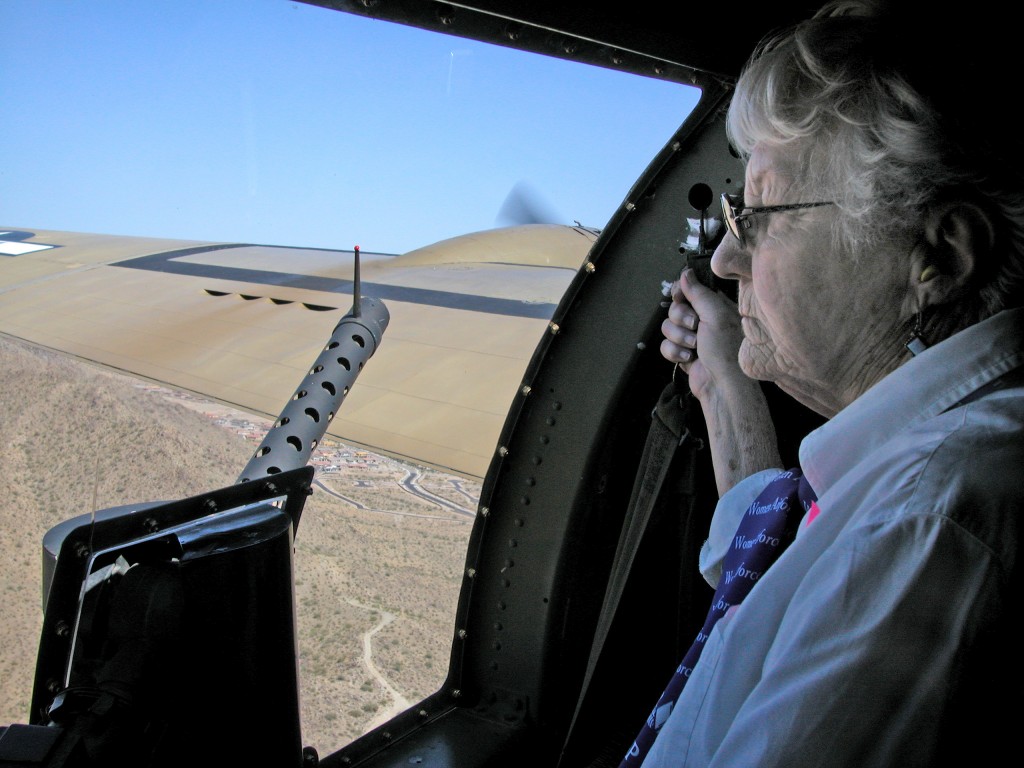
Unsung Heroes of WWII; the distaff side. About time!

More than 1,000 Womens Air Service Pilots, WASPS, served important and often dangerous missions testing and delivering the aircraft that would fly over Germany and Japan. Seventy-nine of them were injured or killed during the war. They were central to the war effort, yet had to buy their own uniforms, and they took up collections to return bodies of their fellow WASPS home after a death. They of course were all volunteers.

After the war, they were rejected by the American Legion, The Veterans of Foreign Wars, and the Veterans Administration, and as they aged, they were denied veterans benefits. Finally Barry Goldwater stood up for them in 1977. It is estimated that 300 to 400 are still alive.

Read the rest of this article...

Bob and Claire Rogers, The New Bohemians

We chose the New Bohemians moniker as descriptive of our unique lifestyle: adventure travel, creativity, self-reliance and frugality. For twenty years, we have lived life as if our time here is limited, has an end unknown to us. Many give the idea fleeting thought, but fear the idea and push it aside. We embrace it.

We are not the anti-social hedonists many associate with the name Bohemians. Anyone who has followed our adventures knows we don’t avoid challenge or discomfort. We get our high by pushing our bodies and minds in pursuit of creative living, travel, and intimate connection with the World and it’s peoples. That is the New in New Bohemians. Many people searching for our site found instead a folk rock band, Edie Brickell and The New Bohemians, since they had the .com long before we conceived of a web presence. They’re a laid back group with a great sound and meaningful lyrics you can actually understand.

Read the rest of this article...