Bikinis, Tibetan Mountains and Stone Jars

Claire: Nothing makes us more stubborn than being told we can’t accomplish our goal.

Stone Jar and Bomb Crater on Plane of Jars, Laos

Stone Jar and Bomb Crater on Plane of Jars, Laos

The nice German tried to break it to us gently that we would probably have to stay with a Lao family because we would not make the big climbs ahead, 1600 meters for the day and it was already noon. He was almost right, we almost didn’t make it. Though we wouldn’t have minded staying with a family, we pushed on a little longer than usual because of his remark. It was a two Nescafe day.

We took a bus excursion to Phonsavan to save ourselves pedaling two days out and back to see the Plain of Jars. The massive, ancient stone jars are intriguing, but what really struck me with awe was envisioning them bouncing and shattering from the impact of the bombs that left huge, diving pool size craters. Some of the answers to the questions surrounding the 2500 year old relics may have been blown to bits.

Soapy Boy Chasing Zippy

Soapy Boy Chasing Zippy

I never did get credit from Bob for pulling off a perfectly timed one day excursion: We rode 50 kilometers by 12:30, found a guesthouse, unloaded and locked Zippy, showered, packed an overnight bag, found the bus ticket seller in the village and were on a bus to Phonsavan by 2:00. Once in Phonsavan, we teamed with Lorenz and Alex in a tuk-tuk to the Kongkeo Guesthouse where we booked the tour for the next day and even arranged for them to drop us back at the bus station at the end of the tour. We made it back to Zippy by 8:30 that night. Okay, it was all just dumb luck.

Bad luck did find me in the form of some foul lettuce. That took a day and some fat out of me, but I’m sure glad Bob didn’t get sick, he doesn’t have any fat to spare.

Though the karst topography is scenic, we’re looking forward to a few less hills. Once in Vientiane, we’ll be riding along the Mekong; the lower elevation will mean warmer temperatures. Let’s hope the roads are good.

Lao Karst Mountains

Lao Karst Mountains

I thought Lonely Planet was joking when they said Vang Vieng was full of backpackers all watching Friends reruns in the bars, but they’re mostly right. It is a strange scene to come upon overfed, tattooed and bikini-clad western girls when the most flesh we’ve seen lately has been on dark, skinny, naked Lao children bathing at the standpipe.

Bob: Claire is not kidding about the fat girls. A bit of weight that comes naturally with age is fine, but to jiggle like Jello at 23, and flaunt it, is bad form. The boys are just pale and flaccid, and drunk by noon. Bah Humbug. I’m getting old.

Mountains

It does appear we are mostly out of the mountains, finally. I think, but I have been wrong before. I looked at our stats, and we will be a little over 1,500 miles for two months. That is very slow for us on tour, as we usually do more like 1,000 to 1,500 per month. Now we are getting older, we would expect our average to come down a bit, but never have we had so many mountains. Of the 1,500 miles, 1,300 were in mountains with climbs of 2,000 to 7,000 feet per day, and many of those climbs were at very high elevation. Neither of those numbers is too bad, except when they come day after day after day, with no let up. For two weeks in Tibetan Sichuan, we were doing those climbs at elevations of 13,500 to nearly 16,000 feet. That was, to put it nicely, hard.

Mountain Panorama of Laos

Mountain Panorama of Laos

When we got to Northern Yunnan, we thought it would ease off, but it was not to be again. The climbs kept coming, just at a bit lower elevation. After the bus ride to Southern Yunnan the mountains continued into Northern Laos, where we were again sure they would at least become hills. It was not to be. Just three riding days ago, we climbed 1,600 meters, or 5,250 feet. This is not a bad day for us in Tucson, on our old but still fairly light road bikes, but on a loaded tandem, in heat and humidity, with 3300 feet waiting the next day, exhausting.

Karst in Central Laos

Karst in Central Laos

I look back at our first tour of the U.S., and the Rockies were with us for a long time, but the top elevation was just over 12,000 feet, and there were rolling plains between the ranges. The Himalayas of Southwest China gave no breaks, and Northern Laos the same, just lower in elevation. British Columbia and Alberta have a lot of big climbs, but the top elevation was 8,000 feet or so, and most of the climbs under 4,000 feet.

So, who is to blame for all these mountains? Me. I could have researched the route and known how hard it would be. But, my natural optimism led me to believe whatever mountains China and Laos threw at us, we would be able to handle. Well, it was close.

But, Stubbornness is our name, tenacity is our game. Now it gets easy, just heat and humidity, and I think there might be some little hills on the border with Vietnam, and some in Cambodia. Not to worry; can’t be much.

A few pictures from the last few days:

Net Fisherman in Laos

Net Fisherman in Laos

Home for Lunch

Home for Lunch

Laos Mountain Scene

Laos Mountain Scene

Working the Rice
Working the Rice

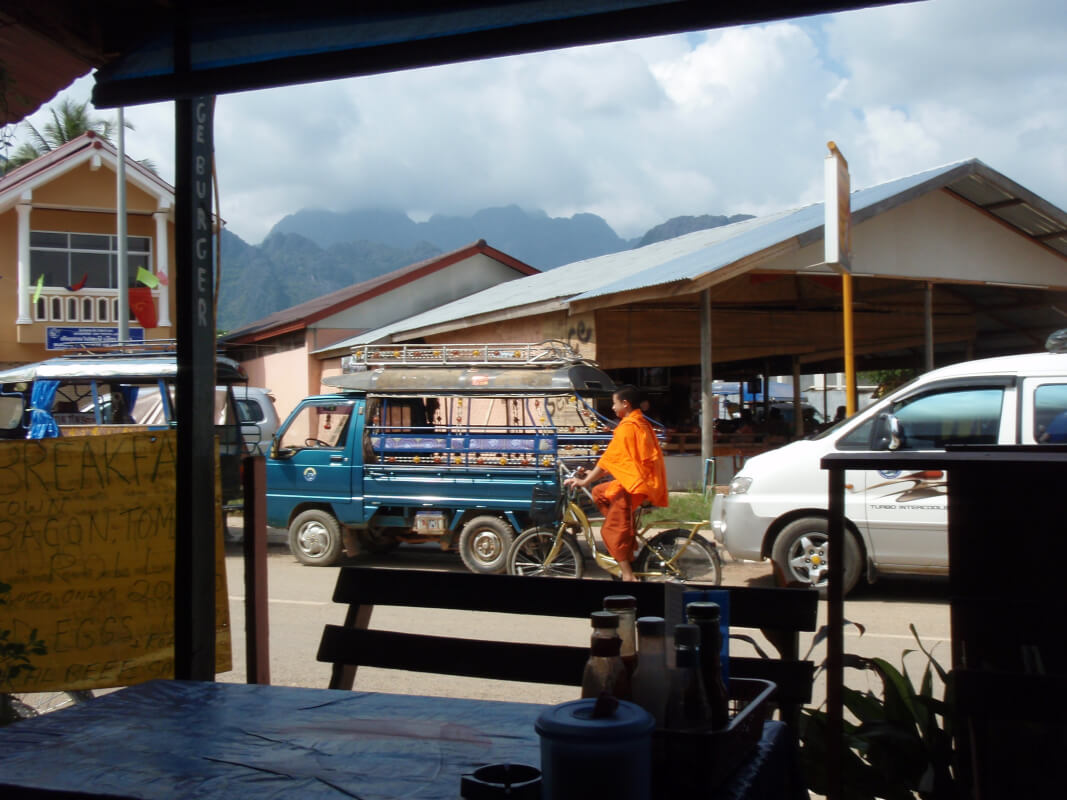
Monk on a Bicycle in Laos

Monk on a Bicycle in Laos

Helping Dad

Helping Dad

Hey! That's My Frog!

Hey! That’s My Frog!

He Found His Shangri-la

His Shangri-la

His Shangri-la

His Shangri-la is Lao

We stopped in the middle of a four hour mountain climb south of Luang Prabang, for a cold drink and some shade. A man came out of the house next door, and I glanced his way. Nah. He looked farang (Western) but it couldn’t be, this far out of the city, in a tiny village. Something about the way he moved about the house, helped a small boy with his shoes, said he belonged here, lived here.

I saw the beard, the nose, yup, farang. He turned to us and said, “Hello.” We spoke, he in a vaguely European accent with excellent English. He said he was German, and had traveled by bicycle, for five years, around the world. We shared touring stories, favorite places, bicycles. He said we could never make the climb by the end of the day, and the worse one waiting after that. We hoped he was wrong.

I wanted to know how he ended up in Laos, and how long he had been there. I waited. It would come.

He began his story: He got food poisoning in Laos. After five years of bicycle touring around the world, he was stuck in Luang Prabang. Then he met her, and his life changed forever. They married, have two children, and he has been in Laos for seven years. He manages a pig farm for his father-in-law, and the family spends half the week in Luang Prabang, where their children can get an adequate education, and half on the farm.

I asked him if he would ever go back to Germany, take his family. He smiled, “Never.” He is Lao now, family man, farmer, happy, healthy. He found what many would call his Shangri-la. His is real. A beautiful wife, comfortable home, two much loved children. So, for some seekers, Shangri-la becomes more than fantasy, an ideal, but a day to day life, real.

He traveled alone those five years on his bicycle; we know just how many pedal strokes that is. He was searching for something, Shangri-la maybe. He entered Laos from Yunnan China, mythical location of mythical Shangri-la, as we did. He hadn’t found it there, lovely as it is. Food poisoning brought it to him, it brought him love and purpose.

Where he lives is beautiful, very, very beautiful. The people are poor, but they laugh at, and with, we crazy farangs pedaling through their lives. They bathe by the roadside at a cold water stand pipe, and instead of complaining, laugh. They expect little, and appreciate much. Perhaps our German friend, now Lao, saw that, and the light of his love’s eyes, and knew he was home, in Shangri-la.

We didn’t get his name, but he has this site and we hope he will e-mail us. We will publish his name and correct any miss-perceptions. We’d also like him to know we made it to Kiukacham, just before dark. It was our hardest day in Laos.

Christmas? Now in a Lao Shangri-la

Christmas? Now in a Lao Shangri-la

Lucky Visits the Plain of Jars

There were all these big things made out of rock in Laos on the Plain of Jars. I got to look at the jars and saw myself in the water. Lorenz and Alex from Germany laughed. The other two nice people from England were Will and Jo. They introduced me to Eeyore. He is in a famous book called Winnie the Pooh, who is a bear. Eeyore is not a bear. He is a donkey. He is the nice people’s traveling companion. Just like me! We had a visit about our travels. He has his own web page. He doesn’t have to share one with his people, like I do.

Read the rest of this article...

Luang Prabang; World Heritage Site

Here are some photos from a morning walk around Luang Prabang. It is a World Heritage Site for the French Colonial architecture. We found much of that architecture degraded, but the town is very lively. Looking at the pictures, we are obviously more into people and food than architecture!

Sun Umbrellas

Sun Umbrellas

Text Messaging

Text Messaging

Fish Market

Fish Market

Interesting Food!

Interesting Food!

First Breakfast

First Breakfast

Morning Ferry Unloading in Luang Pabang

Morning Ferry Unloading in Luang Prabang

The Tunnel

In Southern Yunnan, we had over twenty tunnels on one stretch of fairly new highway. They ranged from 200 meters to nearly four kilometers (around two and a half miles). One small problem: many of them had few or no lights. Try doing that with one of those little LED headlights with weak AAA batteries. Potholes are my greatest fear; you can only see reflective material.

httpv://youtu.be/Lohkyfz1KnU

My Guaranteed Diet

Ride a heavily loaded tandem bicycle across several 15,000 foot passes and innumerable others at slightly lower levels. Then eat mostly rice and noodles, and get sick of both!

I weigh the same as I did in High School, but about fifteen pounds of muscle have just disappeared! The loose skin bothers me, but I am now on a concerted effort to eat as much of anything as possible and in particular protein. Wish me luck!

torso

Laid Back Laos

We’ve been in the mountains of South Yunnan, China and Laos for several days. Our border crossing between China and Laos went smoothly, but we were unable to find accommodation on the Laos side; there were several hotels in Boten and all were filled with workers building two new hotels.

Lao Scene: In the northern mountans of Laos, near here, we saw men walking with  primitive bows and arrows.

Lao Scene: In the northern mountans of Laos, near here, we saw men walking with primitive bows and arrows.

The genius of central planning; in a year, all the workers will have gone elsewhere and the tourists will all be staying on the China side. Brilliant.

So, we were forced to head down the road in the afternoon sun, hoping for a place to lay our heads. As usual all the land is either too steep to camp on, or has crops growing.

Lao House

Lao House

A short 10 kilometers further, we started asking for accommodation, by pantomiming with two hands beside our heads for sleeping. People kept pointing back the way we came, and we feared they meant China, where we could not go, since we’d had single entry visas.

Finally a woman on a veranda nodded in the affirmative, Claire began her magic, and we soon had a nice clean room for $4.80. It was a very nice traditional Lao house. We left our shoes outside, per tradition, and entered a sanctuary of cool tile and warm wood. We were lucky we couldn’t find a Chinese style hotel in Boten; better to stay in a traditional Lao house in a small village on our first night in Laos.

We immediately headed for the wash up room: tile floor, two barrels of cool water, and a scoop to ladle water over our head and body. It sounds unpleasant, but after a day of difficulties, heat and humidity, it felt wonderful. There was a large metal basin on the floor for washing clothes, and a bar of laundry soap. I remember my mother doing a pre-wash in Fells-Naptha before throwing everything in the old ringer washer. The Lao haven’t gotten to those yet. Everything was very clean and our hostess went to the local store for a mosquito net once we found how to ask for it in the phrase book. We had noticed that the other three rooms were equipped with them.

Next on the agenda, was to find my first BeerLao, supposedly the best lager in SE Asia. It was certainly good, and cold from the closest store, 650ml, $.48. I’ll let you know if it’s the best after a few months.

We sat on the veranda of a woman who was old enough to have learned French under French rule in Laos, and Claire obliged, to the limits of her memory.

I enjoyed my BeerLao, and a fast developing sub-tropical rain storm beating the tin roof, releasing new exotic plant scents, and setting off the family rooster.

Welcome to Laos

Welcome to Laos

We slept well and awoke to the largest grasshopper I’ve ever seen gracing Zippy’s stem. We had a long day today, with more mountains, beautiful mountains, fecund and fragrant, so different from the Tibetan Plateau. The road turned awful; fist sized embedded rocks for kilometers at a time, or worse, a maddening 100 meter patch of bitumen every 500 meters. This was a county connector road, and we expect better very soon.

Claire has mixed emotions about leaving China. She was getting pretty good at carrying on basic conversations (I smile a lot) and now we have a new language to learn. We only have 30 days in Laos, so we won’t learn much before facing yet another language, Vietnamese.

The Internet is rumored to be slow in Laos, appropriate for a third world country, but we hope not so slow as to preclude the videos and photos we enjoy sharing with you. (So far it has taken one-half-hour to upload the grasshopper – we will hope for better in tourist towns a few days from here).

Claire:
I was kind of blue at the thought of leaving China. Twice, we’ve been here now and I wonder if we’ll ever be back again. The people have been very kind to us and I hope we’ve brought them some joy, at least a giggle or a good belly laugh as they take a break from the never-ending work. I wish the best for them.

I was glad to be finished with the countless tunnels along the new highway, some of them as long as nearly four kilometers and some with no lights. Poor Bob had to just aim his light at the yellow line and try to keep his balance. The worst tunnels were the ones with bollards to keep cars from overtaking, which meant we had to stop and pull over to the right as far as we could to let trucks pass. It wasn’t a shoulder, but rather a covered drainage ditch, with some of the concrete covers broken through, so Bob had to pick the right spot to stop. The noise was deafening sometimes and the fumes were thick.

The Xishuangbanna region is definitely more Southeast Asian than it is Chinese, environmentally and culturally. It’s a good transition for us. Though we’re sweltering hot by 10:00 a.m., we expect it to start getting a little cooler over the next month.

So far, I love Laos. We’ve seen all sizes of electric blue and neon yellow butterflies; we can hear insects buzzing, frogs chorusing and birds singing; bright flowers bloom and scent the air. The children are delightful; the little ones run naked after us, scattering chickens, waving and squealing “Sabadee, sabadee!”

Change in Latitude; Arriving in Southern Yunnan

Claire:
With a 13-hour bus ride, we’ve changed the backdrop of our tour from a temperate to a tropical climate. The sleeper bus was an experience we’d wanted to try after seeing them on our 2005 tour. In my research, I learned to expect a noisy, smoky and cramped ride of up to 24 hours. We found the bus fine (no smoking), though we would have both been a little more comfortable if we could have removed our feet along with our shoes, as everyone is required to do. (Stepping on the bus, the first thing I noticed is the smell of sour feet, but I can stand anything for a day.) The bunks shoehorn together with the feet of the  person behind tucking into an angled cubbyhole that props up the head of the person in front.

After a while, we learned to adjust our positions and use extra blankets to prop up our knees. We tossed and rolled through the curves and bumps of the night, glad to not be riding Zippy on these steep, switch-backed and largely unpaved roads. Being at the very back of the bus (not by choice), meant that some bumps launched me clear of my bunk, landing me in a completely different position than the one I’d carefully arranged. I finally started using my safety belt when, unable to sleep around midnight, I watched the bus driver pass fuel trucks on blind curves of a particularly mountainous road.

Lessons learned: Take advantage of every bush break or you’ll regret it later; Women: bring your funnel so you can stand on the roadside along with the men (ignore the curious stares), and never, EVER step anywhere you can’t see (I almost went over a ten-foot wall at the 2:00 a.m. stop and ended up covered in mud from catching myself).  Thirteen hours into the trip, we were just getting the hang of it, so you can imagine our surprise, when at 8:00 a.m., we learned we were already in Jinghong and and had to hastily offload and ready Zippy.  We didn’t expect to arrive until 7:00 p.m. and had planned to shoot a video, read, nap and enjoy the scenery. We’ll be glad to get back on Zippy tomorrow.

Another Transition

Another Transition

Hibiscus in Southern Yunnan

Hibiscus in Southern Yunnan

Woman cops a Nap while selling Chickens

Woman cops a Nap while selling Chickens

Bob:
All we had read about these long haul sleeping buses was that the experience was torture. We are both fairly small people, and that must have helped us find reasonable positions on the tiny beds. We have a motorhome with two bunk beds at the back, and they are two feet longer and a foot wider than these bus beds. The scent was not as bad as it could have been; only one man insisted on smoking, out the window he thought, while we were stopped. I would have died in the old days when smoking was allowed anytime during the trip.

The road was very rough and I am glad we didn’t have to put Zippy through that section; he’s had enough of the fist sized rocks, deep potholes and mud, thought I expect SE Asia will provide more of that.

Besides the great change in plants and weather from 2000 meters down to 550 meters, we have noticed that many of the people do not speak Chinese, and many of the signs are in another language, perhaps Bai (Thai/Lao?). We will soon find out; off tomorrow for a few days cycling in the humid hills for the border with Laos.

I like the food here. The hot is a SE Asia hot, hot but it goes away after awhile, unlike Sichuan hot which lingers. We ate at a street fandian twice today: a bowl of rice topped with any mix of at least a dozen different selections. I picked a smokey fatty hot pork and a couple of vegetables. Yum. I think the best food in Asia is found on the street, but then we never eat at high end places for foreigners; we eat what the people eat.

We sat on a stone planter with construction workers on stools or squatting, shoveling in the good stuff. We went back this evening, tried some different toppings to the rice, and a Snow Mountain beer, as we watched the rush hour of mothers hauling young school children on bicycles, recyclers on their truck/tricycles, buses and motorcycles.

Small groups played cards on short tables under the palms, settling in for a long evening of street socializing. There is no place like Asia. I think we’re going to like this part. I’ll let you know if the hills are smaller after a few days.

Zippy Draws A Crowd

httpv://youtu.be/sTK_-HDTPpk

This interesting thing about this is there were twice as many people before I took out the camera to video. Chinese do not like to be photographed as a part of a crowd, and yet they always like to be a part of a crowd. I wonder if it has to do with how much they are under surveillance, or think they are?

Dali and Plans for Beyond

Snow Mountain

Snow Mountain

October 14, 2009
Leaving Lijiang

Claire:
We may be out of the mountains, but we’re not out of the really big hills yet. Language got in our way again as we attempted to leave Lijiang. I didn’t expect to have trouble, but somehow we missed a turn to the new expressway? and ended up on a road that quickly deteriorated to a dirt track. With no one to ask and no traffic, our confidence that we were on the right track flagged. Everyone we had asked earlier and even the road signs indicated this was the way to the next town, Heqing. But this can’t be right! Finally, after 10 kilometers, we saw the expressway and realized our track was a shortcut to it. Soon enough we were back to wishing for less traffic than was on the expressway. Everyone in China, it seemed, was either on the way to or from Dali. And the mid-autumn holiday is supposed to be over.

Along The Way

Working The Rice Fields

Working The Rice Fields

Making Charcoal By Hand

Making Charcoal By Hand

Harvest Time

Harvest Time


Dali Old Town

One Dali Old Town Gate

One Dali Old Town Gate

"Ethnic" guides in Dali

“Ethnic” guides in Dali

Bob:
Two days from Lijiang, and one big hill later, we are in Dali tourist Mecca for the Chinese if there ever was one. We are not having any luck finding a helmet for Claire, the Chinese only wear helmets, on motorcycles not bicycles, and not many even then. We have glue and will apply it liberally to the crack.

The landscape is changing with big hills farther apart, and the summits at lower elevations. Most of yesterday was in flat rice fields, many being harvested and others being prepared for winter crops, with lots of rice chaff and manure, animal and human, being dug in by hand. The amount of hand labor involved in raising rice here is amazing, but there are a lot of people to do the labor. Large paddies are filled with people doing various jobs, and the roadsides are piled high with manure, or harvested rice, forcing us to compete with buses and trucks for the roadway. When the shoulder (yes they often have them in the flats) is clear we cruise in the mid twenties kph, with little effort.

Yesterday we had bunch of school kids trying to keep up with us on their way home to lunch (they all go home for lunch here, biking). They were all yelling and laughing as we passed; we must be quite a sight to them with all our bags. It’s fun to show them something different. I can imagine them being difficult in afternoon classes, trying to figure out what we were.

We Could Rent This In Dali

We Could Rent This In Dali

We are, however, weeks behind schedule due to the unexpected number of 15,000 ft passes on the Tea Horse Route, our hospital visit, and poor planning on the part of the route planner, me. The mountains took nearly two weeks longer than planned for.

Since we are leaving the mountains now, and the ethnic areas we came to see, now we are going to live dangerously: we will take a bus to southern Yunnan to the sub-tropic mountains, and catch up a bit. Laos calls. Lonely Planet says a long distance bus trip in China is a Rite of Passage. We’ll see.

So did we find Shangri-la?

Of course we did. You knew it all along, didn’t you? Shangri-la is a dream, an imagination, and for us it is The Journey, the travel, the things we learn, the things we see and marvel at, and the others we will never understand.

Come with us to Southeast Asia.

The Journey continues through the mountains of Southern Yunnan and Laos, down the valley of the Mekong, over more mountains into Vietnam, Cambodia and ending in Thailand.

There will be new adventures, new sights and smells, new foods, languages, and surely more of those smiling faces we see so often. The adventure continues. Stay with us.

Smiles

Smiles

Backroads Accommodation in Shangri-la

Thanks to everyone for the comments, especially after our unplanned detour to the hospital. It’s really nice to feel more connected to a community and we love hearing from you.

Zippy Joined Us

Zippy Joined Us

‘I complained because I had no shoes until I met a man who had no feet,’ comes to mind after one of our stays along the backroads of Shangrila. Remember the fun we had with the video detailing the trip across the road, down the stairs and over the bridge to the outhouse? This time we stayed at a “hotel” with no toilet–at all.

The Tibetan women we stayed with earlier were not in business, but this hotel was running an accommodation where the toilet was a five minute walk along the road to where the fence ended and the hillside dropped down through some trees for privacy. One really had to watch one’s step and keep eyes from wandering should another villager be occupying a nearby tree. Even open space here has a purpose. On the bright side, Zippy was able to stay with us for a change, rather than with a baby pig or in the meat locker.

The lone light bulb flickered and faltered in sync with whatever was going on in the family living area next door. We didn’t charge our computer or cameras that night!

China Hotel

Shangri-la Backroads

Misty Morning in Shangri-la (Claire)

Misty Morning in Shangri-la (Claire)

We took the recommendation of Bill Weir and Alice and Andoni, cyclists we’d met way back in Almaty in 2005, and took a back road rather than Highway 214 to Tiger Leaping Gorge. We had at least one climb each day, one day we had three climbs totaling about 18 kilometers. The road is now paved except for washouts and we had very light traffic and beautiful views. Villages along the way were full of hard-working but friendly people eager to say “Hello!”. Coming the backway into Tiger Leaping Gorge was more fun because we didn’t feel so much a part of the tourist hordes. The big rock slide blocked vehicle traffic so we had the gorge to ourselves for most of the morning.

Shangri-la Vista

Shangri-la Vista

Clothsline in Shangri-la

Clothsline in Shangri-la

Plowing with Oxen

Plowing with Oxen

Fall Colors in the Mountains of Shangri-la

Fall Colors in the Mountains of Shangri-la

Nearing Another Pass With Moss Covered Trees

Nearing Another Pass With Moss Covered Trees

Shangri-la Flower

Chinese carrying burden of plants for animalsshangri-la flower

Travertine Pools of Bai Shui Tai

Travertine Pools of Bai Shui Tai

The main reason we went the longer, back way to Lijiang was that I (Claire) wanted to see the travertine terraces at Bai Shui Tai. Unlike at Havasupai, these terraces are perched on a hillside, rather than in a canyon.

Flower in Shangri-la

Flower in Shangri-la

Dahlias grow everywhere.

Carved Headstones

Carved Headstones

Village in Shangri-la

Village in Shangri-la

The expansive valleys on this route were stunning; deep enough that we couldn’t see all the way to the bottom.

Mountains of Shangri-la

Mountains of Shangri-la

Chili Harvest

Chili Harvest

View from our $4.20 room

View from our $4.20 room

Lunch Time in a Shangri-la Field

Lunch Time in a Shangri-la Field

All Dressed Up

All Dressed Up

Hava Snow Mountain

Haba Snow Mountain

Tiger Leaping Gorge

Tiger Leaping Gorge

After the rain in Tiger Leaping Gorge

After the rain in Tiger Leaping Gorge

Detour to the Hospital

Our trip through the back country of Shangri-la turned out to be four days instead of two, due to a landslide and constant big (still) mountains.

First Class Care

First Class Care

Bob:
Yesterday we took a little detour on our way into Lijaing – to the hospital. We crashed. A combination of a long day, with 1200 more meters of climbing, a patch of water laid down by the cooling water of a truck’s brakes, a little bit of clay, and down we went at about 30kph.

Claire was not responding at first and I got her out of traffic carefully, in case any bones were broken (none). I can’t explain how I felt seeing her, barely moving, having trouble hearing me, or answering to her name.  She finally came around, and I got her sitting upright and talking coherently. I checked her eyes for dilation or wandering, and she could focus and had no double vision (we’ve been through this before).

A motorcyclist helped direct traffic as I dragged Zippy to the edge. I started to search for the first aid kit, and by then Claire was thinking clearly enough to tell me where to find it. Before I could start cleaning her abrasions, a van full of police arrived. My first thought was that we were in even more trouble than the crash aftermath, but they were great. “We take you to hospital,” said with authority, had an amazingly calming effect. They commandeered a small pickup, and loaded Zippy in. We wondered if we’d ever see him again, until we saw one of the policemen get into the truck.

Claire:
It’s really frustrating having to admit you need help, but when the police came and said “hospital” I knew we probably should go, even though it meant transporting Zippy some other way, struggling to communicate with doctors or nurses, arriving in an unfamiliar town not under your own power, and worst of all, losing your bearings.

Since I’d lost a minute or two, I had a lot of questions for Bob and it took me a while to come out of the fog that makes you think you’re having a bad dream. I remember knowing we were going down, but that’s all.

At the hospital, we had our scrapes swabbed. They thought my nose might be broken, but I think my glasses just gouged it. I took the hit evenly between shoulder and hip. Bob got it pretty bad on the knee, but it hasn’t swollen. Bob noticed the doctor watching me for signs of brain trauma, and from previous experience, he knew to wake me in the middle of the night to make sure I knew who and where I was. We’re both a little stiff and sore today, so we’ll take an extra day in our three star hotel. (Total hospital bill: $6)

We’ll post our days in the back country soon. Beautiful…

With this sign would have been before that curve!

Wisn this sign had been before that curve!

Shangri-la: More to come

Stupas in China

Stupas in China

Another day, another two mountains. When we reached the Yangtze we thought we would be cruising down the river for a few days, but China 214 took a hard left into a narrow gorge where we found yesterday’s accommodations.

China's mountains cloaked in mist and clouds

China’s mountains cloaked in mist and clouds

We began this morning in the rain. The mountain ahead – a 1,000 meter climb – looked grim, with tatters of gray rain hanging from charcoal clouds. Rain dripped from our parka hoods, spray from trucks and small streams crossing the road had wet us thoroughly. We settled in to listening to Zippy creak and grind in the wet and grit.

We stopped often for moon cakes and Tang, our primary power sources these days, and plodded on at the reasonable pace of 6 to 8kph (about 4 to 5mph) for a couple of hours. The road made a switchback that took us away from the rain and we slowly began to dry. An hour or so later, we topped out for a few kilometers of descent and began another 500m climb, with rain threatening the summit.

Claire:
Our day was made sunnier by the friendly Chinese tourists foisting food on us. At one point, we had to reject a girl who was on her third trip to give us fruit and moon cakes. We were already loaded down with walnuts from this morning.

Chinese Village

Chinese Village

We also had a great exchange with some other bike tourists. David and Maria from Bilbao, Spain are going north. I felt bad that they seemed anxious about how high the climbs were and we couldn’t tell them anything encouraging; yes, there would be some very hard all-day climbs ahead. I know exactly how that feels, but during the climb it doesn’t seem so bad after all.

David gave us a map he would no longer need and I gave him my notes transcribed from Mark and Julie McLean’s great website: Mark-Ju.net. Julie’s detailed description through this last segment was spot on.

David and Marie from Spain

We are seeing some of the plants we all take for granted as garden plants here in the West, but originated here. It was Joseph Rock’s explorations in these mountains that began the garden boom in England, and subsequently the Western World. An English author read a story in National Geographic, and based his mythical Shangri-la on Joseph Rock’s cultural observations as an aside to his botanical work. So it is in quite a round-about way that the Shangri-la no-tell-motel on the seedy side of town is named “Shangri-la.”

Flower of Shangri-la, one-inch tall

Flower of Shangri-la, one-inch tall

Still Shangri-la?

Is this part of China still Shangri-la? For many of the people content to live the simple life of farm work and devotion to Buddhism, it still must be a peaceful existence. They watch the world pass and wonder at it, but have little desire to follow it to the cities. Of course, some of the young do follow China 214 to the city, and village life no doubt suffers for their loss. The outside world nibbles at the edges of their world, but so far makes seemingly minor inroads. We see a village high on the mountain as we pedal the China 214, and wonder at how they possibly can get up there, how they found a place to put a house – let alone a barn, and those terraced fields. A few hundred meters is a long way when the slope is 45 degrees.

Are they the healthy happy people who live long lives, as described in the novel? Their smiles indicate they are happy. As for their health, they must have strong hearts to navigate the near vertical hillsides all day – every day. Their sanitary systems are nonexistent, but they’ve probably adapted to some degree, and all consumed water is boiled.

Many of them live as my grandfather lived in West Virginia more than 100 years ago. He was still mowing hay by hand when he was 90 years old. He worked  with horses, had no electricity, went to the outhouse, ate pork every day, and died peacefully at home at 93.

Shangri-la? Not for us, but considering the challenges of modern life, and that American’s life spans are decreasing for the first time ever, perhaps there are lessons to be learned.

Claire took a nice video of a man dragging logs with a team of oxen that reminded us that we were in a world not wholly made up of diesel belching trucks, wildly driven SUVs, and kilometer long lines of tourist cars.

The National Holiday

We are in the middle of one of two national holidays in China. All Chinese who can afford it, and there are many more than four years ago, want to drive their personal autos to some tourist hot spot. We are entering the area defined by the tourist industry as “Shangri-la,” and it is apparently a prime destination.

We’ve had our picture taken so many times by so many Han Chinese, with their huge Canons and Nikons, that I am considering declaring us an official minority and charging for our images. One time it was a huge tour bus filled with photographers, wearing camera vests and sporting lenses larger than both of our cameras put together.

It gives me a new perspective on photographing people. When I was a photojournalist I often just charged into a group and began knocking off frames at a furious pace, with no consideration of the feelings of the people. I don’t have to do that any more. Now I ask, or am so unobtrusive that I don’t disturb the flow of their lives.

Claire shoots from the back of the tandem, and that seems to disarm people. We also get a kick out of the Chinese amateur photographers, scrambling for the best angle, jabbering away, finally waving and giving a thumbs up; it’s all road entertainment for us.

Shangri-la, The City

After a short descent to a large lake which seems to be a major tourist attraction, judging from the traffic jams, we again rode in the rain into the city of Shangri-la. Claire was surprised at the size of the city, and despaired of finding the guest house we sought. We finally found it, paying eight times what we paid the previous night for the privilege of hearing our neighbors, and choking on their smoke that seeps through the walls. The extra price is for arriving during the national holiday; the Chinese also pay the higher fee.

So far it seems like any other medium sized city, except there are many more hotels (all full). There is a tourist “Old Town” that we must see while we are here.

Iris in Shangri-la, China

Iris in Shangri-la, China

We’re off on a back road trip to Tiger Leaping Gorge. Claire says more mountains are ahead of us –  and no doubt some spectacular scenery.

save

Meeting the Yangtze

httpv://youtu.be/c0vp0AkYaiU

You might wonder why we don’t find better accommodations? The next Bingwan was 84 kilometers, and 1500 meters up the road, a hard all day ride. Sometimes the basics seem awfully nice after a long hard day, with another one waiting.


October 3
Shangri-la is changing as we drop in elevation. The yaks are gone, replaced by mixed breed cows, sheep, goats and donkeys. The high meadows, empty of human habitation, other than seasonal tents, with sparkling air and clear water, have been replaced with terraced fields of crops, villages with substantial houses, roofs filled with drying corn and racks with hay. The people remain friendly and vocal as we pass, our unusual mode of transportation a novelty still.

But there is a change. The prayer flags, stupas and monasteries are fewer, the flags more likely to be tattered and faded, and the architecture increasingly Han and not Tibetan. There have been a few instances of architecture new to us, indicating we are entering an area of more diverse ethnicity. Groups of women walk in brightly decorated dresses and several varieties of head dress.

Today was a nearly perfect cycling day: the road was smooth, and mostly downhill, with just enough cooling upstream breeze. We had a few hills, but none were long. There were friendly people, cute donkeys and goats, spectacular gorge scenery, and all our official interactions at check stations were pleasant. I’m beginning to think we just got a couple of bad eggs, on edge because of the 60th anniversary of Communist China’s founding. The army was even guarding a bridge, complete with sand bagged bunkers, though they seemed relaxed, perhaps because the day, October 1, has come and gone without incident, as far as we know. Unescorted foreigners are still blocked from the Tibetan Autonomous Region, though that was supposed to be lifted this week.

Read the rest of this article…

A Thorn Tree Grows in Shangri-la

[httpv://youtu.be/CUH08hlrnbM]
This is the second time small Tibetan boys have stood at attention as we passed and held a salute until we released them with a return salute. We wonder what it means? Is it serious, or is is sarcasm reserved for foreigners and police and army?


October 2, Derong, Sichuan, China: A Thorn Tree Grows in Shangri-laBob:
We left Xiang Cheng, for another long day of climbing, our last over 4,000 meters. The road had a reasonable grade (we could maintain 7kph (about 4.5mph) and the surface was good bitumen. The views back down the valley to the monastery were spectacular and the few small farms blended organically into the vertical mountains.

Tibetan valley with houses

Tibetan valley with houses

At one curve in the road, a woman looked up from weeding her small orchard, and let out with an extended soliloquy on our presence, accompanied by a large smile. Her husband, walking in the road, waved us down, and eagerly suggested, in pantomime, the we join him for a rest under a shade tree. He too beamed with joy at the possibility of enjoying our company. We had a difficult (more than we knew) day ahead of us, and I pointed at my wrist and shook my head in denial. He persisted, and we went back and forth, all with smiles.

Finally we waved and pushed off, our 26 inch prayer wheels spinning out thousands of goodwill messages up his mountain; but I think we might have missed the point. The farmer and his wife live Shangri-la, not just in it, but they are Shangri-la. They are poor, but well fed, and the circle of their days allows for a break when tired, a visit with passing strangers, the rhythm of weeding, or wall building when they feel like it, and the song of bird and stream as accompaniment to it all.

We, on the other hand, have brought our schedule laden philosophy with us. We are here to SEE Shangri-la, not be it or live it. We have conquered her mountains, seen those living Shangri-la, but have not made the truth-based myth our own. Oh, we have absorbed much more than those black SUVs that pass us by the scores each day, carrying Chinese to possess for a holiday, their most exotic locations. At least we have the memory in our legs and lungs of the place; we have the images of the genuine smiles from the minorities directed to us as somehow kindred spirits. But will we bring it home with us?

Farm in China along river

Farm in China along river

Now for that thorn tree: As you will read in Claire’s note, there are many police in Shangri-la. As we have descended the Himalayas, the number of police posts on the roads has grown with one about every 50 kilometers. As we came up the eastern side of the range’s fingers, there were few posts, and they always waved us past, usually with a smile. Here it is different. We are still in Tibetan minority area, and very close to the border with the Tibetan Autonomous Region, where we assume they are expecting trouble. We were not able to go into the TAR as independent travelers, only as part of an organized group with a minder/guide. About a week ago, even that privilege was revoked for foreigners.

Police post in China

Police post in China

To me it seems at least a few of the police on this side have taken a negative tone with laowai (foreigners). Not all by any means, most perform your passport check professionally and even smile. But, after a beautiful descent of our last 4,000 meter peak, we came to a village where we understood there was accommodation. At the police stop, in the center of the village, one young man strutted back and forth of Zippy, regaling the growing crowd of mostly Tibetans with his apparently negative opinion of us. He particularly seemed to dislike the Tibetan prayer flag we had attached to the handlebar bag, and indicated his disgust with a sneer and a dismissive flip of the flag. He also told us the accommodation was no longer available, and through a translator, that we get a family to put us up, an unlikely possibility after word spread about his dislike of us. The locals fear the police. They don’t seem to be there to solve crimes, but to watch over the non-Han population, and make sure they have little contact with foreigners.

Claire Rogers and Lucky in tent

Claire Rogers and Lucky in tent

Tent camouflaged with branches

Tent camouflaged with branches

Valley and river in China

Valley and river in China

Claire getting water from a seep in China

Claire getting water from a seep in China

Tibetan couple

Tibetan couple

Monks on a motorcycle

Monks on a motorcycle

At this point we knew we would have to guerilla camp, and bought two chicken legs at a store, and got some stir-fried egg and tomato, a huge bowl of rice, and all our water bottles filled with boiling water. While we were eating, an old Tibetan man fingering his beads, came over, touched our prayer flag, nodded his head and smiled. There is a split here and it revolved along religious/ethnic lines. Only one side wears uniforms. This could get us thrown out. Yesterday, I had to help a policeman go through all the pictures on the camera Claire uses to shoot from the back of Zippy. He was a pleasant young man, just doing his job, but to an American, it was difficult to endure. Few countries have a First Amendment. Treasure yours.

We left the village for a 12 kilometer climb to an uncertain camping spot. The mountain sides are so steep, below the Plateau, that we had to camp on a power line road, in full sight of the main road. We used a few limbs to break up the contour of the tent, made sure headlights wouldn’t hit us directly, and we don’t think we were seen. Claire had a couple of disturbing dreams, but we both slept well.

There were two more encounters with the police, including a mostly pleasant one here in Derong. We hope this eases us; even though we are getting accustomed to the delays, they are not the delays we would choose.

Stupa in far SW China

Stupa in far SW China

Tibetan women carrying stacks of hay

Tibetan women carrying stacks of hay

Fall colors in China

Fall colors in China

Looking back down a Chinese Valley

Looking back down a Chinese Valley

Woman filling sacks in SW China

Woman filling sacks in SW China

The (renamed) town of Shangri-la (here it is pronounced Shan Ge Li La) is two days away. Stay tuned.

Claire:
We watched the National Day festivities on television last night. The hyperactive, color coordinated crowds rallied for the cameras and the massive, meticulously staged production was visible only to Party members with box seats and everyone in television-land. Our celebration of the day consisted of us wishing the police well on China Day, three different times. The roadside checkpoints only grew tiresome because our day wore on longer as we waited for our passports to be returned. One lone police man called us in to somewhere, browsed through the photos on one camera (he didn’t know about the other one), then after some tense effort to communicate, made it clear we were to check in at Derong, 40 kilometers down the road. At one checkpoint, the police seemed to laugh at us for interrupting their card game.

The festivities here in town consisted of ten minutes of fireworks a few meters in front of our hotel, but I think we were the only ones watching.

We’re enjoying the light traffic and rural roads of this steep mountain country, knowing that we’ll soon come back down to more densely populated areas. Here, the land is simply too vertical to support a large population and any relatively flat space is occupied or in use for growing food.  The thin, clear air has been good for our lungs and the stiff climbs certainly good for our legs.